ai personal finance money harder wealth 2026
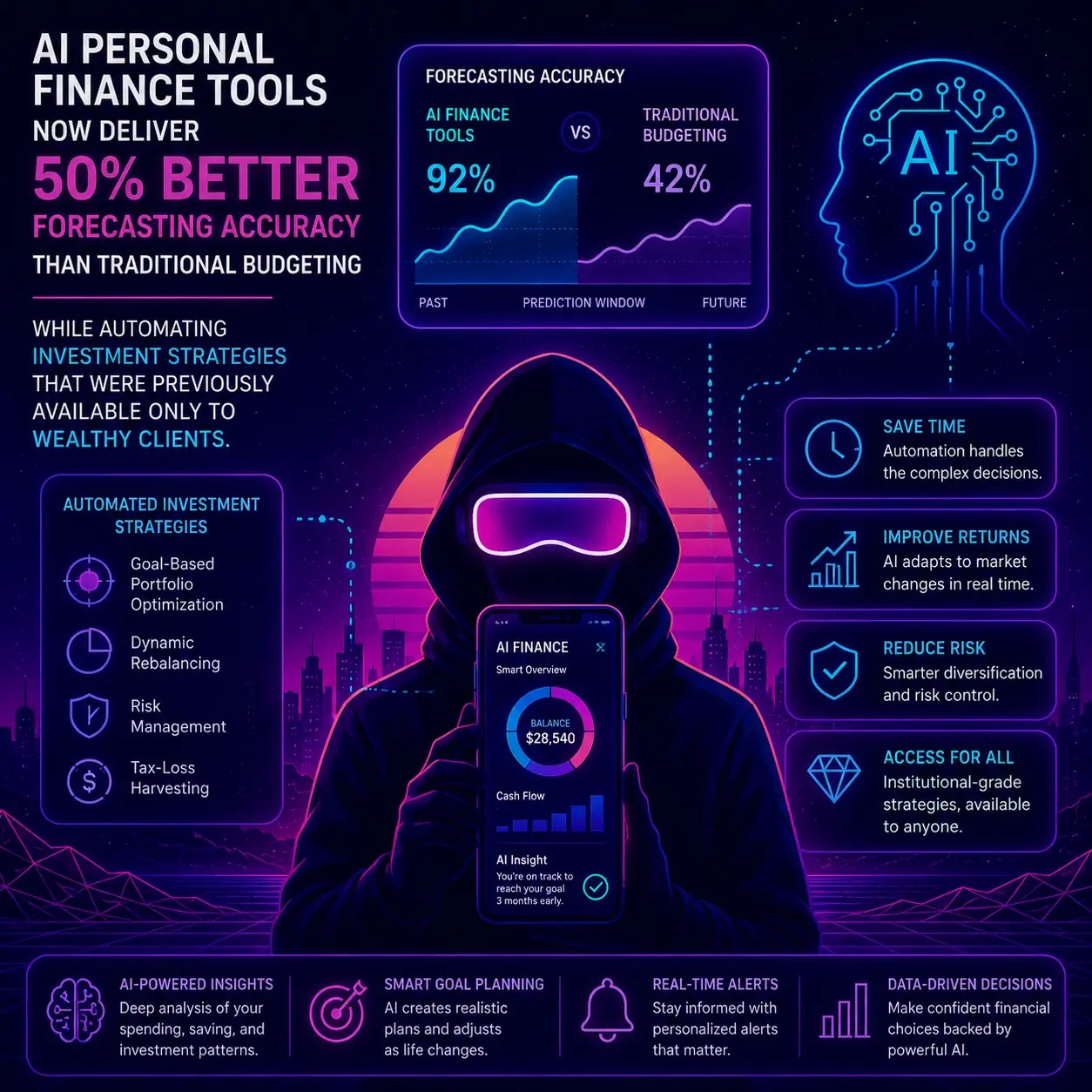
AI personal finance tools now deliver 50 percent better forecasting accuracy than traditional budgeting while automating investment strategies that were previously available only to wealthy clients.
By Stuart Kerr, Technology Correspondent, LiveAIWire
The Sophisticated Financial Tools That Were Once Reserved for the Wealthy Are Now in Everyone’s Pocket
For most of modern history, truly personalised financial advice has been a privilege of the wealthy. A qualified financial adviser who knows your circumstances, understands your goals, tracks your spending, optimises your investments, and alerts you to opportunities requires either significant fees or the kind of relationship that comes with having enough money to make the relationship worthwhile. The average person has had access to a bank account, a mortgage calculator, and a vague sense of anxiety about whether they are saving enough. Artificial intelligence is changing that equation faster and more fundamentally than any previous development in personal finance, and the tools doing it are already available, mostly free or inexpensive, and sitting in the app stores on your phone right now.
AI personal finance tools deliver 50 percent better forecasting accuracy than traditional budgeting methods while saving users more than five hours a month on financial management, according to independent analysis. They democratise investment strategies that were previously available only to institutional clients. They identify hidden costs in your financial life that you never knew existed. And they do all of this continuously, in the background, without requiring you to remember to check a spreadsheet. This is not a future promise. It is the current reality of personal finance in 2026.
What AI Does That Traditional Budgeting Cannot
Traditional personal finance tools answered one question: where did your money go? They categorised past transactions, produced charts of your spending, and left you to draw your own conclusions about what to do differently. The exercise required time, discipline, and a tolerance for confronting uncomfortable truths about your habits. Most people did it for a month, found it depressing, and stopped.
AI personal finance tools ask a fundamentally different question: where is your money going next, and how can we optimise it? Machine learning models analyse your transaction history, identify seasonal spending patterns, account for upcoming obligations, and project your financial position forward in real time. Instead of discovering at the end of the month that you overspent on dining, an AI system alerts you midway through the month that you are on track to exceed your dining budget by 40 percent, giving you the information while you can still act on it.
The practical applications are immediate and specific. Plum, the pan-European AI money app that achieved profitability in January 2026 following 55 percent year-on-year growth, automatically analyses your income and spending patterns to identify the maximum amount you can safely save each week without impacting your essential commitments, then moves that money into savings without requiring any action from you. Origin, named best budgeting app by Forbes, integrates budgeting, investment tracking, and financial planning in a single platform, allowing you to ask plain-English questions about your financial situation and receive answers grounded in your actual data. Cleo combines budgeting tools with conversational AI that can negotiate on your behalf with subscription services and flag spending patterns you may not have noticed.
The subscription audit is one of the most immediately valuable capabilities these tools deliver. The average person pays for between 12 and 20 subscriptions at any given time, and a meaningful proportion of those have not been used in months. AI tools identify these automatically, surface the cost, and in some cases initiate cancellation requests without requiring any manual effort. The savings from a single subscription audit frequently exceed the annual cost of the AI tool enabling it.
Robo-Advisors: Investment Management That Was Once Only for the Wealthy
Investment management at scale, with automatic rebalancing, tax-loss harvesting, dividend reinvestment, and portfolio optimisation against your risk tolerance and time horizon, has historically been available only to clients wealthy enough to justify a human adviser’s time. Robo-advisors powered by AI have been changing this for several years, but the 2026 generation of these tools is genuinely different from their predecessors.
Wealthfront, Betterment, and Schwab Intelligent Portfolios manage investment portfolios automatically for between zero and 0.25 percent annually, a fraction of the cost of human portfolio management. Wealthfront’s AI tax-loss harvesting, which systematically sells investments at a loss to offset taxable gains, claims to add one to two percent in annual after-tax returns for users in higher tax brackets. At scale, that represents thousands of pounds or dollars in additional wealth over a decade for a mid-sized portfolio.
The newest generation goes considerably further. Robinhood’s Strategies product, reported in Fortune’s April 2026 issue, counts 250,000 customers paying an average of $250 annually for AI-guided investment management that can account for far more complex personal circumstances than earlier tools. A user with significant wealth tied to employee stock options, or planning to buy a home within three years, can receive genuinely personalised guidance that accounts for those specific factors rather than a generic allocation to a basket of ETFs. Anthropic, the company behind Claude, announced a partnership with LPL Financial in February 2026, providing AI capabilities to tens of thousands of registered advisers serving approximately eight million clients, effectively embedding AI investment intelligence into existing human advisory relationships.
McKinsey analysis has identified a looming adviser shortage as fewer people enter the financial planning profession and those who remain focus increasingly on ultra-high-net-worth clients. The practical implication is that the gap between the quality of financial guidance available to wealthy and ordinary individuals is about to widen significantly on the human advice side, making AI tools the primary mechanism through which sophisticated financial management remains accessible to people without significant existing wealth.
Cash Flow Prediction and the End of Financial Surprises
One of the most practically valuable capabilities AI personal finance tools now deliver is cash flow prediction. Traditional bank statements show you what happened. AI systems show you what is about to happen. By analysing your income timing, your recurring obligations, your variable spending patterns, and your upcoming scheduled payments, AI tools can alert you weeks in advance that a particular month is likely to create a cash shortfall, giving you time to adjust spending, move funds, or arrange a short-term facility before the problem materialises.
This capability removes one of the most common sources of financial stress and cost: the unexpected shortfall that triggers an overdraft fee, a missed payment, or a decision to put something on a credit card at high interest because the timing of income and expenditure happened to misalign. For people managing irregular or freelance income, the ability to model multiple scenarios forward in real time represents a genuinely transformative improvement in financial visibility.
As explored in How AI Is Catching Financial Fraud Before the Bank Even Notices, the AI systems running inside financial institutions are already working on your behalf in the background. The personal finance tools described here extend that intelligence into your own hands, giving you the same kind of forward-looking, pattern-aware financial awareness that banks have always had about your account, but that they have rarely shared directly with you.
What You Should Do Right Now
The practical starting point is identifying your single biggest financial inefficiency and finding the AI tool that addresses it most directly. If subscriptions and discretionary overspending are the issue, Plum or Cleo offer immediate, measurable results. If investment management feels overwhelming or expensive, Wealthfront or Betterment deliver institutional-quality portfolio management at a fraction of traditional advisory costs. If your financial life spans multiple accounts and goals and you want a single integrated view, Origin provides the most comprehensive picture currently available.
The one caveat that deserves stating plainly is that AI personal finance tools are not regulated financial advisers, and this article does not constitute financial advice. For complex financial situations involving significant assets, tax planning, estate planning, or major life transitions, a qualified human adviser remains essential. AI tools augment and democratise access to financial intelligence. They do not yet replace the judgment and accountability of a qualified professional for high-stakes decisions.
What they do, for the vast majority of everyday financial management, is remove the friction, the forgetting, and the willpower requirement that has historically made good financial habits so difficult to maintain. Your money does not need you to be disciplined. It needs AI to automate the discipline on your behalf.
About the Author
Stuart Kerr is Technology Correspondent at LiveAIWire. He writes about artificial intelligence, ethics, and how technology is reshaping everyday life. Follow @LiveAIWire on X.