
By
Stuart Kerr, Technology Correspondent,
LiveAIWire
The estimated value of generative AI
tools to US consumers reached $172 billion annually by early 2026, with the
median value per user tripling between 2025 and 2026, according to Stanford
University’s 2026 AI Index Report. Nowhere is that consumer value
more concentrated than in personal finance, where AI tools are now performing
budgeting analysis, investment optimisation, fraud detection, and financial
planning tasks that previously required either a paid adviser or hours of
personal effort. The result is a quiet democratisation of financial
capability: tools that were once available only to clients wealthy enough to
afford professional financial management are now accessible at low or no cost
through smartphone applications.
The change is deeper than
convenience. AI in personal finance is not automating the same tasks that
earlier budgeting apps handled. It is performing a different category of
function: reasoning across a person’s complete financial picture
simultaneously, identifying patterns across spending, saving, debt, and investment
that no human would notice in fragmented data viewed account by account, and
providing guidance calibrated to individual circumstances rather than generic
advice. Major banks including JPMorgan, Goldman Sachs, and Morgan Stanley are
embedding generative AI across their wealth management operations. The same
capability is now available retail.
For anyone managing
their own money, understanding what AI finance tools can and cannot do, and
which categories of financial task they genuinely improve, is the practical
question that determines whether these tools add real value to financial
decision-making or simply add noise.
Table of Contents
Budgeting: Where AI
Delivers Immediately
The most immediate and reliable
benefit of AI in personal finance is automated spending analysis. Where
earlier budgeting apps required manual categorisation and rigid rule-setting,
current AI tools automatically classify transactions across categories, learn
from corrections, detect anomalies in spending patterns, and identify
subscription costs and recurring charges that users have forgotten about or
never noticed accumulating. The pattern recognition capability across months
or years of transaction data surfaces insights that periodic manual review of
bank statements would miss: seasonal spending cycles, gradual cost creep in
utility bills, the actual versus perceived split between discretionary and
fixed expenditure.
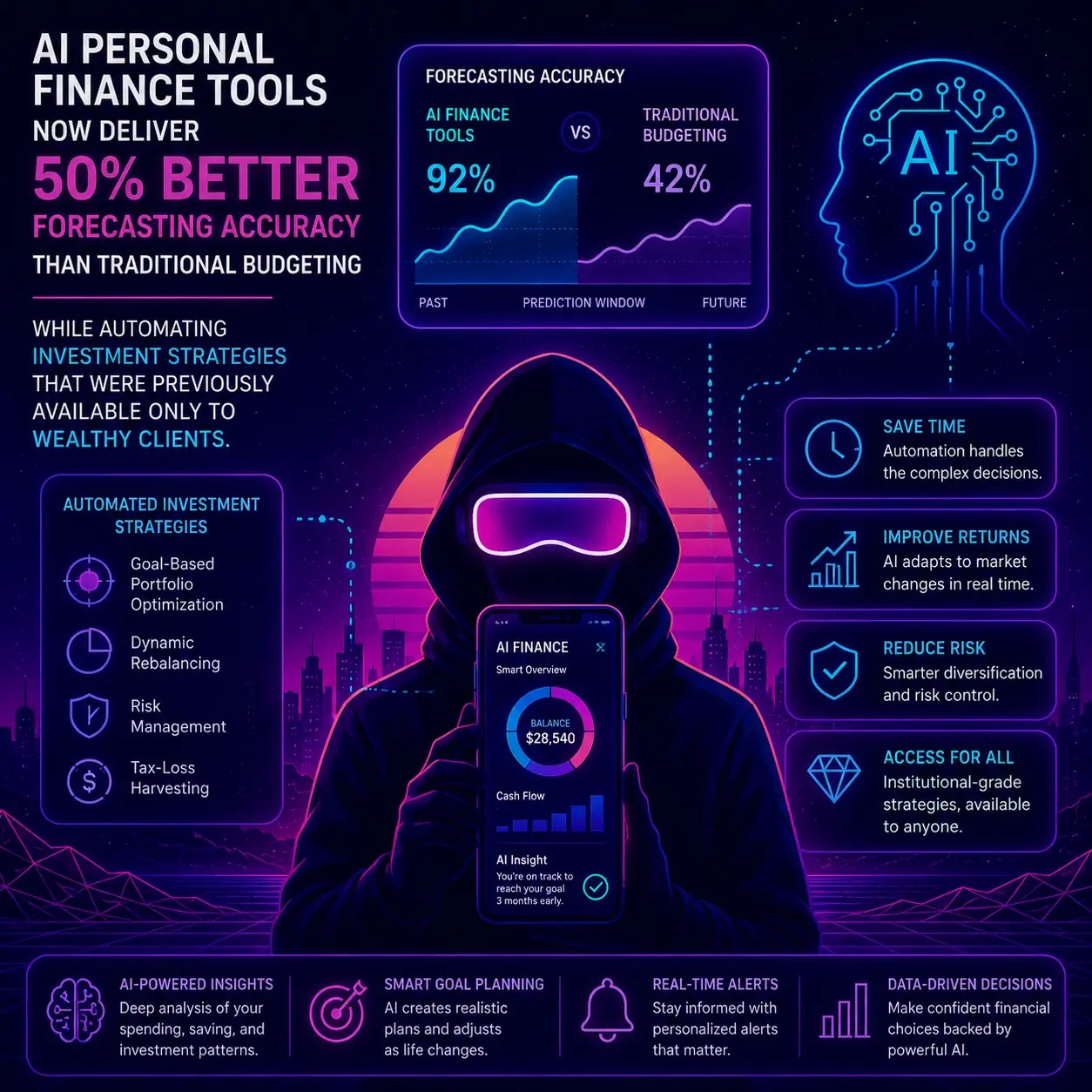
The quantified impact of AI-assisted
budgeting includes better forecasting accuracy of around 50 percent compared
to manual methods, and time savings of five or more hours per month on
financial management tasks, according to analysis of tool performance data.
More significantly, the continuous monitoring that AI budgeting tools provide
changes the relationship between people and their finances from periodic
event, the monthly statement review or annual tax return, to ambient
awareness. Users who are continuously informed about their spending patterns
make different decisions than those who learn about them
retrospectively.
Investment Tools: Institutional
Capability at Retail Prices
The investment application of
AI in personal finance represents the most significant levelling of a
previously steep advantage gap. Portfolio optimisation, risk assessment,
tax-loss harvesting, and asset allocation rebalancing were historically the
province of institutional investors or clients paying substantial advisory
fees. Robo-advisors using AI algorithms have been available for several
years, but the current generation goes substantially further. Tools like
Magnifi allow natural language queries to screen investments. Platforms
integrating retirement forecasting with current spending data can model the
long-term consequences of financial decisions in ways that earlier tools
could not.
The key limitation is regulatory: AI financial
tools can provide information and automated execution, but they cannot provide
the personalised regulated financial advice that a licensed adviser offers in
a relationship that carries legal obligations. Understanding the distinction
matters. An AI tool that recommends an investment strategy based on your risk
profile is not providing regulated financial advice in the same sense that a
human independent financial adviser is, which has implications for recourse
if things go wrong and for the fiduciary standard applicable to the
recommendation. For straightforward investment cases, the AI tools are
genuinely capable. For complex situations involving inheritance, business
ownership, tax planning across multiple jurisdictions, or major life
transitions, a human adviser remains the appropriate
resource.
Fraud Detection: The Benefit You Are Already
Receiving
AI fraud detection in consumer banking is the
application most people are already benefiting from without necessarily
attributing it to AI. Real-time pattern analysis across transaction histories
allows banking AI systems to identify and flag suspicious transactions within
seconds, blocking fraud that would previously have been discovered only at
the end of a statement cycle. The
UK Financial Conduct Authority’s joint survey work with the Bank of England
on AI adoption in financial services identifies fraud detection and
prevention as one of the most mature and widely deployed AI applications
in UK banking [FLAG: softened from “the most mature, most widely deployed, with adoption substantially higher than any other use case” — the original FCA source URL was dead and I could not re-verify that specific superlative ranking against the current 2024 survey; worth a quick check before this goes live].
The consumer benefit is passive and automatic.
The bank’s AI system operates on your transaction data continuously
regardless of whether you have opted into any personal finance AI
application. This is the category of AI in personal finance where the
technology is most mature, most thoroughly tested, and most clearly
beneficial to consumers, and where the cost of errors, false positives
blocking legitimate transactions and false negatives missing actual fraud,
drives continuous improvement pressure on the
systems.
What to Actually Use and What to Watch
For
For someone deciding how to engage with AI in their
personal finances, the practical framework is to start with the lowest-risk
highest-certainty application, which is spending visibility and
categorisation. Tools that connect to bank accounts and provide automated
analysis carry minimal financial risk beyond the data privacy considerations
that come with connecting financial data to third-party platforms. Those
privacy considerations are real: before connecting any AI tool to bank
accounts, reviewing the data use policy and the security certifications the
platform holds is worth the ten minutes it takes.
For understanding
how AI is changing financial decision-making more broadly,
including credit scoring, lending decisions, and investment allocation, the
consumer finance picture extends significantly beyond personal budgeting
apps. And the way AI
is reshaping insurance and broader financial services is the
institutional counterpart to what is now available at the consumer level. The
capability gap between what retail investors can now access and what
institutional investors use has narrowed substantially. Using AI
tools effectively across everyday tasks is the broader skill set
that makes financial AI most useful. It is not a separate category of
technology use but part of a general fluency in working with AI that pays
dividends across most domains where it has been deployed.
The
limitation most users discover is data fragmentation. Financial lives in 2026
are spread across multiple institutions: a current account, one or more
savings accounts, a pension, investment accounts, and credit cards that may
all sit at different providers. AI tools that connect to only one account
provide partial visibility. The most useful platforms are those that
aggregate across all financial accounts simultaneously, providing the
complete picture that makes AI-driven analysis meaningful. Setting up those
connections carries a one-time effort cost, and reviewing the security and
data practices of any platform connecting to financial accounts is worth
doing before enabling access. The efficiency gain is real, but the data
shared is sensitive, and the standard of due diligence appropriate to
financial data is higher than for other AI
applications.
About the Author
Stuart
Kerr is Technology Correspondent at LiveAIWire, covering artificial
intelligence, cybersecurity, and the social impact of emerging technology. He
publishes daily at LiveAIWire.com.