
AI job displacement is no longer a future scenario. One in four workers worldwide is now employed in an occupation where generative AI has measurable exposure to their daily tasks, according to a March 2026 working paper from the International Labour Organization. The ILO’s refined global index of occupational exposure found that 3.3 percent of global employment falls into the highest GenAI exposure category, with a striking gender asymmetry: women represent 4.7 percent of that high-exposure group against 2.4 percent for men. Clerical occupations carry the highest overall exposure across all categories, reflecting where large language models perform best: producing structured text outputs, handling data entry, drafting routine communications, and managing information retrieval.
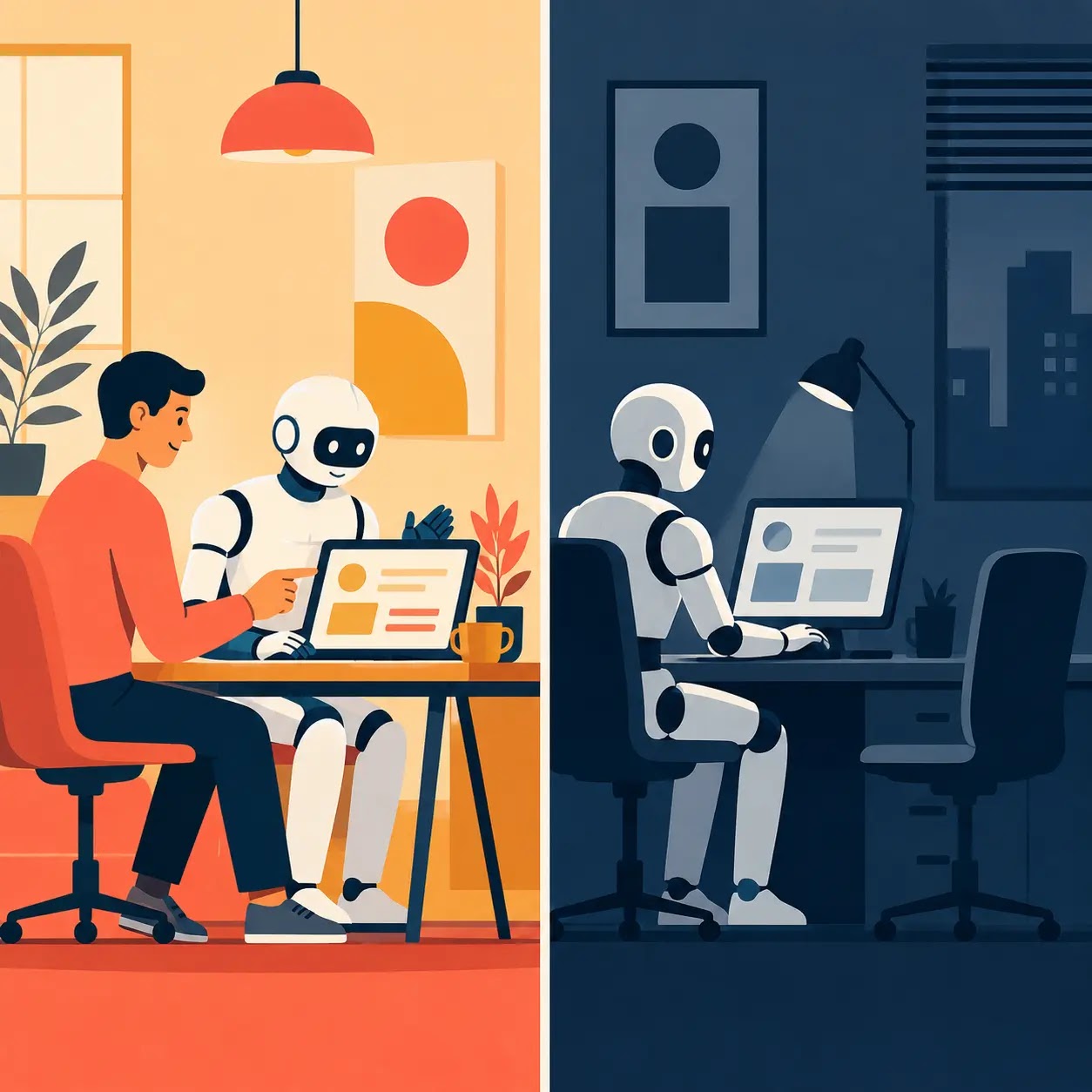
The distinction between automation and AI job displacement on one hand, and augmentation on the other, is the pivot point in any honest assessment of what AI is doing to the workforce. Automation removes the human from the task. Augmentation makes the human more productive at the task, potentially changing which tasks the human is paid to perform without eliminating their role entirely. Both are happening simultaneously, in different occupations, at different rates, with outcomes that depend heavily on which firm, which country, and which regulatory environment the worker is operating within.
For workers trying to assess their own exposure, understanding where their occupation sits on that spectrum, and whether that position is shifting, is more practically useful than any aggregate statistic about jobs at risk globally.
Where AI Job Displacement Is Actually Happening
The clearest evidence of AI job displacement comes not from mass redundancy announcements but from hiring data. Administrative roles, routine data processing, and certain categories of customer service are seeing real headcount reductions as AI tools handle workflows that previously required human operators. The mechanism is attrition rather than active layoffs: organisations are letting natural turnover reduce headcount in automatable roles and not backfilling positions. The effect shows up in job-posting data before it appears in unemployment statistics, which is why official figures have not yet captured the full scale of the transition underway.
The workers most affected are not the low-skill manual workers who bore the brunt of earlier automation waves. They are graduates entering professional environments where AI now handles the volume tasks that once provided entry-level experience. Legal drafting, basic financial analysis, early-stage software development, and first-pass research are all areas where AI has reduced the volume of work flowing to junior staff, compressing career pipelines that professional training has historically relied on to develop expertise.
The Augmentation Evidence the Headlines Miss
The case for augmentation is as well-evidenced as the case for AI job displacement but involves a different set of industries and occupations. The OECD Generative AI and Future of Work report, published in 2025, identified significant augmentation potential for knowledge workers who incorporate AI tools into their workflows, extending capacity to handle complex analysis, multilingual communication, and research tasks previously bounded by available time. The worker who learns to treat AI as a productivity multiplier rather than a competitor gains capabilities that took years to develop organically and translates them into higher individual output quality.
The OECD analysis explicitly identifies digital divides as barriers to realising this augmentation potential. Workers without access to quality AI tools, without the technical literacy to use them effectively, or in organisational environments that do not reward AI-enhanced output, face the exposure side of AI adoption without the benefit. This is most acute in lower-income countries and among workers in the informal economy, where the tools that would enable augmentation are least accessible. The global distribution of AI productivity gains is, by current trajectory, deeply uneven, which is a policy problem as much as an economic observation.
What AI Still Cannot Replace
The ILO exposure framework is as useful for what it excludes as for what it captures. Physical tasks requiring tactile precision, occupations involving sustained interpersonal care, roles demanding real-time judgment in genuinely unpredictable environments, and work requiring accountability and institutional trust that AI systems cannot provide are all in lower-exposure categories. The trades, healthcare delivery, emergency services, and certain categories of management remain substantially insulated from direct AI job displacement.
For those in high-exposure roles, the practical response involves identifying the tasks within their occupation that AI handles poorly and actively migrating toward those. An administrator whose correspondence drafting is now handled by AI creates value by shifting toward judgment-intensive work: managing exceptions, handling sensitive communications that require contextual understanding, building relationships, and interpreting ambiguous situations.
The Policy Gap and What It Costs
The ILO’s March 2026 publication arrives in a context where the policy infrastructure for managing this transition is still forming. Most jurisdictions lack clear obligations on employers to retrain displaced workers or adequate social insurance frameworks to support workers in occupational transitions. The research on AI job displacement is moving significantly faster than regulatory responses to it, and that gap is itself a labour market risk for the workers least able to self-fund a career transition.
The way AI is creating winners and losers across whole industries reflects the same mechanism operating at sector level, a pattern LiveAIWire has examined in how AI is reshaping insurance. Incumbents with data, capital, and technical capacity accelerate. Those without face disruption on a timeline they did not set. The ILO conclusion is measured: AI’s effect on overall employment levels remains limited so far, but the distributional impact is already substantial.
For workers assessing personal exposure, understanding the specific, predictable patterns in how AI systems fail matters just as much as understanding where they succeed, a discipline LiveAIWire covered in how to know when you can actually trust an AI system. Understanding where you sit on the exposure spectrum is the actionable starting point, and the ILO framework gives workers the tools to do that assessment clearly.
The evidence from sectors that moved earliest into AI-assisted workflows, including financial services, legal practice, and software development, suggests that augmentation and AI job displacement effects play out over a longer timeline than initial adoption rates imply. Productivity gains from AI tools take time to translate into firm-level hiring decisions, and the full labour market impact of those decisions takes additional time to appear in aggregate employment statistics.
Workers experiencing displacement today are often the advance signal of a process that will register in official data one to two years later. That lag is consequential for policy: by the time data confirms the disruption, the workers who needed support have already navigated the transition without it, or failed to. Closing that gap between the speed of AI adoption and the speed of policy response is the most consequential labour market challenge of the current decade. As LiveAIWire’s coverage of the AI cheating crisis in schools found, the same institutional lag between technology arriving and frameworks catching up shapes how education, not just employment, is adapting to AI in real time.
About the Author
Stuart Kerr is Technology Correspondent at LiveAIWire, covering artificial intelligence, cybersecurity, and the social impact of emerging technology. He publishes daily at LiveAIWire.com.