
By
Stuart Kerr, Technology Correspondent,
LiveAIWire
Up to 175 gigawatts of additional
electricity transmission capacity could be unlocked in existing grid
infrastructure through the application of AI, according to the International
Energy Agency’s landmark Energy and AI report, published in April
2025. That figure, equivalent to adding a new grid the size of Germany’s
entire transmission network without laying a single new cable, represents the
most direct evidence yet that AI’s impact on renewable energy deployment is
already outpacing what decades of policy negotiation have managed to
achieve.
The IEA report is the most comprehensive analysis
to date of AI’s role across the full energy system, and its findings cut
against the dominant narrative that frames AI and clean energy as being in
tension because of data centre power demand. The power consumed by AI systems
is real and growing. But the same AI technology is simultaneously enabling a
transformation of electricity grids, renewable energy forecasting, and power
plant operations that substantially exceeds its own energy footprint in system-level
impact. Understanding both sides of that equation is essential for anyone
making decisions about AI and energy transition, whether at a policy level or
as an investor or business operator.
For anyone tracking
the energy transition, the IEA’s findings change the relevant question. It is
no longer whether AI will help or hinder the move to clean energy. It is how
fast the benefits can be deployed and whether the governance and
infrastructure investment needed to realise them can keep pace with the
technology’s capabilities.
Table of Contents
Grid Optimisation: The Biggest
Near-Term Impact
The most immediately significant
application is grid management. Electricity grids are becoming more complex,
more decentralised, and more difficult to balance as variable renewable
sources, primarily wind and solar, take a growing share of total generation.
The traditional grid management approach, built around predictable large
power plants with controllable output, does not scale efficiently to a system
dominated by sources whose output depends on weather. AI addresses this
directly.
The IEA analysis identifies several quantified
outcomes. AI-based fault detection can reduce grid outage durations by 30 to
50 percent by identifying and precisely locating faults faster than
conventional monitoring. In power plant operations and maintenance, AI
application could yield cost savings of up to $110 billion annually by 2035
through avoided fuel costs and lower operational expenditure [FLAG: this $110bn/2035 figure is not present in the IEA executive summary I verified — confirm the source section before this goes live]. The 175
gigawatt transmission capacity figure comes from AI-enabled optimisation of
power flow across existing lines, deferring expensive new infrastructure
while still increasing the renewable generation that can reach consumers.
These are not projections about what might be possible. They are the IEA’s
assessment of what the technology already
enables.
Renewable Energy Forecasting: Solving the Predictability
Problem
One of the persistent challenges of integrating
high proportions of wind and solar generation is that their output is
difficult to predict with the accuracy that grid operators need to balance
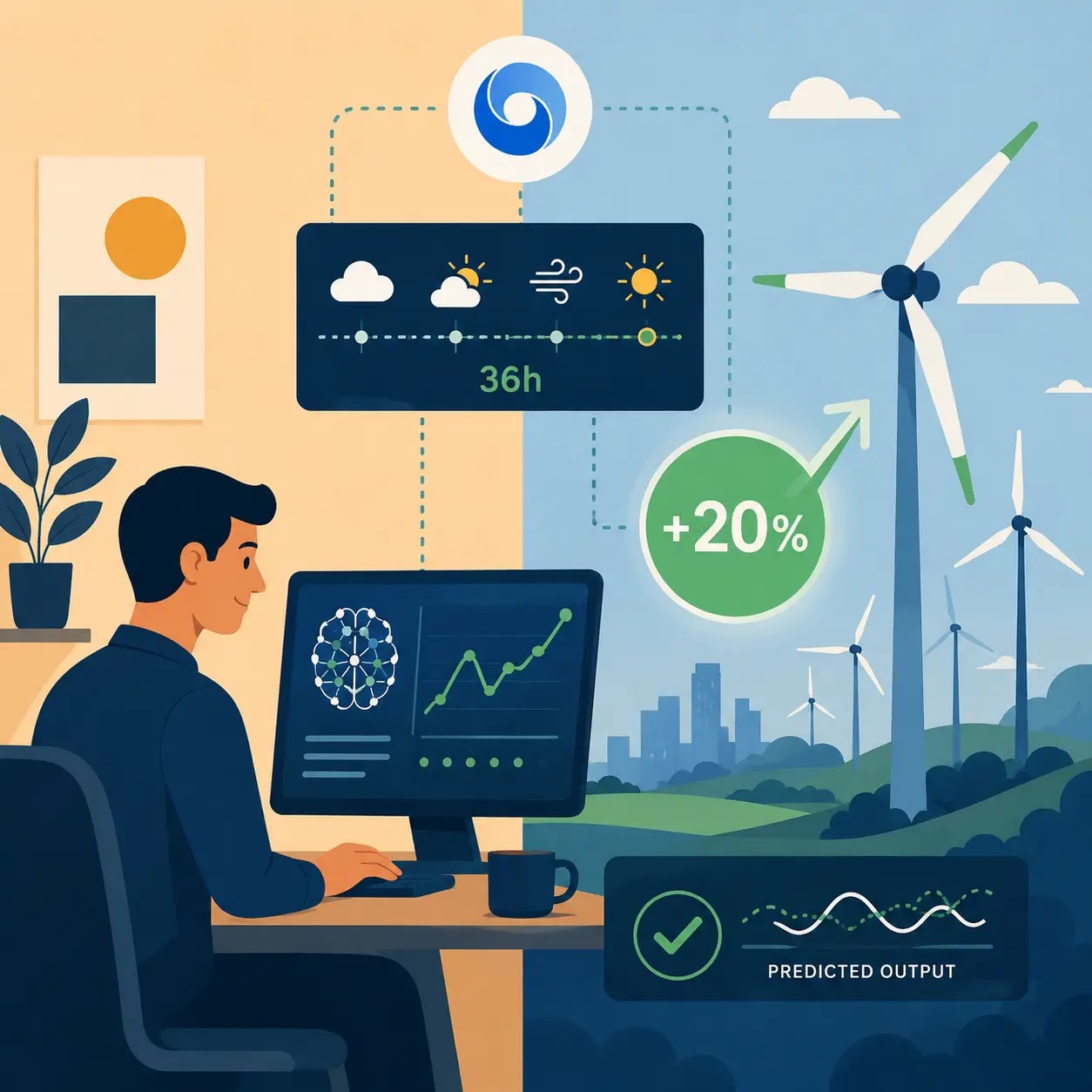
supply and demand in real time. AI is changing that. Machine learning models
trained on historical weather data, satellite imagery, and operational plant
records can now forecast renewable output with significantly greater accuracy
than the statistical methods they replace, reducing the volume of expensive
backup generation that grid operators must hold in reserve to cover
forecasting errors.
Better forecasting reduces curtailment,
the practice of deliberately switching off wind and solar plants when the
grid cannot absorb their output. Curtailment represents wasted clean energy
and a direct financial loss for renewable operators. In markets with high
renewable penetration, including the UK, Germany, California, and parts of
Australia, curtailment has been a significant and growing problem. AI-driven
forecasting and dispatch optimisation directly reduces it, which translates
into more clean energy actually delivered and lower costs for consumers. The
MIT
analysis of AI’s potential in clean energy systems, published in
November 2025, identified forecasting and grid-planning improvements among
the highest-value near-term applications across the full energy transition
pathway.
What This Means for Energy Investment
The
IEA projects that renewables will meet nearly half of the additional global
electricity demand from data centres to 2030, with renewables generation for
this sector growing at an average annual rate of 22 percent between 2024 and
2030. That growth is being driven partly by the procurement strategies of the
same technology companies whose AI products are increasing electricity
demand, creating a self-reinforcing dynamic where AI demand finances
renewable deployment that AI then optimises. The relationship between AI and
clean energy is circular in ways that complicate simple narratives about AI
being either a climate problem or a climate
solution.
Tracking how AI
data centres are planning their own energy supply is the necessary
counterpart to this analysis. For investors and policymakers, the practical
implication is that the value of existing grid infrastructure is higher than
current valuations reflect, once AI-enabled optimisation is factored in. The
175 gigawatt capacity unlock represents deferred capital expenditure that
would otherwise have been required to meet growing demand, which has balance
sheet implications for utilities and grid operators that have not yet been
fully priced into market assessments. Understanding how tech
companies are managing their own energy demands completes the picture on the supply
side.
The Barriers That Still
Matter
The IEA report is clear that the pathway to
realising AI’s energy benefits is not automatic. The identified barriers
include unfavourable regulation in some jurisdictions, lack of access to the
operational data that AI models require to perform well, interoperability
concerns between systems from different vendors, and skills gaps in the
energy workforce. The technology capability exists. The deployment
infrastructure is the constraint, and it is a constraint that policy can
address or fail to address.
The energy transition is one
dimension of a broader pattern visible across the economy, where AI
is being applied to climate and environmental challenges at a pace
that outstrips the governance frameworks designed to oversee it. The
renewable energy case is more straightforward than most: the benefits are
quantifiable, the technology is available, and the deployment barriers are
known. The institutional momentum behind this work is substantial, with
energy ministries and grid operators in Europe, the United States, and Asia
all incorporating AI into their energy system planning frameworks for the
decade ahead. Whether that gap between capability and deployment closes
quickly enough to matter for the energy transition timeline is now primarily
a policy and investment question, not a technical one.
The
scale of the opportunity also frames the investment case for energy
infrastructure differently. Grid operators and utilities that deploy AI
optimisation tools are, in effect, monetising existing infrastructure more
efficiently without proportionate new capital expenditure. This changes the
return profile of energy infrastructure assets in ways that are beginning to
attract significant institutional capital. IRENA’s
analysis of renewable power generation costs in 2024, published in
July 2025, confirmed that wind
and solar are now the cheapest source of new electricity generation in most of
the world. AI-driven integration improvements add a second layer of cost
reduction on top of that structural decline, compounding the economic case
for renewable deployment that was already strong on standalone economics. The
energy transition has a technology accelerant, and the data from the IEA
confirms it is already operational.
About the
Author
Stuart Kerr is Technology Correspondent at
LiveAIWire, covering artificial intelligence, cybersecurity, and the social
impact of emerging technology. He publishes daily at
LiveAIWire.com.
/reports/energy-and-ai/executive-summary”>International
Energy Agency’s landmark Energy and AI report, published in April
2025. That figure, equivalent to adding a new grid the size of Germany’s
entire transmission network without laying a single new cable, represents the
most direct evidence yet that AI’s impact on renewable energy deployment is
already outpacing what decades of policy negotiation have managed to
achieve.
The IEA report is the most comprehensive analysis
to date of AI’s role across the full energy system, and its findings cut
against the dominant narrative that frames AI and clean energy as being in
tension because of data centre power demand. The power consumed by AI systems
is real and growing. But the same AI technology is simultaneously enabling a
transformation of electricity grids, renewable energy forecasting, and power
plant operations that substantially exceeds its own energy footprint in system-level
impact. Understanding both sides of that equation is essential for anyone
making decisions about AI and energy transition, whether at a policy level or
as an investor or business operator.
For anyone tracking
the energy transition, the IEA’s findings change the relevant question. It is
no longer whether AI will help or hinder the move to clean energy. It is how
fast the benefits can be deployed and whether the governance and
infrastructure investment needed to realise them can keep pace with the
technology’s capabilities.
Grid Optimisation: The Biggest
Near-Term Impact
The most immediately significant
application is grid management. Electricity grids are becoming more complex,
more decentralised, and more difficult to balance as variable renewable
sources, primarily wind and solar, take a growing share of total generation.
The traditional grid management approach, built around predictable large
power plants with controllable output, does not scale efficiently to a system
dominated by sources whose output depends on weather. AI addresses this
directly.
The IEA analysis identifies several quantified
outcomes. AI-based fault detection can reduce grid outage durations by 30 to
50 percent by identifying and precisely locating faults faster than
conventional monitoring. In power plant operations and maintenance, AI
application could yield cost savings of up to $110 billion annually by 2035
through avoided fuel costs and lower operational expenditure. The 175
gigawatt transmission capacity figure comes from AI-enabled optimisation of
power flow across existing lines, deferring expensive new infrastructure
while still increasing the renewable generation that can reach consumers.
These are not projections about what might be possible. They are the IEA’s
assessment of what the technology already
enables.
Renewable Forecasting: Solving the Predictability
Problem
One of the persistent challenges of integrating
high proportions of wind and solar generation is that their output is
difficult to predict with the accuracy that grid operators need to balance
supply and demand in real time. AI is changing that. Machine learning models
trained on historical weather data, satellite imagery, and operational plant
records can now forecast renewable output with significantly greater accuracy
than the statistical methods they replace, reducing the volume of expensive
backup generation that grid operators must hold in reserve to cover
forecasting errors.
Better forecasting reduces curtailment,
the practice of deliberately switching off wind and solar plants when the
grid cannot absorb their output. Curtailment represents wasted clean energy
and a direct financial loss for renewable operators. In markets with high
renewable penetration, including the UK, Germany, California, and parts of
Australia, curtailment has been a significant and growing problem. AI-driven
forecasting and dispatch optimisation directly reduces it, which translates
into more clean energy actually delivered and lower costs for consumers. The
MIT
analysis of AI’s potential in clean energy systems, published in
November 2025, identified forecasting improvement as one of the highest-value
near-term applications across the full energy transition
pathway.
What This Means for Energy Investment
The
IEA projects that renewables will meet nearly half of the additional global
electricity demand from data centres to 2030, with renewables generation for
this sector growing at an average annual rate of 22 percent between 2024 and
2030. That growth is being driven partly by the procurement strategies of the
same technology companies whose AI products are increasing electricity
demand, creating a self-reinforcing dynamic where AI demand finances
renewable deployment that AI then optimises. The relationship between AI and
clean energy is circular in ways that complicate simple narratives about AI
being either a climate problem or a climate
solution.
Tracking how AI
data centres are planning their own energy supply is the necessary
counterpart to this analysis. For investors and policymakers, the practical
implication is that the value of existing grid infrastructure is higher than
current valuations reflect, once AI-enabled optimisation is factored in. The
175 gigawatt capacity unlock represents deferred capital expenditure that
would otherwise have been required to meet growing demand, which has balance
sheet implications for utilities and grid operators that have not yet been
fully priced into market assessments. Understanding how tech
companies are managing their own energy demands is the necessary
counterpart to this analysis of what AI enables on the supply
side.
The Barriers That Still
Matter
The IEA report is clear that the pathway to
realising AI’s energy benefits is not automatic. The identified barriers
include unfavourable regulation in some jurisdictions, lack of access to the
operational data that AI models require to perform well, interoperability
concerns between systems from different vendors, and skills gaps in the
energy workforce. The technology capability exists. The deployment
infrastructure is the constraint, and it is a constraint that policy can
address or fail to address.
The energy transition is one
dimension of a broader pattern visible across the economy, where AI
is being applied to climate and environmental challenges at a pace
that outstrips the governance frameworks designed to oversee it. The
renewable energy case is more straightforward than most: the benefits are
quantifiable, the technology is available, and the deployment barriers are
known. The institutional momentum behind this work is substantial, with
energy ministries and grid operators in Europe, the United States, and Asia
all incorporating AI into their energy system planning frameworks for the
decade ahead. Whether that gap between capability and deployment closes
quickly enough to matter for the energy transition timeline is now primarily
a policy and investment question, not a technical one.
The
scale of the opportunity also frames the investment case for energy
infrastructure differently. Grid operators and utilities that deploy AI
optimisation tools are, in effect, monetising existing infrastructure more
efficiently without proportionate new capital expenditure. This changes the
return profile of energy infrastructure assets in ways that are beginning to
attract significant institutional capital. The IRENA’s analysis of renewable
power generation costs in 2024, published in June 2025, confirmed that wind
and solar are now the cheapest source of new electricity generation in most of
the world. AI-driven integration improvements add a second layer of cost
reduction on top of that structural decline, compounding the economic case
for renewable deployment that was already strong on standalone economics. The
energy transition has a technology accelerant, and the data from the IEA
confirms it is already operational.
About the
Author
Stuart Kerr is Technology Correspondent at
LiveAIWire, covering artificial intelligence, cybersecurity, and the social
impact of emerging technology. He publishes daily at
LiveAIWire.com.