
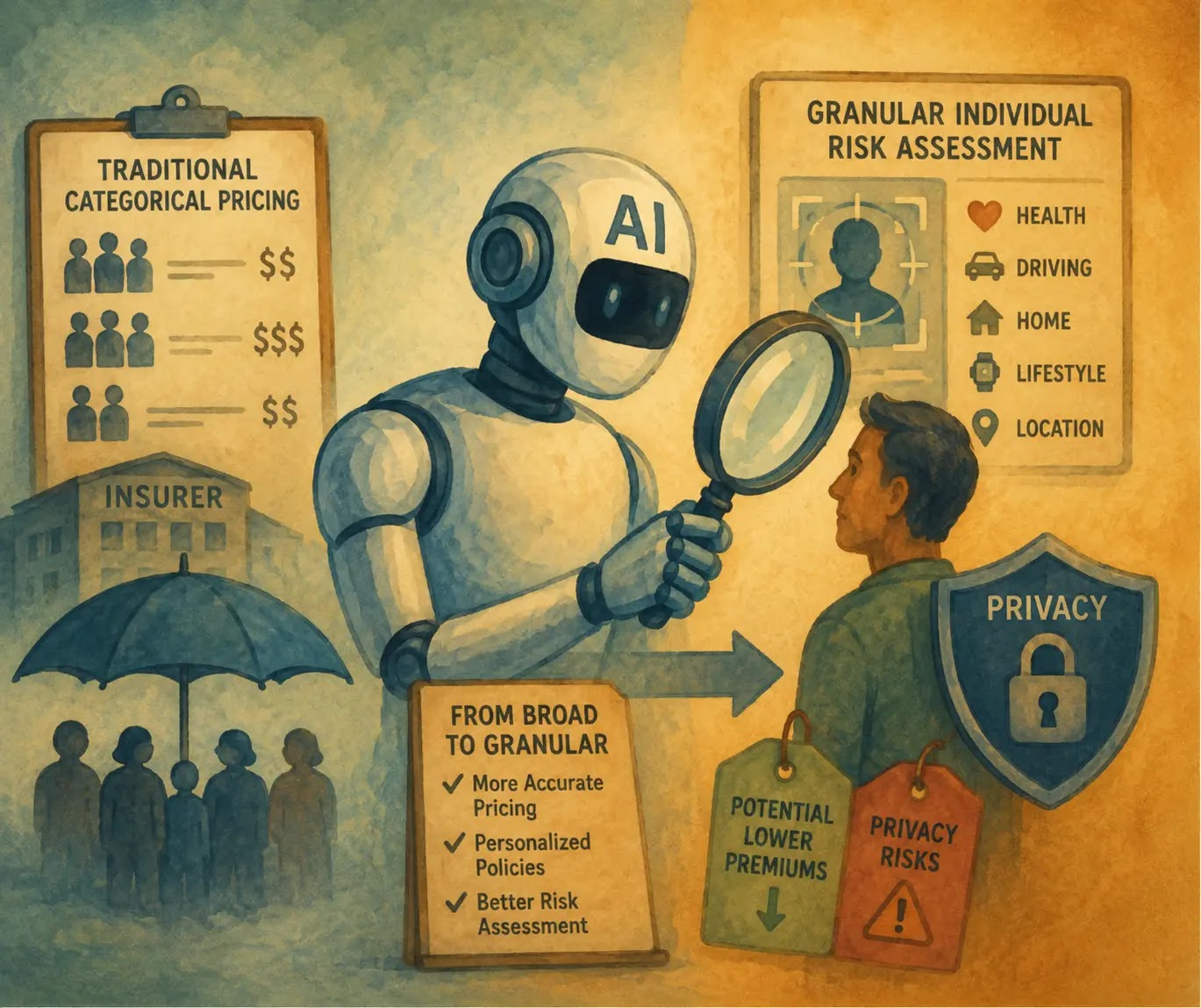
AI insurance pricing has reached ninety-five percent adoption among UK insurance firms, the highest rate of any financial sector, according to the Bank of England and Financial Conduct Authority’s 2024 survey of AI in UK financial services. That places insurers ahead of banks and investment managers. It matters now because the same technology deciding how fast your claim is paid is also deciding what you are charged, and increasingly whether you can get cover at all.
The Premium You Pay Is Now Set by a Machine
Pricing and underwriting, once the work of human actuaries poring over tables, are now largely machine tasks. The European insurance regulator EIOPA found that 50 percent of non-life insurers and 24 percent of life insurers across Europe were already using AI across the value chain, including pricing and underwriting, in its 2024 digitalisation review. The appeal for insurers is obvious. Models trained on thousands of data points can price an AI insurance pricing decision in seconds and spot patterns a person would never see.
For many customers that means faster quotes and, in low-risk cases, lower premiums under AI insurance pricing. A careful driver with a clean record and a telematics box may pay less than they would have under a blunt human estimate. The granularity cuts both ways, though, and the closer a model looks, the more it can separate one customer from another.
Faster Claims Are AI Insurance Pricing’s Easiest Win
The clearest benefit shows up after something goes wrong. AI systems now triage claims, read damage photographs, flag likely fraud and settle simple cases without a human ever opening the file. EIOPA’s review identified claims management and fraud detection as two of the most common uses across European insurers, alongside pricing.
That speed is real and it favours the customer. A motor claim that once took weeks can clear in days when software handles the routine paperwork and routes only the awkward cases to a person. Fraud detection, meanwhile, protects the honest majority, because every fraudulent payout is eventually recovered through everyone else’s premiums. This is the part of the story insurers are happy to tell, and on the evidence they are right to.
The gains are easiest to see in motor and home cover. An insurer using image recognition to assess a dented bumper from a few phone photographs can issue a settlement before a human assessor would have booked a visit, and that convenience is genuine. The same models that read those photographs also scan for the tell-tale inconsistencies of a staged claim, quietly screening out fraud that would otherwise be absorbed by every honest customer through higher renewal prices. Where AI sticks to this work, sorting the routine from the suspect, the case for it is strong and the customer mostly benefits.
The People AI Insurance Pricing Quietly Prices Out
The harder story sits in who gets left behind. EIOPA warned in its 2024 review that AI driven pricing can lead to excessive standardisation and a limited consideration of a customer’s specific circumstances. In plain terms, a model optimised for the average can misread anyone who is not average, and the people most often misread are those already on the margins.
When a system prices on hundreds of correlated signals, it can rebuild a picture of someone’s health, income or neighbourhood without ever being told those things directly. The result can be higher premiums or quiet exclusion for higher-risk and vulnerable customers, a concern EIOPA has raised repeatedly as it presses supervisors to watch for unfair outcomes.
None of this requires malice. It is simply what happens when accuracy becomes the only goal and fairness is left to look after itself. As LiveAIWire’s coverage of how AI already manages more of your money than you might think found, this same tension between finer prediction and fairer treatment surfaces across credit scoring and AI insurance pricing alike.
The Black Box Problem Insurers Cannot Yet Explain
Speed and accuracy come with a cost the industry is still wrestling with: many insurers cannot fully explain how their own systems reach a decision. The Bank of England and FCA survey found that a large share of firms hold only a partial understanding of the AI they deploy, and that foundation models, the complex systems behind generative AI, already account for around 17 percent of all AI use cases in UK financial services. When a model is opaque even to the company running it, a customer trying to contest a price or a refusal faces a steeper climb still.
This is why supervisors keep returning to transparency. A premium you cannot interrogate is a premium you cannot challenge, and an insurer that cannot show its working cannot easily prove it treated you fairly. The same survey recorded that firms themselves see cybersecurity as the single greatest risk attached to their AI, a reminder that the systems now holding your most sensitive financial and medical data are also a target for the people who would steal it.
As LiveAIWire’s analysis of how AI is rewiring global finance found, this accountability gap is not unique to insurance; it is a pattern across every corner of financial services where AI now makes consequential decisions faster than regulators can audit them.
What This Means for You
For an ordinary policyholder navigating AI insurance pricing, three practical habits now matter more than they used to. Shop around harder, because two insurers running different AI insurance pricing models can return startlingly different prices for the identical risk, and loyalty is rarely rewarded. Ask what data a quote is based on, since under UK data protection law you are entitled to know, and you can challenge a decision made solely by automated means. And read the detail on telematics or app-based policies before signing, because the discount on offer is paid for with a continuous stream of data about how you drive, live and move.
Consider a self-employed courier refused affordable motor cover because a model reads gig-economy mileage as elevated risk. The fix is rarely to argue with the algorithm. It is to find an insurer whose model weighs that profile differently, which is why comparison and a willingness to switch are now a consumer’s strongest tools. As LiveAIWire’s coverage of how to know when you can actually trust an AI system found, the same calibration principle applies here: understand the specific, predictable ways a model can fail before you rely on its output.
The Next Five Years Will Decide Who AI Insurance Pricing Serves
Regulators overseeing AI insurance pricing are no longer watching from the sidelines. Under the EU AI Act, AI systems used for risk assessment and pricing in life and health insurance are now classed as high-risk and face stricter requirements, and EIOPA has issued guidance pushing insurers toward transparency and accountability. Britain’s Bank of England and FCA are running their own monitoring through repeated surveys and a dedicated AI consortium.
The question for the rest of this decade is whether that oversight keeps pace with the models, or trails a step behind them. The technology that makes AI insurance pricing faster and cheaper for most people is the same technology that can shut the door on a minority, and which of those outcomes wins will be settled less by code than by the rules we choose to write around it.
Britain has so far favoured monitoring over hard legislation, leaving its regulators to lean on surveys and supervisory pressure rather than statute, while Europe has reached for binding law. Which approach better protects the customer who finds themselves on the wrong side of a model is a question the next few years will answer in public.
About the Author
Stuart Kerr is Technology Correspondent at LiveAIWire, covering artificial intelligence, cybersecurity, and the social impact of emerging technology. He publishes daily at LiveAIWire.com.