AI at Work The Technology That Is Helping and Hurting Workers at the Same Time
By Stuart Kerr, Technology Correspondent
Published: 9 May 2026
Author Bio: https://liveaiwire.com/p/to-liveaiwire-where-artificial.html
The Most Honest Conversation About AI and Jobs That Nobody Is Having
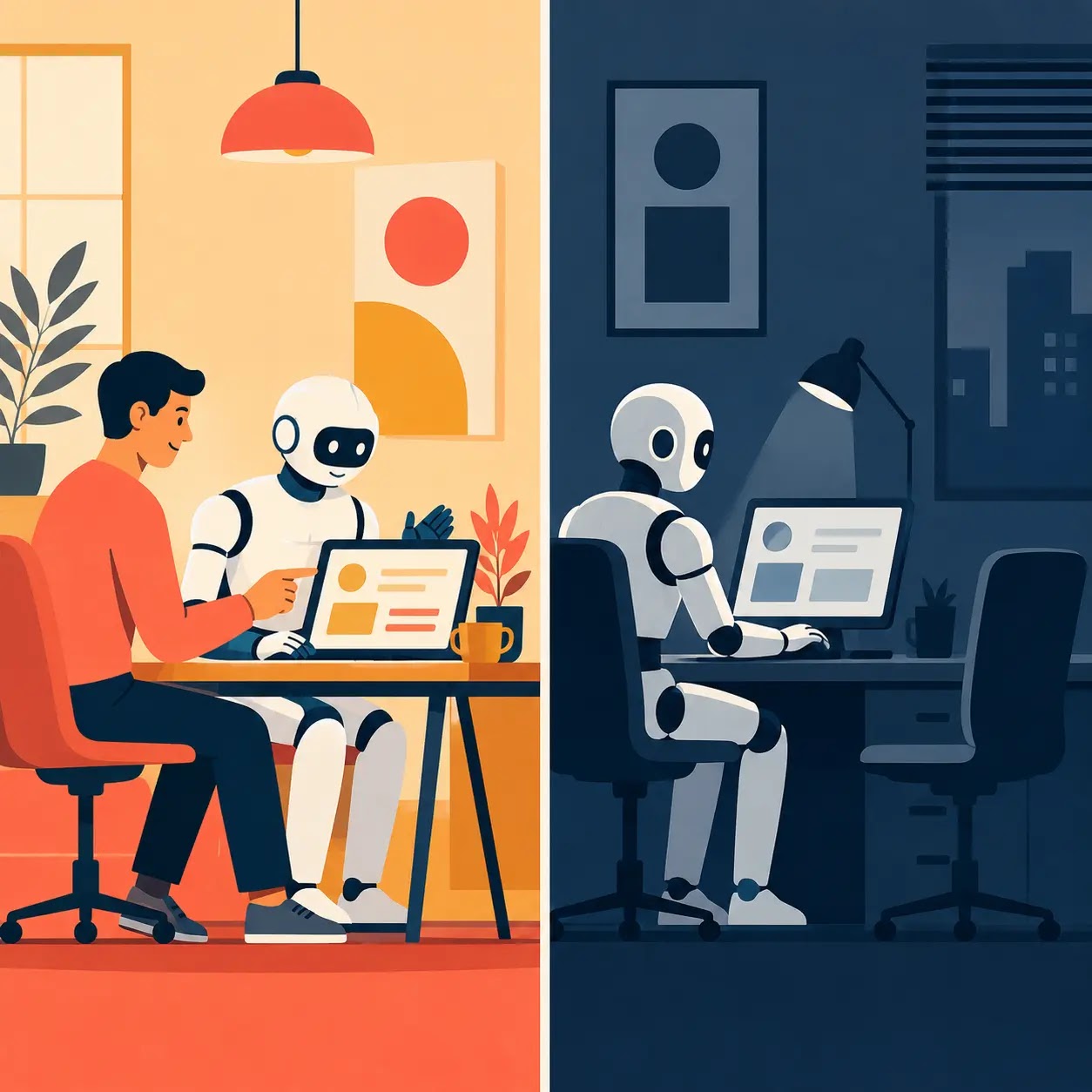
The debate about AI and work has been dominated by two opposing camps for the past three years. One side insists AI is going to eliminate most jobs within a decade and the economic disruption will be catastrophic. The other insists AI will create more jobs than it destroys, as every previous wave of automation has done, and that the panic is overblown. Both sides are telling a version of the truth. The more uncomfortable reality, confirmed by a landmark Harvard Business School study published in March 2026, is that AI is doing both things simultaneously, right now, in the same economy, often in the same industry, and sometimes in the same company.
Understanding which side of that equation you are on, and what determines it, is one of the most practically important things any worker can do in 2026. This is not an abstract question about the distant future. It is happening in offices, factories, studios, and server rooms today.
The Programmer Problem: A Case Study in Both Sides
Software development is the clearest and most striking example of AI’s dual nature at work because it is the field where AI’s capabilities are most advanced and where the tension between augmentation and replacement is most visible in real time.
The numbers are remarkable. Approximately 41 percent of all code written in 2025 was AI-generated according to analysis of developer workflows, with current trajectories suggesting that figure will cross 50 percent in organisations with high AI adoption by late 2026. Tools like GitHub Copilot, Claude Code, Cursor, and ChatGPT can generate functioning code in seconds that would have taken a junior developer hours to write. Developers using AI tools consistently report saving 30 to 60 percent of their time on coding, testing, and documentation.
For experienced developers, this is largely positive. They are using AI to generate the routine code that used to consume the majority of their working day, freeing them to focus on architecture, system design, debugging complex problems, and the kind of strategic technical judgment that AI cannot replicate. AI-savvy developers are commanding salaries of $90,000 to $130,000 at entry level, compared with $65,000 to $85,000 in traditional development roles. The World Economic Forum reports that four in ten developers said AI had already expanded their career opportunities in 2025, and close to seven in ten expect their role to change further in 2026, with most seeing that change as an evolution rather than an ending.
For junior and entry-level developers, the picture is considerably harder. Junior developer hiring is down. The traditional apprenticeship model, where new developers learned their craft by writing routine code under senior supervision, is breaking down because AI now writes much of that routine code instead. The shortcuts that allowed someone to be a competent developer without deep system design knowledge have disappeared. As one industry analyst put it bluntly: skills that were optional five years ago are now mandatory. The developers who understood why systems work the way they do are thriving. Those who knew the frameworks without understanding the underlying principles are struggling.
Boris Cherny, creator of Claude Code, said in February 2026 that coding is practically solved and predicted that the title of software engineer would eventually give way to titles like builder or product manager. He is right about the shift, though the builder still needs deep engineering judgment. The tools have changed. The need for human expertise in knowing what to build and why has not.
The Broader Pattern: Augmentation or Replacement?
The programmer story is not unique. The Harvard Business School study found that AI had reduced job postings by 17 percent in roles most exposed to automation while augmentation-friendly roles saw a 22 percent increase in demand. The Federal Reserve Bank of Dallas found that wages are rising in AI-exposed occupations that place high value on tacit knowledge and experience, while declining in those where the knowledge can be codified and replicated by a machine.
The distinction the Dallas Fed draws is the most useful framework for any worker trying to understand their own position. Codified knowledge is information that can be written down, learned from a textbook, or extracted from a dataset. AI can replicate codified knowledge effectively. Tacit knowledge is understanding gained through experience, judgment developed over years, the ability to read a room, to sense when a client relationship is fragile, to know instinctively when an architectural decision will cause problems three years down the line. AI cannot replicate tacit knowledge. This is why the same technology can simultaneously automate entry-level work while increasing the value of experienced workers in the same field.
MIT Sloan’s research reinforces this. Their EPOCH framework found that human-intensive tasks are less susceptible to automation but strong candidates for augmentation. The roles growing fastest in 2026 are those where human judgment, social intelligence, ethical reasoning, and complex communication are combined with AI tools rather than replaced by them. Healthcare, strategic consulting, complex project management, and roles requiring significant human judgment in high-stakes situations are all seeing AI-driven growth rather than AI-driven contraction.
The Industries Feeling It Most
Customer service has been hit hard. Eighty percent of customer service roles are projected to face significant automation, with AI chatbots now capable of handling the majority of routine enquiries without human involvement. The roles surviving are those handling complex, emotionally sensitive, or high-stakes interactions where human empathy and judgment are essential.
Finance and professional services have seen the largest declines in routine analytical job postings as AI handles the data processing, report generation, and pattern recognition that once required teams of analysts. Senior roles requiring strategic interpretation and client relationship management are if anything more valuable than before.
Manufacturing continues its long automation journey, with AI-driven robotics expanding from production lines into quality control, logistics optimisation, and predictive maintenance. The human roles remaining are increasingly those involving oversight, troubleshooting, and the kind of adaptive physical judgment that robots still handle poorly in unstructured environments.
Creative industries face a genuinely complicated picture. AI image generation, music composition tools, and writing assistants are competing directly with human practitioners at the entry level. Established professionals with distinctive voices, deep domain knowledge, and client relationships are finding AI a powerful productivity tool. Those who were competing primarily on speed and technical execution are under real pressure.
As explored in Will AI Really Take Your Job in 2026?, the demographic distribution of displacement risk is uneven in ways that receive too little attention. The roles most exposed are disproportionately held by younger workers and women, concentrated in administrative, customer service, and clerical work. This is not an abstract economic statistic. It is a structural shift in who bears the cost of technological transition.
The Evidence That Cuts Both Ways
There is genuine evidence on both sides and intellectual honesty requires acknowledging both. Companies already using AI report 55 percent creating new roles, with 63 percent adding up to 25 new positions, according to the 2025 Reveal Software Development Challenges survey. The WEF projects 170 million new jobs globally by 2030 against 92 million displaced, a net gain of 78 million. Gartner predicts AI’s impact on global jobs will be broadly neutral through 2026. These are not small organisations making optimistic projections. They are the most rigorous institutional analysts of the global economy.
At the same time, GitClear’s analysis of over 153 million lines of code found that code duplication is up fourfold with AI and short-term code churn is rising, suggesting more copy-paste and less architecturally sound design. AI writes working code quickly. It struggles with generating code that remains maintainable over years. The danger is not that AI writes bad code. It is that AI writes working code so fast that teams ship features before addressing structural problems, creating technical debt that will cost significantly more to fix later.
And Harvard’s finding that automation has reduced job postings by 17 percent in exposed roles is not a future projection. It is a present-tense measurement of what is already happening in the labour market right now.
What This Means for You
The practical question for any worker is not whether AI will affect their field. It will, and in most cases it already is. The question is on which side of the augmentation or replacement line your specific role sits, and what you can do to move toward the augmentation side if you are currently on the wrong one.
The workers thriving are those who have treated AI as a tool that amplifies their human capabilities rather than a competitor to be feared or ignored. They are using AI to handle the codified, routine, and repetitive components of their work while investing their human attention in the judgment, relationships, creativity, and complex problem-solving that AI cannot replicate. They are also the ones learning to direct, verify, and correct AI outputs rather than simply accepting them, which is itself becoming one of the most valuable professional skills in the economy.
As covered in Beyond Buzz: Why the AI Hype Cycle Is Over and The AI Agent Revolution, the tools available to workers who want to augment rather than be replaced by AI have never been more capable or more accessible. The choice of how to engage with them is, for now, still largely a human one.
Ninety-four percent of workers surveyed in the Harvard study said they prefer AI as a collaborative tool rather than a full replacement. The technology industry, for all its bold predictions, is building toward that preference rather than against it. The outcome will depend on whether workers, employers, and governments move quickly enough to close the reskilling gap before the displacement wave peaks. The evidence says that window is open but narrowing.
About the Author
Stuart Kerr is Technology Correspondent at LiveAIWire. He writes about artificial intelligence, ethics, and how technology is reshaping everyday life. Follow @LiveAIWire on