
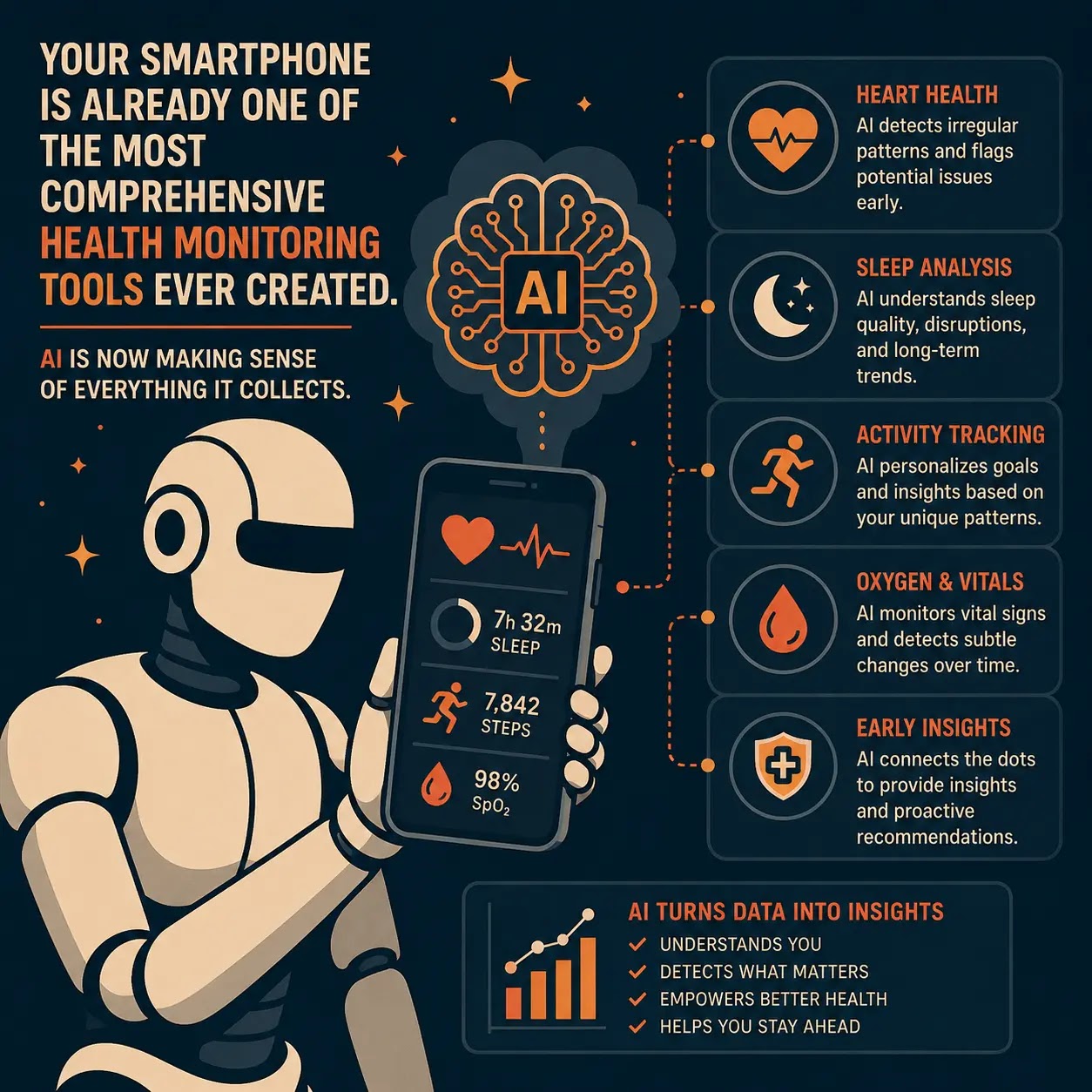
AI health monitoring on your smartphone is expanding faster than most people realise. More than 1,250 AI-enabled medical devices had received marketing authorisation from the US Food and Drug Administration as of July 2025, according to analysis by the Bipartisan Policy Center, a figure that had risen by more than 300 in a single year. The smartphone in your pocket is quietly becoming the interface layer for a significant number of them. The device categories driving that growth are not hospital machines but consumer health applications running on devices hundreds of millions of people already own, and the AI performing the analysis is more capable than most users realise.
The FDA device tracker shows radiology imaging still dominates AI medical device authorisations at 76 percent of all approvals by end-2025, but cardiovascular and neurology applications are growing at pace. For most people, the relevant shift in AI health monitoring is not hospital-grade diagnostics requiring clinical interpretation but the consumer tier: heart rate irregularity detection, sleep staging, blood oxygen monitoring, and mental health tracking running continuously on devices they carry.
What makes 2026 different from three years ago is the transition from passive measurement toward clinical-grade inference, and the FDA is adjusting its regulatory posture accordingly. In January 2026, the FDA clarified that low-risk wellness devices, including most fitness wearables and health tracking apps, generally do not require FDA regulatory oversight. That decision removes friction for a generation of products reaching market in the next 18 months.
For anyone with a recent smartphone or wearable, the practical consequence is that health-relevant AI is already operating on your device whether you have opted into it consciously or not. Understanding what it can and cannot tell you, and who else can access that information, is no longer a niche concern.
What the AI Health Monitoring Architecture Actually Does
The architecture of modern AI health monitoring involves three layers working simultaneously. The sensor layer collects raw data from device hardware: the accelerometer tracking movement quality, the optical sensor reading blood volume pulses through the skin, the microphone picking up breathing patterns during sleep. The processing layer applies machine learning models, trained on millions of annotated physiological recordings, to convert that raw data into health inferences. The interface layer presents those inferences as notifications, trends, or alerts calibrated to what the evidence supports communicating to a non-clinical user. The combination is more powerful than any single sensor would suggest because the AI is drawing inferences from the interaction between signals, not from individual readings in isolation.
Fitbit confirmed in March 2026 that it was integrating medical records into its AI coaching layer, which represents a meaningful step beyond passive monitoring. Connecting longitudinal health records with real-time physiological monitoring changes what the AI can conclude. It can compare your sleep quality this week against your baseline across three years of data and flag a deviation invisible in a single night. It can cross-reference heart rate variability against documented medication changes. The clinical usefulness of that integration is substantial. So are the privacy implications, and the two do not separate easily.
What Clinical-Grade Actually Means
The Bipartisan Policy Center analysis notes over 1,250 AI-enabled medical devices had received cumulative FDA authorisation by mid-2025, up from 950 a year earlier. The standards a hospital-facing clinical AI system must meet to achieve clearance are significantly more demanding than those governing a wellness application on your phone. The distinction matters for setting realistic expectations.
Consumer health apps have not cleared the clinical validation bars that medical devices must meet. That does not make them useless. It places them in a different risk category: appropriate for health awareness and early signal detection, not for definitive clinical conclusions. Your heart rate sensor is not replacing your cardiologist. It is providing a richer longitudinal dataset your cardiologist can incorporate, provided that data is shared at the consultation and interpreted in clinical context.
As LiveAIWire’s coverage of how to know when you can actually trust an AI system found, calibrating trust to the evidence behind a specific tool, rather than to the general reputation of “AI”, is the same discipline that applies to a health monitoring app on your wrist.
Understanding how AI diagnostics are transforming clinical healthcare settings clarifies what the consumer tier of this technology is and is not: hospital AI systems are trained on clinical datasets with prospective outcome validation, while consumer apps are trained on larger but less rigorously labelled datasets, with accuracy varying significantly across populations underrepresented in training data.
The Privacy Gap Nobody Is Discussing
Most people have not read the privacy policies governing their health applications, and those policies determine who can access the data collected, under what circumstances, and for how long. The FDA’s January 2026 guidance clarified that low-risk wellness devices fall outside its regulatory scope, which is a reasonable risk calibration given their safety profile. It does not mean the data those devices generate is private by default. Health app data sits in a different legal category from medical records in most jurisdictions. It can be sold, shared with third parties, and used for purposes unrelated to healthcare without the protections that govern hospital records under frameworks like HIPAA in the US or the UK GDPR special category provisions.
This matters more now than three years ago because the data is more valuable. An AI model trained on your sleep patterns, heart rate variability, activity levels, and location data can draw health inferences that no single sensor supports alone. The aggregation creates a picture that is clinically meaningful, commercially valuable, and legally under-protected in most regulatory frameworks simultaneously. The consumers generating that data are rarely aware of its value or its reach.
Where AI Health Monitoring Is Heading and What to Watch
Apple’s decision to scale back its AI health coach plans in early 2026 amid accuracy and regulatory concerns reflects where the genuine engineering challenge for AI health monitoring lies: not in collecting health data but in making accurate, safe inferences from it across billions of diverse users. A false positive sending someone to a cardiologist unnecessarily wastes time and money. A missed cardiac event costs a life. The margin for error is not equivalent to consumer entertainment software.
The trajectory over the next three years points toward tighter integration between consumer devices and clinical systems, producing a situation where data from your wrist, phone, and health records can form a continuous health picture accessible to you and your clinical team simultaneously. The barriers are not primarily technical. They are interoperability standards between device manufacturers, liability frameworks for AI-generated health insights, and patient consent architectures that have not kept pace with the data ecosystem being built around them.
For those navigating AI mental health tools specifically, whether AI therapy tools actually work is a related question with a similarly nuanced answer. The smartphone in your pocket already knows more about your health than most people realise. Whether what it knows helps you or merely monetises your data depends on decisions being made right now by regulators, device manufacturers, and healthcare systems, not by the AI itself. Knowing that changes how you should read the privacy settings on your health apps.
The two-track regulatory approach, lighter rules for wellness applications and stricter standards for clinical AI, is a reasonable attempt to enable consumer innovation while protecting patients from unvalidated medical claims. The practical gap for consumers is that distinguishing between a wellness app and a clinical tool on the basis of the product description alone is not reliably possible, and the FDA guidance does not resolve that legibility problem for ordinary users navigating an increasingly crowded market of AI health monitoring applications making capability claims that exceed what their regulatory status actually authorises.
About the Author
Stuart Kerr is Technology Correspondent at LiveAIWire, covering artificial intelligence, cybersecurity, and the social impact of emerging technology. He publishes daily at LiveAIWire.com.