ai accelerating renewable energy transition 2026
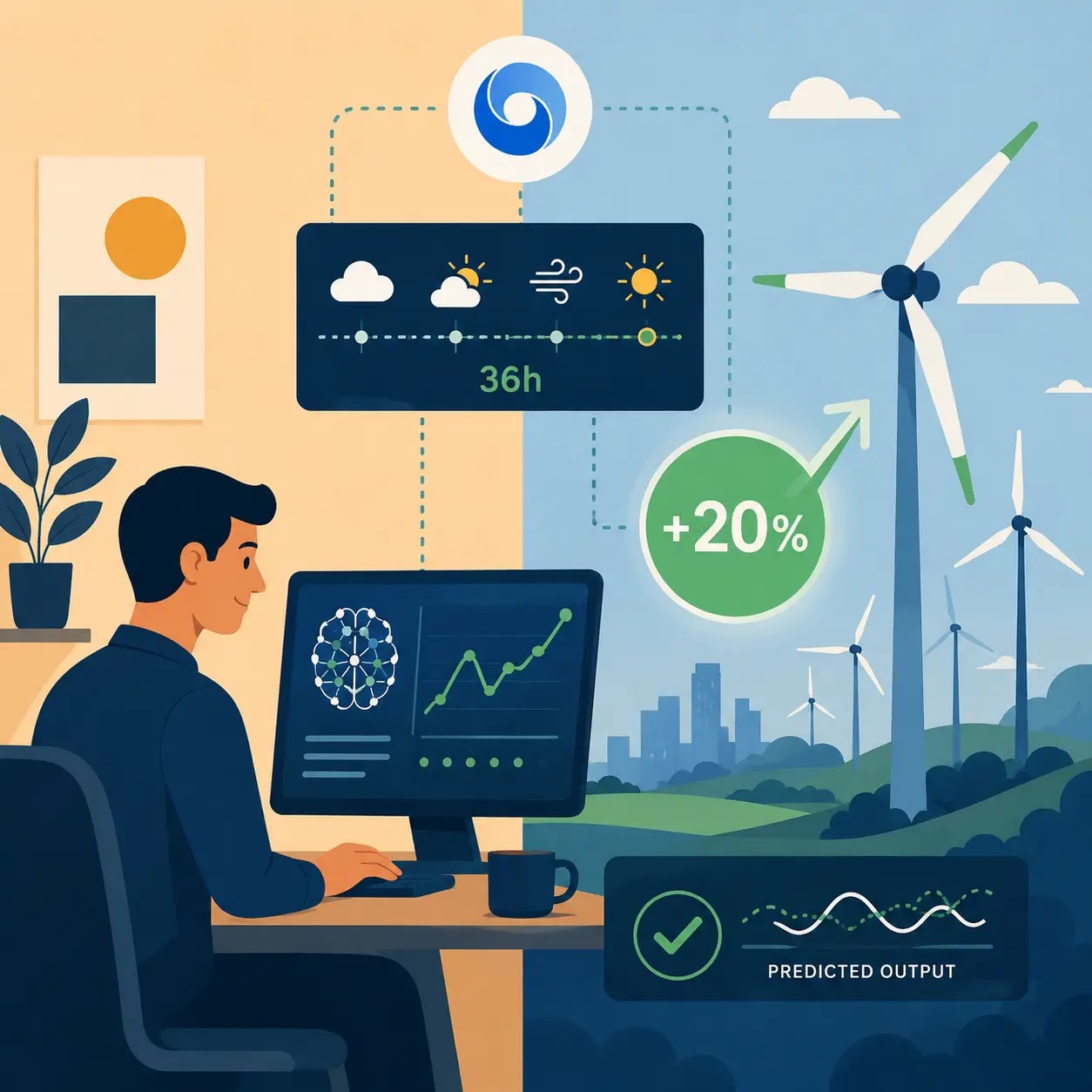
Google DeepMind’s AI increased the value of wind energy by 20 percent by predicting output 36 hours in advance, solving the intermittency problem that has always limited renewable energy’s potential.
By Stuart Kerr, Technology Correspondent, LiveAIWire
The Biggest Problem Blocking the Clean Energy Transition Is Not Politics or Cost. It Is Predictability. AI Is Solving It.
For all the progress made in renewable energy over the past decade, with wind and solar costs falling by over 90 percent and installed capacity growing from 630 terawatt-hours globally in 2012 to over 3,400 terawatt-hours by 2022, the clean energy transition faces a fundamental technical problem that no policy or subsidy can fix. The sun does not always shine. The wind does not always blow. And electricity grids are built on the principle that power supply must match demand at every moment of every day, or the lights go out. The intermittency of renewable energy has been the single most stubborn barrier to replacing fossil fuels entirely, because fossil fuel power stations can be turned on and off on demand while solar panels and wind turbines cannot. Artificial intelligence is solving this problem in ways that are already producing verified, measurable results at commercial scale, and the implications for the speed of the clean energy transition are significant.
An AI system built by Google’s DeepMind and applied to 700 megawatts of wind capacity across Google’s wind farms in the central United States increased the value of that wind energy by approximately 20 percent compared to the baseline scenario of no time-based commitments to the grid. The mechanism was straightforward but the achievement was not: DeepMind trained a neural network on historical weather data and turbine performance to predict wind power output 36 hours in advance, then used those predictions to make optimal hourly delivery commitments to the power grid a full day ahead. Energy that can be scheduled and delivered at a committed time is worth more to a grid than energy that arrives unpredictably. AI made wind power schedulable for the first time.
The Intermittency Problem and Why Solving It Unlocks Everything
The intermittency challenge is not simply an inconvenience. It is the reason why even countries with abundant renewable resources have not been able to eliminate fossil fuel generation entirely. When the wind drops suddenly or cloud cover reduces solar output, something must fill the gap immediately. Historically, that something has been gas peaking plants, kept warm and ready at significant cost, or coal and gas baseload generation that cannot be switched off quickly enough to track rapid changes in renewable output.
Between five and fifteen percent of all renewable energy generated in major grids including Europe and China is currently curtailed, wasted because it cannot be absorbed by the grid at the moment it is produced. In the US in 2022, one regional grid curtailed over 11,000 gigawatt-hours of wind energy, more than ten percent of all wind produced in that region. Another curtailed nearly 2,450 gigawatt-hours of solar, almost seven percent of its total solar production. AI curtailment prediction tools being developed by Meta and others aim to predict precisely when and where this waste occurs, allowing grid operators to route energy more effectively and reduce curtailment substantially.
AI-enhanced forecasting platforms now predict solar irradiance and wind speeds with over 95 percent accuracy, according to analysis of leading systems in 2026. AI-based models reduce forecast error in solar irradiance prediction by 15 to 20 percent compared to previous generation forecasting tools, according to peer-reviewed research. A Danish wind project that used AI to optimise turbine layout and operation achieved 12 percent higher energy production from the same installed capacity. AI-powered solar trackers and control systems that adjust panel positioning and anticipate weather impacts increase photovoltaic system efficiency by approximately 20 percent.
How AI Is Transforming the Grid Itself
Beyond forecasting, AI is transforming how electricity grids operate, making them more capable of absorbing high proportions of renewable energy without the stability problems that have historically limited penetration.
Smart grid systems using machine learning algorithms now monitor grid health continuously, detect anomalies before they cause failures, and automate energy flow between producers and consumers in real time. Load balancing, previously a reactive process requiring human operators to manually adjust settings, is now handled by AI that anticipates demand changes and pre-positions resources accordingly. Demand response systems adjust industrial and commercial consumption patterns in real time based on AI analysis of supply conditions, effectively creating flexible demand that can absorb renewable surpluses and reduce during renewable shortfalls.
Predictive maintenance powered by AI is reducing the operational costs of renewable energy infrastructure significantly. AI systems using sensors and image recognition to detect anomalies in wind turbines, solar panels, and hydroelectric infrastructure are reducing maintenance costs by up to 40 percent and increasing system uptime by 15 to 20 percent through early fault detection. For a wind farm with significant installed capacity, that translates to annual cost savings of $10,000 to $30,000 per megawatt, making renewable energy increasingly competitive with fossil fuel generation even before carbon pricing is considered.
Energy storage systems, particularly lithium-ion battery installations, are being managed by AI-based control systems that optimise when to charge, when to discharge, and how to balance storage capacity against predicted future generation and demand. This is vital for integrating variable renewables into the grid without interruptions, effectively allowing excess renewable generation to be stored and dispatched precisely when it is needed most.
An AI Trained on 13,000 Virtual Worlds Projects the Renewable Future
A peer-reviewed study published in Nature Energy in April 2026, using an AI model trained on 13,000 simulated scenarios of global energy transition, found that solar and wind power are likely to grow worldwide at a pace compatible with limiting global warming to two degrees Celsius, though not the more ambitious 1.5 degree target. The model outperformed the International Energy Agency’s conventional forecasting methodology, according to analysis by Anthropocene Magazine, by incorporating a far wider range of historical national energy transition experiences and running probabilistic projections across a much larger scenario space than any human analyst team could manage.
The two degree finding is simultaneously encouraging and sobering. Encouraging because it represents a significant improvement on trajectories seen even five years ago, driven substantially by the cost reductions in solar and wind technology and the accelerating deployment of AI-optimised energy management. Sobering because two degrees represents significant and damaging climate change, and the gap between the two degree trajectory and the 1.5 degree target where the most severe climate impacts become less likely is substantial.
The Honest Tension: AI’s Own Energy Appetite
The honest account of AI and renewable energy in 2026 must acknowledge a significant tension that is receiving increasing attention from researchers and energy analysts. AI data centres are themselves among the most energy-intensive facilities ever built. The training and operation of large AI models consumes electricity at a scale that is growing rapidly. As explored in Elon Musk, a Million Satellites, and a Data Centre in the Sky, the energy demand of AI infrastructure is one of the defining constraints on AI development in the current era, and it is driving significant investment in new energy capacity including, paradoxically, the renewable energy that AI is also helping to develop and optimise.
Google’s DeepMind has reduced its own data centre cooling energy consumption by 40 percent using AI, cutting total data centre electricity use by 15 percent. That efficiency saving, applied across the global data centre estate, represents a meaningful energy reduction. But the scale of new AI compute being deployed means that even significant efficiency improvements may not be sufficient to offset the growth in total consumption.
The direction of travel is nonetheless clear. AI’s contribution to solving the intermittency problem, reducing the cost and waste of renewable energy systems, and accelerating the deployment of clean generation capacity is already producing verified results at commercial scale. Whether it produces them fast enough to matter for the climate is the question that the 2026 Nature Energy study quantifies more honestly than most policy documents do: a two degree world is achievable on current trajectories. The 1.5 degree world requires more.
About the Author
Stuart Kerr is Technology Correspondent at LiveAIWire. He writes about artificial intelligence, ethics, and how technology is reshaping everyday life. Follow @LiveAIWire on X.