
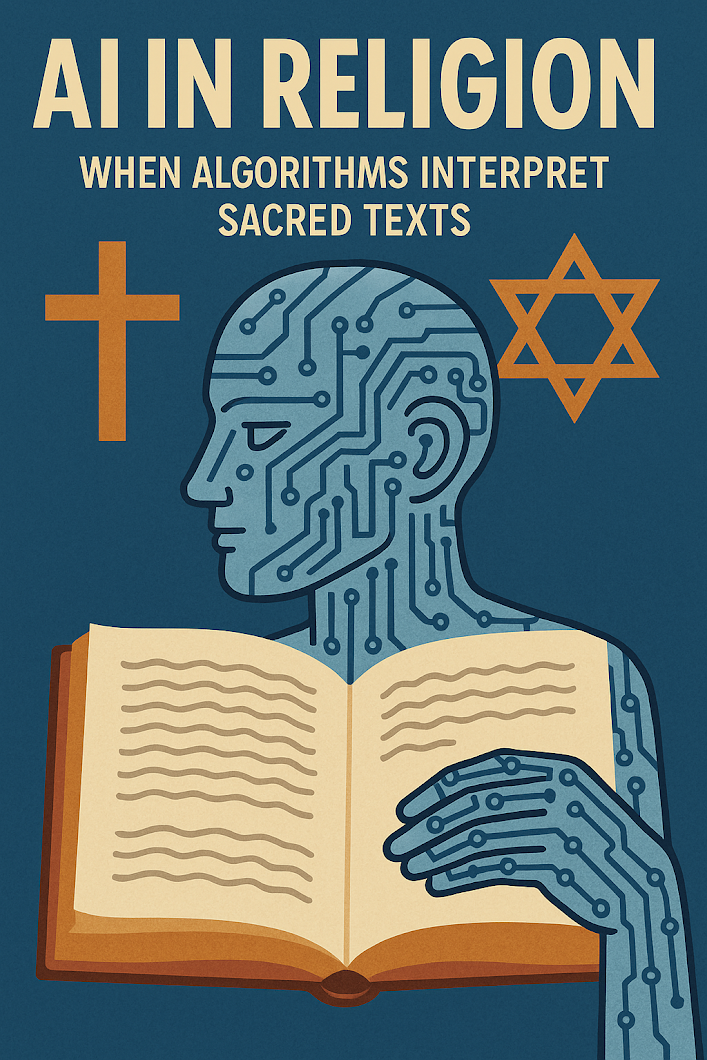
AI scripture interpretation just received its first formal institutional ban. In January 2026, Egypt’s Dar al-Ifta al-Misriyyah, the governmental Islamic advisory body that has issued authoritative rulings on Sunni jurisprudence since 1895, declared that using AI applications, including ChatGPT, to interpret the Quran is religiously impermissible. The ruling was not precautionary. It was reactive, issued after concrete queries from Muslims already using these tools for Quranic study showed the practice had become widespread enough to require urgent intervention.
Grand Mufti Nazir Ayyad explained the reasoning in terms that reach well beyond Islamic jurisprudence. Independent reliance on AI scripture interpretation, he argued, exposes a sacred text to conjecture without proper scholarly grounding, because Quranic exegesis must remain confined to those trained in recognised interpretive methodologies. Attributing unverified meanings to scripture, in his view, risks undermining the integrity of the text itself.
A Cross-Traditional Pattern in AI Scripture Interpretation
What makes the Dar al-Ifta fatwa notable is that it is not an isolated case. The Catholic Church confronted a near-identical risk through direct operational experience. Catholic Answers’ “Father Justin” chatbot, built to offer spiritual guidance in a priestly persona, told a user that Gatorade could substitute for water in baptism, an error that touches a sacramental distinction with real doctrinal weight. The organisation demoted the chatbot from its priestly persona to a generic lay role within twenty-four hours of the error surfacing.
Bobby Gruenewald, chief executive of YouVersion, the world’s most downloaded Bible app with more than a billion installs, disclosed in March 2026 that AI-generated biblical quotations carry error rates of fifteen to sixty percent across major platforms, according to reporting on the pattern of AI distortion across major religious traditions. That figure carries particular weight because it comes from an executive whose company has every commercial incentive to promote AI adoption rather than flag its limits. YouVersion has since declined to deploy a public-facing theological chatbot of its own.
Why AI Scripture Interpretation Fails on Doctrinal Nuance
The empirical case against unsupervised AI scripture interpretation goes beyond headline anecdotes. A peer-reviewed study published in AI and Ethics evaluated two leading language models against a doctrinal knowledge base of 576 claims drawn from catechisms, confessions, and denominational statements across eleven Christian traditions. GPT-4o scored 0.864 on precision but only 0.561 on recall, meaning it was accurate on what it did say while missing well over a third of the doctrinal content a complete answer should have included. Gemini 2.5 Flash performed worse on both measures.
That precision-recall gap matters because it creates a false impression of reliability. A separate study by the Bible Society found that the word sacrament appeared only three times across all examined chatbot responses, with no mention at all of transubstantiation, Eucharistic adoration, or the theological concept of mystery central to Catholic and Orthodox belief. Researchers attribute this to models trained predominantly on English-language, evangelical-leaning source material, which produces a homogenised default Christianity that quietly erases minority traditions rather than representing the diversity within the faith.
This is where AI scripture interpretation and translation intersect in ways that go beyond doctrine into everyday devotional life. As covered in LiveAIWire’s reporting on AI in religious life, machine translation is expanding scripture access to language communities that previously had none, while introducing new risks of decontextualised meaning that trained scholars are trained specifically to avoid.
Clergy Are Already Using It, Quietly
Despite the institutional pushback, AI scripture interpretation is already routine in ordinary parish life. In a Barna Group survey of senior Protestant clergy, twelve percent said they were comfortable using AI to write sermons outright, and forty-three percent said they saw genuine merit in using it for sermon preparation and research, according to reporting from Religion News Service and NPR. One Lutheran pastor described feeding a week’s Bible reading into ChatGPT and receiving a nine-hundred-word sermon in under thirty seconds that she admitted was genuinely good, and that this quality was itself what unsettled her.
Rabbi Daniel Bogard of Central Reform Synagogue in St Louis has taken a different approach, using AI scripture interpretation as a study partner rather than a source of finished answers, comparing it to the Talmudic practice of chavrutah, where two people argue a text together to reach a deeper shared understanding. He is careful to note that the value of that practice was never really about extracting the correct reading faster. It was about understanding the debate partner, and understanding yourself, in ways an AI model cannot participate in even when it can hold up its side of the argument competently.
What This Means for You
If your faith community is using AI scripture interpretation for sermon drafts, devotional content, or scriptural Q&A, the practical lesson from the past year is not that the tool is useless. It is that the tool’s fluency is not evidence of theological accuracy, and the two can diverge sharply in exactly the passages where getting it wrong matters most. A model can produce syntactically flawless, confident-sounding commentary on the Eucharist while omitting the concept entirely from its worldview, and nothing in its tone will signal that gap to a reader who has not studied the tradition themselves.
The practical response emerging across traditions is not prohibition alone. It is treating AI output on scripture the way a newsroom treats an unverified tip: useful as a starting draft, never publishable as a finished answer without a subject-matter expert checking it against the primary text and the community’s own interpretive tradition. As LiveAIWire’s coverage of AI clergy and algorithmic sermons has found, the traditions handling this transition most thoughtfully are training their own leaders in exactly that verification discipline rather than banning the tool outright or adopting it uncritically.
The Governance Gap Is the Real Story
No binding international standard currently governs AI scripture interpretation. The Dar al-Ifta fatwa carries authority within Egyptian religious law but has no enforcement mechanism on global platforms operated from outside its jurisdiction. A user in London or Lagos asking an AI model to interpret the Quran has no way to know whether the model has been reviewed by any religious authority, what theological assumptions are embedded in its training data, or what recourse exists if the guidance it gives is wrong.
That gap is not unique to Islam. As LiveAIWire’s broader analysis of AI and religious faith has documented, the populations most likely to rely on AI-mediated spiritual guidance because they lack easy access to human clergy are frequently the same populations least equipped to independently verify whether that guidance is theologically sound. Until religious institutions, AI developers, and regulators build shared criteria for evaluating AI-generated religious content, that asymmetry will keep falling hardest on the believers with the fewest alternatives.
About the Author
Stuart Kerr is Technology Correspondent at LiveAIWire, covering artificial intelligence, emerging technology, and their impact on business, society, and geopolitics. LiveAIWire publishes daily AI news and analysis at liveaiwire.com.