
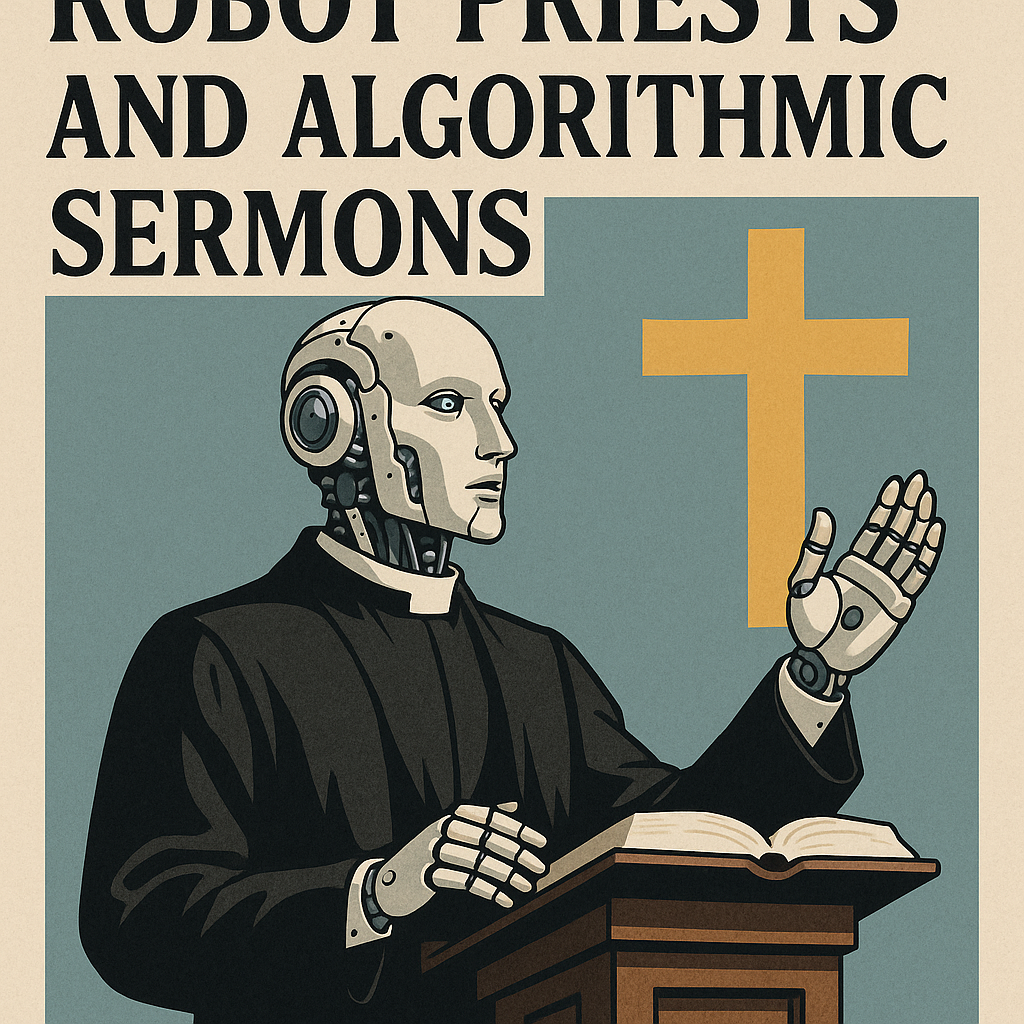
A
robot designed by a Buddhist temple in Kyoto performs rituals, recites
sutras, and offers guidance to worshippers at a fraction of the cost of human
clergy. A Catholic church in Germany broadcast an AI-generated service to
thousands of online viewers who rated it warmly. An evangelical megachurch in
the United States uses AI to generate personalised Bible study plans for its
congregation of over 20,000. These are not science fiction scenarios. They
are documented realities, and they are forcing religious institutions around
the world to ask a question no previous generation of clergy has faced: can
artificial intelligence perform a genuine spiritual function, or does it only
mimic one?
The question matters far beyond theology faculties and
ecclesiastical committees. Roughly 84 percent of the global population
identifies with a religious tradition, according to the Pew Research Center.
If AI is reshaping how faith is practised, transmitted, and experienced, it
is reshaping something central to the daily lives of the majority of
humanity. And it is doing so faster than most religious institutions have
begun to think seriously about.
What AI Is Actually Doing in Religious Contexts
The applications range from the mundane to the profound. At the
operational level, AI is handling scheduling, donation processing, volunteer
coordination, and communications management for thousands of congregations
that lack the administrative staff to do these things manually. These
applications are uncontroversial; they free human clergy and community
workers to focus on relational and pastoral work.
More significant are the AI tools being used for scripture study
and spiritual formation. Apps including YouVersion, Bible.is, and several
Islamic and Jewish equivalents use AI to personalise devotional content,
answer scriptural questions, and suggest prayer practices calibrated to
individual users. These applications have attracted tens of millions of users
globally. Whether they deepen or dilute genuine religious engagement is
debated earnestly within traditions, though few have developed formal
positions on the question.
The most challenging applications are those that attempt to
replicate pastoral functions. Chatbots trained on religious texts and
counselling frameworks are being used by people experiencing grief, spiritual
crisis, and mental health challenges who reach for digital support before or
instead of human pastoral care. The Vatican’s Dicastery for Culture
and Education has addressed this directly, arguing that authentic
pastoral accompaniment requires human presence that no AI system can
replicate, regardless of how sophisticated its outputs
become.
The Kyoto Robot and What It Reveals
Kofuku-ji Temple’s robot priest, known as Mindar, represents the
furthest current development of AI in religious practice. Built at a cost of
nearly one million dollars with contributions from a technology company,
Mindar delivers sermons drawn from the Heart Sutra and can make eye contact,
move its hands, and respond to basic questions. Temple officials describe it
as a tool for making Buddhist teaching accessible to younger generations who
find traditional formats alienating.
The critical response from within Japanese Buddhism has been
illuminating. Several senior Buddhist scholars have argued that Mindar
fundamentally misunderstands what a religious teacher is. In Buddhist
thought, the relationship between teacher and student is not primarily
informational; it is about the transmission of something that requires the
teacher’s own spiritual attainment. An AI that recites the Heart Sutra
accurately but has no interior life of its own is, in this view, performing a
simulation of religious teaching rather than the real thing.
This critique applies with varying force across different
religious traditions. Traditions that place the greatest weight on the
transmission of living wisdom through personal relationship are most
resistant to AI substitution. Traditions that emphasise the text itself as
the primary vehicle of religious authority are more open to AI as an
interpreter and guide. These theological differences are ancient; AI has
simply made them urgently practical.
Algorithms and the Formation of Belief
Beyond the debate about AI clergy, there is a larger and less
visible question about how AI recommendation systems are shaping religious
belief at scale. Social media platforms use AI to curate religious content
for billions of users, but the optimisation targets are engagement and
retention, not spiritual wellbeing or theological accuracy. Research from the
Knight
Foundation and others has documented how recommendation algorithms
consistently surface more extreme, emotionally intense religious content over
moderate or contemplative material, because extreme content generates more
engagement signals.
The consequences for religious communities are significant.
Congregations that were once shaped primarily by the teaching of local clergy
are now shaped equally by the algorithmic curation of global content streams.
Young people in particular are forming religious identities through
AI-mediated content ecosystems that no human pastor has designed or can
control. The erosion of institutional religious authority is not primarily a
consequence of secularism; it is partly a consequence of algorithmic
competition.
Religious institutions that have recognised this dynamic are
investing in digital strategy and content creation to ensure their voices are
present in the algorithmic ecosystem. The Catholic Church’s significant
investment in digital media, the rapid growth of evangelical YouTube
channels, and the sophisticated social media presence of several Islamic
institutions all reflect an understanding that algorithm fluency is now a
pastoral necessity.
What This Means for You
For the religiously committed, AI presents both tools and
temptations. The tools are genuine: better access to scriptural resources,
more personalised devotional support, and broader connection to
co-religionists across geographic boundaries. The temptations are equally
genuine: the substitution of algorithmically curated spiritual content for
the slower, harder, more transformative work of real community, real
practice, and real relationship with a human spiritual
director.
The emergence of AI as a religious actor, however limited its
capacities, is forcing theologians to revisit foundational questions about
what makes religious practice valid and what role the human agent plays in
spiritual life. These are questions that each tradition must work through on
its own terms, and the answers will differ. What is clear is that the
pressure to address them is not going to diminish, and that institutions
which avoid the questions will find themselves shaped by commercial
technology decisions made entirely outside their theological
frameworks.
The traditions navigating this moment most thoughtfully are those
developing explicit frameworks for AI use that distinguish between
applications that genuinely serve their members’ spiritual lives and those
that merely simulate doing so. For related analysis of how AI is reshaping
other dimensions of community and social life, see coverage of AI
in religious life and AI
in personal relationships. The financial dimension of AI in
religious life deserves acknowledgment. Religious organisations that adopt AI
tools become commercially dependent on the companies supplying them, creating
relationships of reliance that can conflict with institutional independence.
Several major denominations have raised concerns about data sovereignty when
pastoral data, including counselling records and spiritual direction notes,
is processed through commercial AI platforms. The principle that what is
shared in a pastoral context should remain confidential is ancient and widely
respected. Whether commercial AI platforms providing pastoral support
services honour this principle in their data practices is a question that
religious institutions adopting these tools have often not examined closely
enough before deployment. The World Council of Churches has specifically
called for transparency about data handling in religious AI applications as a
minimum condition for responsible deployment.
The question is not whether AI belongs in religious life. It is
whether religious communities are shaping how it is used, or whether they are
simply letting technology companies make that decision by
default.
About the Author
Stuart Kerr is a technology correspondent at LiveAIWire, covering
artificial intelligence, digital innovation, and the social impact of
emerging technologies. Follow LiveAIWire for daily analysis at liveaiwire.com.