
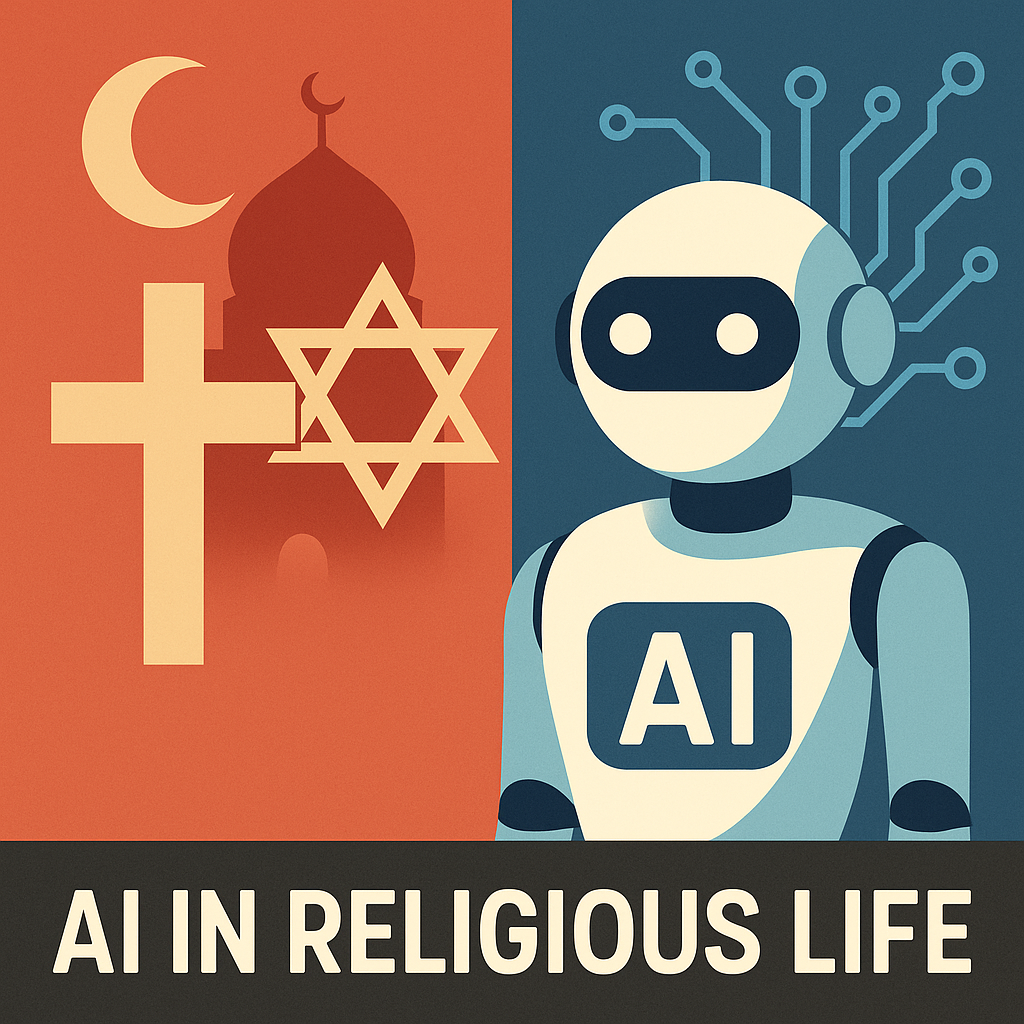
An
AI-generated sermon delivered to a Lutheran congregation in Germany in 2023
drew hundreds of worshippers and significant media attention, not because it
was scandalous, but because many of those who attended found it moving. The
experiment exposed a question that religious institutions around the world
are now confronting with increasing urgency: what role should artificial
intelligence play in the practice of faith, and where does automation cross a
line that technology should not cross?
The intersection of AI and religion is broader than most people
appreciate. Chatbots trained on religious texts are providing spiritual
guidance to millions of users. AI is being used to translate and analyse
ancient scriptures, restoring texts that had been partially lost. Virtual
reality systems are enabling immersive pilgrimages for those who cannot
travel. And social media algorithms are shaping religious community formation
and belief in ways that are poorly understood but potentially profound in
their long-term effects on how faith is practised and transmitted across
generations.
AI as Spiritual Guide
Several AI applications specifically designed for religious use
have attracted large user bases. Faith-based chatbots trained on the Bible,
the Quran, or the Torah offer question-and-answer interfaces that millions of
users treat as a first port of call for spiritual queries. Some of these
applications are explicitly devotional; others position themselves as
research tools. The line between the two is rarely clear to users, and
neither category is subject to any formal quality standard or accountability
mechanism.
The concerns voiced by religious leaders and ethicists centre on
the nature of spiritual guidance itself. In most faith traditions, pastoral
care is understood as a relationship between persons, one that involves
empathy, presence, and genuine human understanding of suffering. An AI system
that mimics the surface features of spiritual counsel without any of this
underlying reality is, in the view of many theologians, performing a kind of
counterfeit ministry that could do genuine harm to vulnerable people seeking
genuine support in times of crisis or grief.
The Roman Catholic Church has engaged seriously with these
questions. A Vatican symposium on AI ethics produced the Rome Call for AI
Ethics in 2020, signed by major technology companies, which includes
provisions about the dignity of persons that apply directly to religious AI
applications. Pope Francis has spoken about the need for AI development to
respect human dignity in terms that explicitly encompass the spiritual
dimension of human experience. The Church’s engagement with AI ethics has
been more substantive and philosophically sophisticated than that of most
secular institutions.
Scripture, Translation, and Preservation
On the scholarly side, AI is proving transformative for religious
textual analysis. Machine learning models have enabled significant advances
in the analysis of the Dead Sea Scrolls, helping to identify scribal hands and
reconstruct fragmentary texts that centuries of traditional scholarship could
not fully recover. Similar applications are active in the analysis of
cuneiform religious texts, Buddhist sutras, and early Christian
manuscripts.
AI-assisted translation is making religious texts accessible to
language communities with previously limited access to primary sources. The
Quran has been translated by AI into hundreds of languages, though Islamic
scholars have raised important questions about the limits of algorithmic
translation for texts whose meaning depends on layers of interpretation
developed over centuries. The Vatican’s AI ethics
initiative has specifically addressed these translation questions,
noting that AI can expand access while also introducing new risks of
decontextualised interpretation that trained religious scholars would
recognise as problematic.
Archaeological AI applications are also recovering religious
heritage that would otherwise be lost. Computer vision systems trained to
identify text in damaged manuscripts have accelerated work at the British
Library, the Bodleian, and multiple national archives, enabling the recovery
of religious and liturgical texts from communities that no longer have living
speakers of their original languages.
Algorithms, Community, and Belief Formation
The most consequential and least discussed intersection of AI and
religion may be at the level of recommendation algorithms. Social media
platforms use AI to curate content, including religious content, in ways that
shape what believers encounter and with whom they form community. Research
has documented patterns in which recommendation algorithms amplify more
extreme or emotionally intense religious content over moderate voices, a
dynamic that has contributed to the growth of online religious movements
bypassing traditional institutional structures.
This algorithmic shaping of religious community is not deliberate
on the part of platform designers; it is an emergent property of
engagement-optimising systems. But its effects on the diversity and stability
of religious belief across populations are real and largely unmonitored by
either religious institutions or technology regulators. The radicalisation
pathways that researchers have documented in political contexts operate through
the same algorithmic mechanisms in religious content.
What This Means for You
The question of AI-generated religious content raises specific
concerns about authenticity and authority that are distinct from the general
questions about AI-generated text. In traditions where religious authority
derives from lineage, training, and community recognition, an AI that
produces religious content without any of these attributes is making an
implicit claim that the traditions themselves would dispute. The appearance
of religious authority, without the accountability structures that legitimate
authority entails, is a concern that goes beyond questions of accuracy to
questions of accountability. Who is responsible when an AI spiritual guide
gives harmful advice to a vulnerable person? The answer under current legal
frameworks is essentially nobody, a gap that urgently needs addressing as
these applications scale.
For the billions of people for whom religion is central to daily
life, AI is already shaping spiritual experience in ways they may not fully
recognise. The apps used for prayer and scripture study, the social media
communities where faith is discussed, and the recommendation systems
surfacing religious content are all AI-mediated. The question worth asking is
not whether AI belongs in religious life; it is already there. The question
is whether religious communities, institutions, and individuals are
exercising meaningful agency over how it is used.
The theological questions raised by AI are genuinely
novel in some respects while echoing older debates about the role of
technology in religious practice. Every major technological shift, from the
printing press to radio to television, has required religious communities to
develop positions on new mediums and their appropriate relationship to faith.
AI raises these questions more acutely because it operates at the level of
cognition and communication rather than simply distributing content. An AI
that conducts a counselling session is doing something categorically
different from a radio broadcasting a sermon, and the theological frameworks
for evaluating that difference are still being developed within most
traditions. The World
Council of Churches has established a working group on AI ethics
that is bringing together theologians from diverse traditions to develop
shared principles for AI in religious contexts.
The traditions engaging most thoughtfully with these questions,
developing ethical frameworks, training clergy in digital literacy, and
maintaining human-centred pastoral care at the core of their practice, are
best positioned to navigate a transition that is in some ways as challenging
as any the world’s religions have previously faced. For related analysis of
how AI is reshaping community formation and social life, see our coverage of
AI
in personal relationships and how
AI is exploited in online communities.
About the
Author
Stuart Kerr is a technology correspondent at LiveAIWire, covering
artificial intelligence, digital innovation, and the social impact of
emerging technologies. Follow LiveAIWire for daily analysis at liveaiwire.com.