
By Stuart Kerr, Technology Correspondent, LiveAIWire
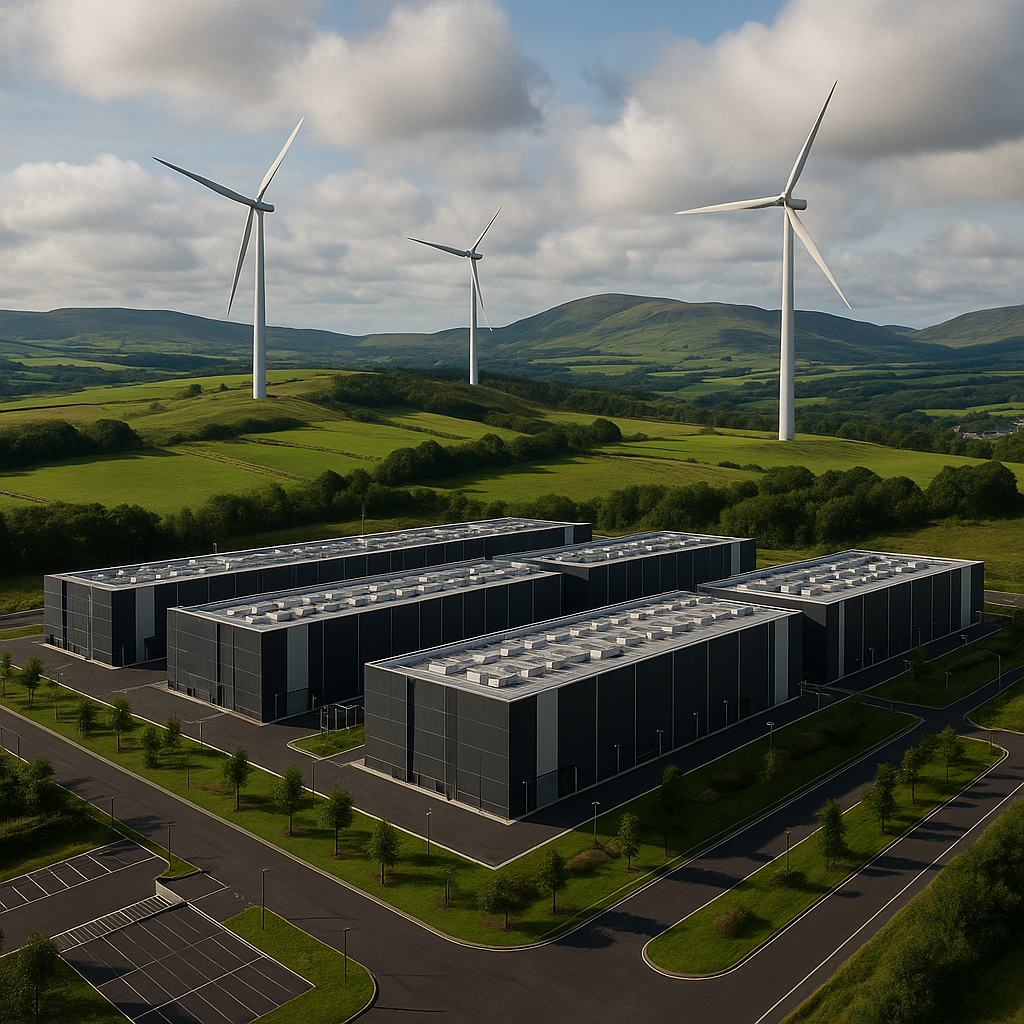
Scotland’s green AI dream rests on a genuinely elegant idea: use the wind power the grid already throws away to run the data centres the AI boom needs. Central Scotland generates more renewable electricity than the transmission lines south can carry, so wind farms get paid to switch off on windy days while gas plants in England get paid to switch on. That waste, called curtailment, cost consumers £1.2 billion in the year to late 2025 alone, a figure forecast to reach £3 billion by 2030.
Put a data centre and a battery next to the wind farm, the pitch goes, and the wasted electricity finally has somewhere useful to go.
That is the case for developments like Apatura’s proposed £3.9 billion campus at Ravenscraig, the former steelworks site outside Glasgow. It is also, as of this month, a case running head-on into a very different Scottish story: an £8.2 billion flagship AI data centre whose promised on-site renewables, according to a Guardian investigation published in July 2026, do not actually exist on paper, on the ground, or in any credible near-term plan.
Table of Contents
What’s Actually Being Proposed at Ravenscraig
Apatura’s Ravenscraig scheme would pair a 550-megawatt data centre with 650 megawatts of battery storage on 160 acres of the old steelworks site, at a stated cost of £3.9 billion. An independent socio-economic study commissioned for the project put its contribution at 0.4% of Scotland’s annual GDP, with roughly £766 million in construction-phase economic activity and £583 million a year afterward.
Apatura chief executive Giles Hanglin has called the site part of an ambition “to make Scotland a powerhouse of AI-enabled digital infrastructure powered by Scotland’s vast renewable resource.” The company says heat recovered from the data centre’s servers could supply the equivalent demand of more than 180,000 homes, and that 75% of attendees at its first public consultation event supported the plans. Russell Wilkie, director at Ravenscraig Ltd, described the proposal as “a once-in-a-generation opportunity” for a masterplan site that already has more than 1,000 homes and a new college campus delivered.
Ravenscraig is one of nine sites Apatura is developing across Scotland’s central belt, and one of dozens of AI data centre proposals now working through Scottish planning systems. It has also been put forward for the UK Government’s AI Growth Zone programme, a Department for Science, Innovation and Technology initiative that would cut qualifying Scottish projects’ electricity costs by up to £24 per megawatt-hour specifically because they would absorb curtailed renewable power rather than adding new demand to an already strained grid. Apatura plans to submit its final proposals to North Lanarkshire Council, with construction beginning in 2026 and the campus targeted for completion by 2029, subject to planning approval and the outcome of the AI Growth Zone decision.
What This Means for You
If a data centre proposal in your area promises to run on on-site renewables, the single most useful question to ask is not how much capacity is planned, but how much land has actually been secured and how much grid connection has actually been confirmed for it. As the Lanarkshire case below shows, the gap between a headline renewable figure and the physical infrastructure needed to deliver it can be enormous, and by the time that gap becomes public, construction commitments and community expectations are often already locked in.
It is also worth asking who benefits if the project is delayed rather than cancelled. A ten-year grid connection queue means a data centre that fails to secure AI Growth Zone status, and the discounted electricity that comes with it, may simply sit unbuilt for years while still shaping local land use, property values, and planning debate. Community groups are increasingly asking councils to treat that limbo period, not just the eventual outcome, as something worth planning for explicitly.
Where the Numbers Stop Adding Up
The £8.2 billion Lanarkshire AI data centre, built by US firm CoreWeave and Scottish company DataVita and positioned as a centrepiece of the UK’s AI Growth Zone programme, was announced in January 2026 as powered entirely by on-site renewables and complete by 2030. A Guardian investigation based on documents obtained under freedom of information rules found neither claim holds up. DataVita’s stated plan, 400 megawatts of solar and 800 megawatts of wind, would generate more than one and a half times the output of Whitelee, the UK’s largest onshore wind farm.
Its two operational data centres currently draw about 25 megawatts from the grid, and the only mooted wind development tied to the project envisions up to 19 turbines, roughly 5% of what the renewables claim would require. Internally, officials had acknowledged an “issue” with “power provision” even while publicly promising up to 1 gigawatt of new energy infrastructure.
The gap extends to jobs and community benefits. The promised 3,400 jobs were traced back to figures for a different, unrelated site, and the countryside charity Action to Protect Rural Scotland found them inflated by potentially “a hundred times” relative to what the Lanarkshire project itself could support. A promised £543 million community fund is not committed money; it is contingent on DataVita generating future revenue that does not yet exist. Nearby residents in Newarthill told the Guardian they had been offered free solar panels, tree planting, and cash by energy firms seeking access to land, an approach one energy consultant described bluntly: “To go from ‘nothing public’ to ‘country’s largest operational onshore windfarm’ in four years is pretty ambitious.”
Scotland Says Pause
The Lanarkshire revelations landed in the middle of a broader reckoning. Scotland’s SNP-led government moved this month to support a moratorium on new AI data centre developments, after its National Council voted to back a pause following calls from the Scottish Greens and, before that, from Edinburgh and East Ayrshire councils. The countryside charity ARPS has mapped roughly two dozen proposed hyperscale data centre projects across Scotland, and campaigners argue their cumulative electricity demand could exceed one and a half times the country’s current peak grid demand. Separately, developers routinely cite grid connection waits of eight to ten years for large new projects, a queue that AI Growth Zone status is explicitly designed to let qualifying sites jump.
Not every project in that pipeline is Lanarkshire. Ravenscraig’s backers point to a more modest, and more verifiable, claim: pairing a data centre with 650 megawatts of battery storage to absorb power that would otherwise be switched off, rather than promising to build renewable generation from scratch on a timeline that does not match physical reality. Whether Scottish and UK regulators can tell the difference between those two kinds of proposal, at the planning stage rather than after an FOI investigation, is precisely what the moratorium movement is now asking them to demonstrate.
The moratorium itself is not yet law. It passed as a National Council motion within the governing SNP, which campaigners expect the Scottish Government to act on given that the SNP and the Scottish Greens together hold a majority in the Scottish Parliament. Until and unless it is formally adopted, planning applications for Ravenscraig, Lanarkshire, and the roughly two dozen other proposed sites continue to move through the normal North Lanarkshire and equivalent council processes, with the AI Growth Zone decision from the Department for Science, Innovation and Technology still pending separately in London.
The Bigger Pattern Behind the Green AI Pitch
LiveAIWire’s recent analysis of AI climate claims found that 74% of the statements Big Tech makes about AI’s climate benefits are unproven, and that researchers could not identify a single case of a consumer generative AI product delivering a verified, material emissions reduction anywhere in the world. Lanarkshire’s on-site renewables promise fits that pattern closely: a specific, appealing, verifiable-sounding claim that collapses under the kind of scrutiny an FOI request, rather than a press release, actually applies.
LiveAIWire’s earlier reporting on AI’s energy disclosure gap found that major cloud providers routinely decline to publish workload-specific energy data even as their overall data centre electricity consumption climbs by double-digit percentages year over year. Scotland’s curtailment-focused pitch is a genuine attempt to solve a real problem, wasted renewable electricity, rather than simply claim credit for one. That distinction is exactly why the Lanarkshire case matters beyond Lanarkshire: it shows how easily a legitimate curtailment argument can be borrowed to sell a project that has no realistic path to delivering it.
Who Actually Benefits If It Works
LiveAIWire’s coverage of AI’s uneven economic benefits found that the gains from AI infrastructure investment tend to concentrate among shareholders and highly skilled workers in the metropolitan areas where AI companies are headquartered, while the communities hosting the physical infrastructure often see a smaller and more contested share. Ravenscraig’s backers project more than 4,000 permanent jobs and a real GDP contribution if the site is built as described. Lanarkshire’s backers projected 3,400 jobs that turned out to be borrowed from a different project entirely.
The difference between those two outcomes will not be visible in a groundbreaking ceremony. It will be visible only in whether the specific megawatts, the specific turbines, and the specific community fund payments materialise on the timeline promised, which is precisely the kind of detail that took an FOI request to surface once. LiveAIWire’s coverage of Google’s nuclear power agreement found at least one tech company treating long-term power procurement as an infrastructure problem to be solved a decade in advance, rather than a claim to be made and reconciled with reality later. Scottish regulators evaluating AI Growth Zone bids now have a clear template for the kind of verification that distinction requires.
Where This Leaves Scotland’s Green AI Dream
The underlying case for Scottish AI data centres, that curtailed wind power is a genuine, wasted resource worth putting to use, has not been disproven by the Lanarkshire scandal. What has been disproven is the assumption that a developer’s own renewable claims can be taken at face value without the kind of independent verification that, in this case, only emerged through freedom of information law rather than routine planning oversight.
Scotland’s moratorium movement is not a rejection of green AI infrastructure. It is a demand that the difference between Ravenscraig’s more conservative curtailment pitch and Lanarkshire’s unbuilt wind farm get sorted out before ground is broken, not years afterward. Whether that verification happens through the planning system, the AI Growth Zone selection process, or further freedom of information requests, is now the question that will determine whether Scotland’s green AI dream survives contact with the projects built in its name.
About the Author
Stuart Kerr is Technology Correspondent at LiveAIWire, covering artificial intelligence, emerging technology, and their impact on business, society, and everyday life. LiveAIWire publishes original AI journalism every weekday at liveaiwire.com.