
By Stuart Kerr, Technology Correspondent, LiveAIWire
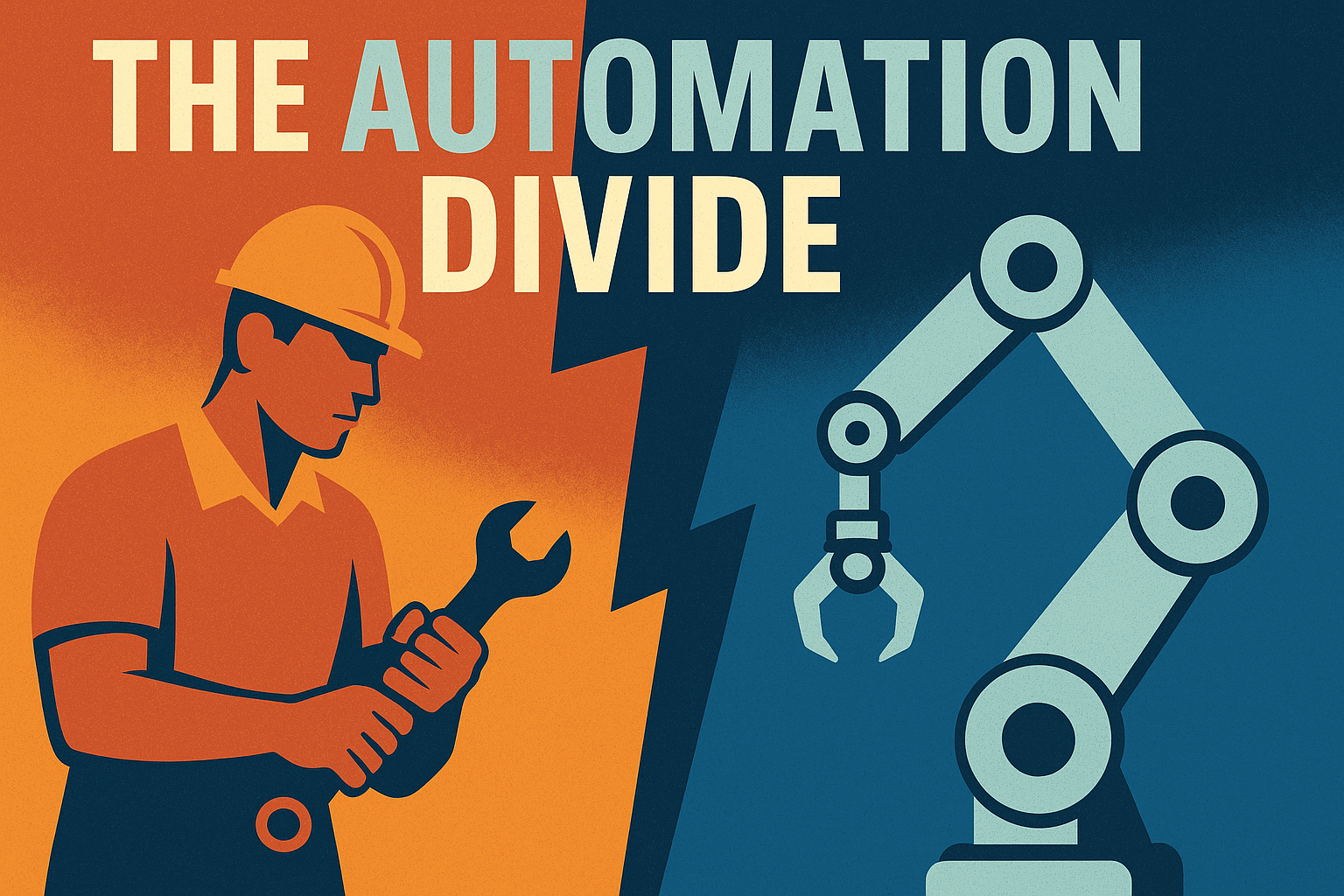
The AI automation divide is not a projection for a distant future, it is happening now, unevenly, in ways that cut along existing fault lines of class, race, geography, and education. The IMF’s 2024 assessment of AI’s labour market impact concluded that approximately 40 percent of jobs globally are exposed to AI automation, and that the technology is likely to increase inequality within countries even as it potentially raises aggregate productivity.
The automation narrative has a long history of false alarms. Previous waves of technological change, including mechanisation, computerisation, and the internet economy, disrupted specific job categories while creating new ones, typically resulting in net employment growth over decades-long timeframes. The question with AI is whether the current wave is categorically different: faster, broader, and less complementary to human labour in ways that make historical analogies misleading. Economists are genuinely divided on this question, and the honest answer is that nobody knows with certainty.
Who the AI Automation Divide Actually Affects
The pattern of AI-related labour market disruption differs from previous automation waves in one significant respect: it disproportionately affects white-collar and cognitive work rather than being concentrated in manufacturing and physical labour. Roles involving document processing, data analysis, customer service, routine legal work, basic medical transcription, and administrative functions are all facing significant AI substitution pressure that would have seemed implausible five years ago, a pressure that compounds with the algorithmic filtering LiveAIWire has documented in our coverage of AI recruitment tools now screening most job applications before a human ever reviews them.
Research from McKinsey Global Institute estimates that activities accounting for up to 30 percent of work hours in the US economy could be automated with current AI by 2030. The sectors with the highest exposure include financial services, legal services, information technology, and professional services, historically well-compensated sectors whose workers have not been the traditional focus of concerns about automation. At the same time, workers at the bottom of the income distribution face different pressures, as retail, hospitality, and logistics jobs are being automated through AI-enabled robotics and self-service systems, roles that typically offer fewer transition options.
The Geographic Shape of the AI Automation Divide
AI economic gains are heavily geographically concentrated. The companies developing and commercialising AI are clustered in a handful of metropolitan areas, primarily in the United States, China, and Western Europe. The productivity gains from AI adoption flow largely to shareholders and highly skilled workers in these locations, while the communities where displaced workers live face the consequences of automation without commensurate access to its benefits. Research by the Brookings Institution has mapped the geographic distribution of AI-exposed jobs and found that rural areas and smaller cities face disproportionate displacement risk relative to their capacity to absorb or adapt to it.
Why Retraining Alone Cannot Close the AI Automation Divide
Policy responses to AI labour displacement have focused heavily on retraining and upskilling. The idea that workers can transition to new roles if given access to education and support is intuitive and politically palatable, but the evidence that large-scale retraining programmes successfully transition workers from disrupted industries is, at best, mixed. Trade adjustment assistance programmes in the United States, which have operated for decades, have consistently underperformed in terms of participant employment and earnings outcomes.
Models distributing AI productivity gains more broadly, through progressive taxation of AI-generated profits, sovereign AI funds, or universal basic income, are attracting renewed attention as complements or alternatives to individual retraining. The OECD has published comparative analysis of these policy options that suggests no single approach is sufficient and that combinations of targeted support, social insurance reform, and revenue-sharing mechanisms are needed.
Rethinking Social Insurance for the AI Economy
The social insurance implications of the AI automation divide are receiving increasing attention from economists and policymakers who recognise that existing welfare systems were designed for a different labour market structure. Unemployment insurance systems calibrated to temporary job loss between similar roles are poorly suited to permanent displacement into different occupational categories. This same structural mismatch runs through LiveAIWire’s coverage of who really controls the gig economy, where algorithmic management has already outpaced the labour protections designed for an earlier era of work.
What This Means for You
If you work in a role involving significant document processing, data analysis, customer communication, or routine professional judgement, it is worth honestly assessing how your role might change over the next five to ten years as AI capabilities continue to develop. This is not cause for panic, since the pace of actual deployment typically lags behind the pace of technical possibility, but it is reason for strategic thinking about skills, adaptability, and professional positioning.
The broader imperative is political as much as personal. The distribution of AI’s economic benefits is not determined by the technology itself but by the policy choices societies make about taxation, labour regulation, social insurance, and public investment, a dynamic that connects directly to LiveAIWire’s coverage of the AI shadow workforce whose labour underpins the systems driving these same displacement pressures. The AI automation divide is widening, but it is not inevitable.
About the Author
Stuart Kerr is Technology Correspondent at LiveAIWire, covering artificial intelligence, cybersecurity, and the social impact of emerging technology. He publishes daily at LiveAIWire.com.