
By Stuart Kerr, Technology Correspondent, LiveAIWire
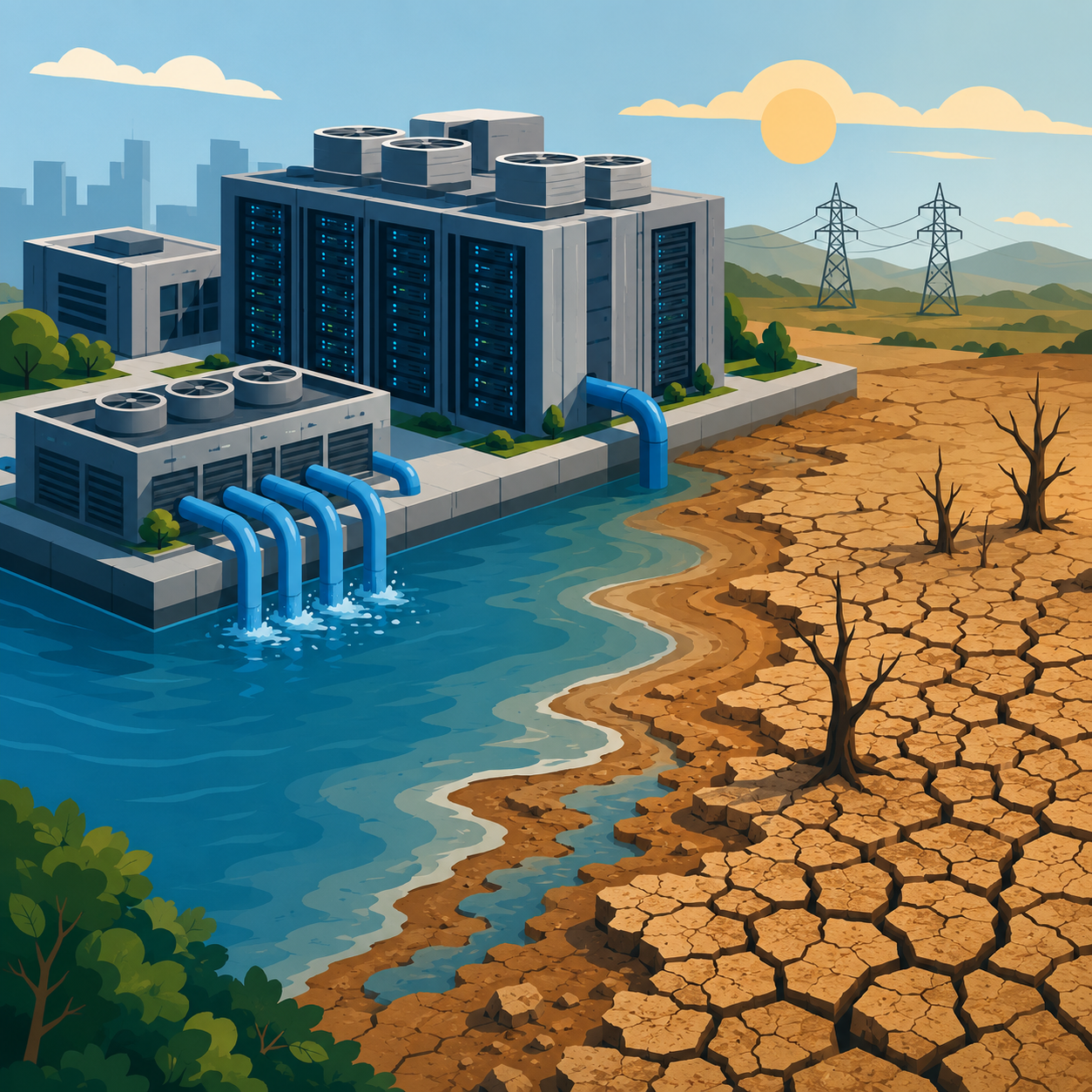
Data centre water consumption has become the resource fight the AI industry cannot advertise its way out of. Seventy-one percent of Americans now oppose building an AI data centre in their own area, more opposition than Americans register against a local nuclear power plant, according to Gallup’s first poll on the subject, released in May 2026. Half of that opposition cites resource strain directly, water and energy in roughly equal measure, and it is arriving at the exact moment the largest technology companies in the world are expanding their AI data centre footprint faster than at any point in the industry’s history.
The tech industry’s response has been a wave of efficiency announcements timed almost to the week: Amazon, Google, Nvidia and Microsoft all published updated water figures within a single month in mid-2026. Reading those announcements against the harder evidence on total consumption reveals a familiar pattern. The efficiency claims are frequently real. The overall trajectory of data centre water consumption is still climbing, because the same demand growth that data centre water figures try to explain away keeps outrunning every efficiency gain reported alongside it.
Why Data Centre Water Consumption Has Two Separate Sources
Data centre water consumption has two primary sources, and most public debate collapses them into one. The first is direct cooling. Data centres generate enormous heat from the chips and servers running AI workloads, and the most common cooling approach uses water evaporation to dissipate it, the same principle as an industrial cooling tower. A single large data centre can consume millions of litres of water a day through this process alone.
The second source is indirect: the electricity generation that powers the facility. Power plants using steam turbine technology require substantial water for their own cooling, so a data centre drawing electricity from a coal or gas-fired grid is effectively drawing on the water used to generate that power, even when no water is consumed on-site. Microsoft’s own newest AI-focused data centre designs address only the first category. As Axios reported in June 2026, these facilities continuously recirculate coolant directly to the chips and use air-cooled chillers outside the building, eliminating the need for water-consuming cooling towers during normal operation, and the company says roughly 90 percent of its current owned fleet already runs on low- or zero-water cooling systems.
The Efficiency Announcements Are Real, and the Comparisons Are Not Apples to Apples
Microsoft’s June 2026 disclosure, covered in detail by GeekWire, claims a 90 percent cut in water intensity compared with its earliest facilities in the early 2000s, down to 0.27 litres per kilowatt-hour, and says it replenished more fresh water globally in fiscal year 2025 than it withdrew across its operations, a milestone toward a 2030 water-positive goal. Amazon made a similar claim weeks earlier, saying its data centres are roughly seven times more water efficient than the industry average, though that comparison measured Amazon’s full fleet against only Google’s AI-specific facilities rather than Google’s fleet as a whole, a methodological gap that overstates the actual efficiency gap between the two companies.
Both figures can be true and still leave the underlying trend in data centre water consumption unresolved. Data centres account for only about 0.5 percent of global industrial water use today, a figure Amazon itself has cited to argue the concern is overstated relative to agriculture or manufacturing. That share is climbing from a small base at a pace efficiency improvements have not offset, which is precisely why local opposition is intensifying even as corporate sustainability reports describe genuine technical progress.
Why Comparing Companies on Data Centre Water Consumption Is Harder Than It Looks
Even the companies publishing the most detailed figures acknowledge that comparing data centre water consumption across the industry is not straightforward. Microsoft’s own reporting notes that its liters-per-kilowatt-hour figure applies only to facilities it owns outright, while Amazon’s includes both owned and leased sites, a structural difference that makes even a simple ranking exercise unreliable without reading well past the headline number. Google, for its part, does not publish a single global water use effectiveness figure at all, which is why third-party analysts trying to build a standardised comparison across hyperscalers have had to estimate Google’s figure from industry averages rather than from a disclosed company total.
That measurement gap matters because it shapes public perception of data centre water consumption in a way that favours whichever company frames its own numbers most favourably. A ranking built on self-reported, differently scoped figures will always tend to flatter the company that chose the most generous boundary for its own disclosure, and none of the current voluntary reporting frameworks require companies to use a common standard.
Where Data Centre Water Consumption Growth Is Actually Concentrated
The geography of data centre water consumption is making the underlying tension worse, not better. New construction is concentrated disproportionately in the Southwest, Southeast and interior West, regions already under water stress, because land and electricity costs are lower there than in wetter climates. Google’s Council Bluffs, Iowa facility consumed 1.3 billion gallons of potable water in 2024 alone, drawn from aquifer systems that also serve local agriculture in a state that has faced repeated drought conditions.
That siting pattern is the direct driver of the backlash the Gallup poll documents. Data centre construction hit roughly 46.5 billion dollars in project starts through the first quarter of 2026 alone, against a comparable 2025 total of just 7.3 billion dollars, and industry forecasters expect full-year 2026 spending to reach approximately 121 billion dollars if current momentum holds. Communities in Seattle, upstate New York, New Mexico, Ohio and Indiana have all pursued permitting fights, construction moratoriums or public campaigns against specific projects in 2026, and water availability is now a named factor in nearly every one of those disputes, alongside grid capacity and noise.
The Rebound Effect That Keeps Water Efficiency From Translating to Lower Total Use
The pattern playing out in data centre water consumption mirrors a dynamic LiveAIWire has tracked closely in AI’s energy footprint more broadly. LiveAIWire’s coverage of the green AI myth and why efficiency gains keep getting consumed by demand growth found that a UN University report projected AI-related water consumption could reach 9.3 trillion litres by 2030, alongside 945 terawatt-hours of electricity demand, even as individual efficiency metrics, like Google’s reported 33-fold cut in energy per prompt, are independently verified and genuinely accurate.
The mechanism is the same one economist William Stanley Jevons identified in 19th-century steam engines: making a technology cheaper to run does not shrink total consumption, it expands the range of tasks people are willing to run it for. Applied to water specifically, that means every efficiency improvement in cooling technology makes it commercially viable to build more data centres in more places, including the water-stressed regions where construction is currently concentrated precisely because efficiency gains have made those sites financially attractive despite the added water risk. Efficiency and expansion are not competing forces in this industry. They are the same force, pointed in the direction that keeps total consumption rising.
The Disclosure Gap Regulators and Researchers Are Still Fighting
The most persistent obstacle to assessing data centre water consumption accurately is that most of the relevant figures are simply not published at the level of detail that would let anyone verify a company’s claims independently. Technology companies report aggregate water figures in annual sustainability disclosures, but rarely break those numbers down by specific facility, by workload type, or by AI versus non-AI infrastructure.
That opacity has real consequences beyond academic disagreement. LiveAIWire’s related coverage of machine greenwashing in the AI industry found that companies routinely present a specific, audited efficiency figure in a way that implies a broader claim about total environmental improvement, a gap that survives precisely because the underlying facility-level data needed to check the broader claim is not disclosed. Communities near new data centre construction, and the regulators meant to represent their interests, are making decisions about water allocation with less specific information than the companies building the facilities themselves possess.
What the Public Backlash Is Already Changing
The Gallup findings are not an abstract sentiment reading. They describe a governance problem the industry is already responding to, unevenly. Microsoft launched a Community-First AI Infrastructure initiative in early 2026, pledging to cover local electricity infrastructure costs and forgo local tax breaks specifically to blunt the “not in my backyard” reaction Gallup measured, and separately committed to replenishing more water than it consumes in each individual district where it operates an AI data centre, a stricter local standard than its global water-positive target implies.
Nvidia announced in June 2026 that its newest AI systems could eliminate the need for mechanical chilling equipment entirely, which, if it scales, would represent the most significant architectural shift in data centre cooling since evaporative towers were first adopted.
None of that changes the more fundamental point sitting underneath the backlash. LiveAIWire’s coverage of how AI is simultaneously accelerating renewable energy deployment found the same industry driving both sides of the environmental ledger at once, real grid optimisation benefits on one side of the balance sheet and real, unresolved resource consumption on the other, often inside the same company’s own disclosures. Efficiency gains and expansion gains are being reported as though they settle the question independently, when they are, in fact, the same story told from two different angles.
What This Means for Anyone Living Near a Proposed Data Centre
For communities facing a proposed data centre, the practical lesson from the last year of disclosures is that a company’s headline efficiency statistic is not a reliable proxy for what that specific facility will actually draw from the local water supply. Asking for facility-level water use projections, the source of that water, and the specific replenishment commitment tied to that district, rather than the company’s global average, is the only way to evaluate a proposal on terms that match how the technology actually behaves.
LiveAIWire’s coverage of AI’s role in precision agriculture found the same resource-competition dynamic playing out one sector over, where AI tools marketed as helping farmers manage water more efficiently sit uneasily alongside the water draw of the data centres running those same tools.
The regulatory frameworks that govern industrial water use in most US states were not designed with AI-scale data centre water consumption in mind, and local water authorities frequently lack the technical capacity to evaluate the long-term hydrological consequences of a large new industrial water user moving into a stressed watershed. Until disclosure requirements catch up to the scale of the industry they are meant to oversee, the Gallup poll’s 71 percent opposition figure is likely to keep climbing rather than settling, because it reflects a genuine information gap between what companies say about data centre water consumption and what communities can actually verify about the water arriving at the tap next door.
About the Author
Stuart Kerr is Technology Correspondent at LiveAIWire, covering artificial intelligence, emerging technology, and their impact on business, society, and everyday life. LiveAIWire publishes original AI journalism every weekday at liveaiwire.com.