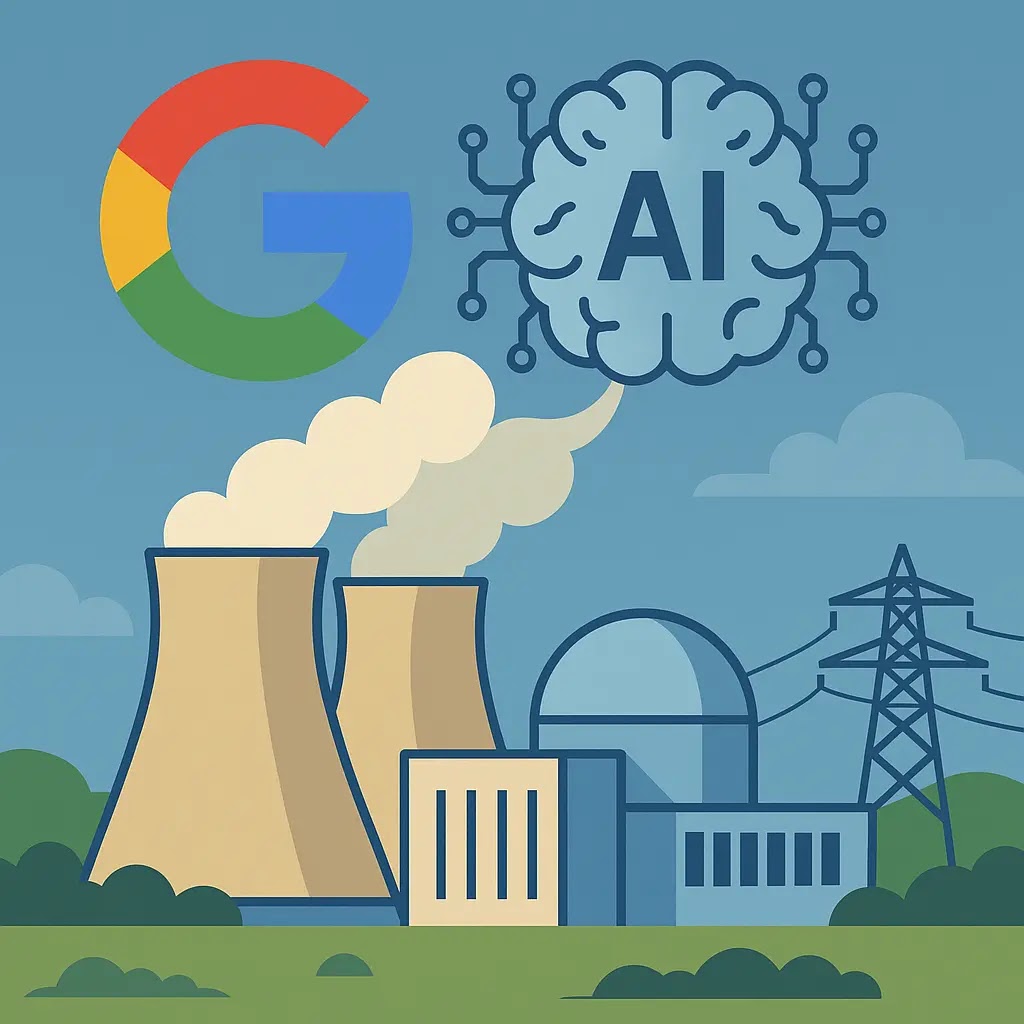
The Google AI nuclear power bet moved from paper to concrete this spring. On 17 April 2026, Kairos Power broke ground on Hermes 2 in Oak Ridge, Tennessee, the first commercial-scale reactor built under the pair’s 2024 agreement to supply Google’s data centres with up to 500 megawatts of advanced nuclear energy by 2035. The reactor design has also become the first non-light-water reactor ever approved for construction by the US Nuclear Regulatory Commission, a milestone that had eluded the American nuclear industry for decades.
The timing matters because the gap between announcement and delivery has always been the weak point in this story. When Google first signed with Kairos in October 2024, the first working reactor was not expected until 2030, leaving years in which the company’s AI infrastructure would keep running on whatever power the grid could supply. Eighteen months on, steel is going into the ground in Tennessee, and that changes the conversation from intention to execution.
Why the Google AI Nuclear Power Bet Is Now Under Construction
Kairos Power’s Hermes 1 demonstration unit, a low-power test reactor also sited in Oak Ridge, is already under construction alongside Hermes 2. Both use a molten fluoride salt cooling system paired with TRISO fuel, a ceramic-coated particle fuel form that Kairos and independent nuclear engineers describe as inherently safer than conventional water-cooled designs because it can shed heat passively if power is lost. The US Department of Energy agreed in January 2026 to supply the high-assay low-enriched uranium, known as HALEU, that Hermes needs to run, removing one of the supply-chain bottlenecks that has slowed nearly every advanced reactor project in the country.
Hermes 2 is designed to reach commercial power output before the end of the decade, and Kairos has said the plant will demonstrate the manufacturing and construction techniques it plans to repeat at scale for Google’s full 500-megawatt commitment. That repeatability is the entire point of the deal. Google is not simply buying electricity from one plant; it is funding the industrial learning curve that Kairos needs to build reactors faster and cheaper each time, a model closer to serial manufacturing than traditional one-off nuclear construction.
Google Is Hedging Across Nuclear and Fusion, Not Just Betting on One Reactor
The Kairos relationship is no longer Google’s only advanced energy bet. The company has separately signed a power purchase agreement with Commonwealth Fusion Systems for output from its planned ARC fusion plant, and expanded a renewable-and-firm-power partnership with ENGIE, spreading its exposure across several unproven but promising generation technologies rather than concentrating risk on one supplier. Total capital committed to Google’s data centre and AI infrastructure build, including energy procurement, is now running well above $170 billion for 2026 alone, underscoring how central power sourcing has become to the company’s AI infrastructure spending strategy.
That diversification reflects a lesson the industry has learned the hard way over the past two years: the AI compute build-out can now be financed and staffed faster than new generation capacity can be sited, permitted and connected to the grid. Chips and data halls can be ordered and installed in months. Power plants, nuclear or otherwise, take years even when everything goes right, which is precisely why Google is placing several parallel bets rather than waiting on a single technology to mature.
The Case Against Waiting for the Grid
Solar and wind capacity has expanded faster than almost any forecast predicted, but neither can guarantee the round-the-clock baseload that a data centre running frontier AI models needs. Battery storage narrows that gap but has not closed it at the scale hyperscalers require. Nuclear’s appeal to Google is specifically that a reactor running at full output delivers steady power regardless of weather, which is why the company has framed advanced nuclear as a complement to renewables rather than a replacement for them.
That framing has not silenced sceptics. Reactor waste management, decommissioning costs, and community consent near proposed sites remain unresolved questions that cloud providers have historically left to utilities and regulators. The wider environmental reckoning around AI’s power and water demands, which LiveAIWire has tracked in detail in its analysis of AI’s carbon footprint, means Google’s nuclear commitments will be judged against the same disclosure standards now being applied to every other part of its energy portfolio.
Federal policy has moved in the same direction. The Department of Energy’s own commercial liftoff roadmap for advanced nuclear has repeatedly pointed to early demand commitments from large power buyers, exactly the kind of anchor customer role Google is now playing, as the missing ingredient that could bring reactor construction costs down through repetition rather than one-off engineering. Washington’s willingness to supply HALEU fuel and streamline permitting for Hermes suggests the government sees Google’s order book as leverage for reviving a domestic nuclear supply chain that had shrunk to near nothing over the past three decades, not just a private commercial transaction between two companies.
Rivals Are Watching Oak Ridge Closely
Google was the first major cloud provider to commit to advanced nuclear power for AI data centres, and its rivals have not stood still since. Amazon has signed its own agreements with X-energy and Talen Energy to secure small modular reactor capacity near its Pennsylvania data centre campus, while Microsoft has taken a different route, financing the restart of a retired conventional reactor unit at Three Mile Island to guarantee firm, carbon-free power to its own facilities. Each approach reflects a similar conclusion reached by different means: renewables alone cannot meet the round-the-clock demand of frontier AI training and inference, and every major cloud provider now needs a nuclear line item somewhere on its energy balance sheet.
What sets the Google AI nuclear power approach apart is its choice of an unproven reactor design over a conventional one. Amazon and Microsoft have leaned more heavily on established light-water reactor technology, either new small modular designs or restarted legacy plants, which reduces licensing risk but caps the efficiency and siting flexibility that molten-salt designs like Kairos’s promise. If Hermes 2 performs as modelled, Google’s willingness to back a genuinely novel reactor chemistry could look like the more forward-looking bet. If it does not, the company will have spent years and considerable capital on a technology that never left the demonstration phase.
What Comes Next
Hermes 1 is expected to reach criticality before Hermes 2 begins commercial operation, giving Kairos and Google an early read on whether the underlying reactor physics performs as modelled at this scale. If it does, the same design is meant to be replicated at additional sites through 2035 to reach the full 500-megawatt commitment. Communities near those future sites, and the strained grids already absorbing new AI data centre demand elsewhere in the country, will be watching Oak Ridge as closely as Google’s shareholders are.
For now, the groundbreaking in Tennessee is the clearest signal yet that Google’s AI nuclear power strategy has moved past the announcement stage. Whether it can deliver reliable, licensed nuclear power on anything like its original timeline is the test that begins now, not in 2030.
Reporting drawn from Kairos Power’s own project updates and independent coverage of the Hermes 2 groundbreaking, including Google’s original announcement of the Kairos partnership and Interesting Engineering’s report on the NRC’s first non-light-water reactor approval.
Stuart Kerr is Technology Correspondent at LiveAIWire, covering artificial intelligence, energy, and the infrastructure decisions that shape how AI develops at scale.