
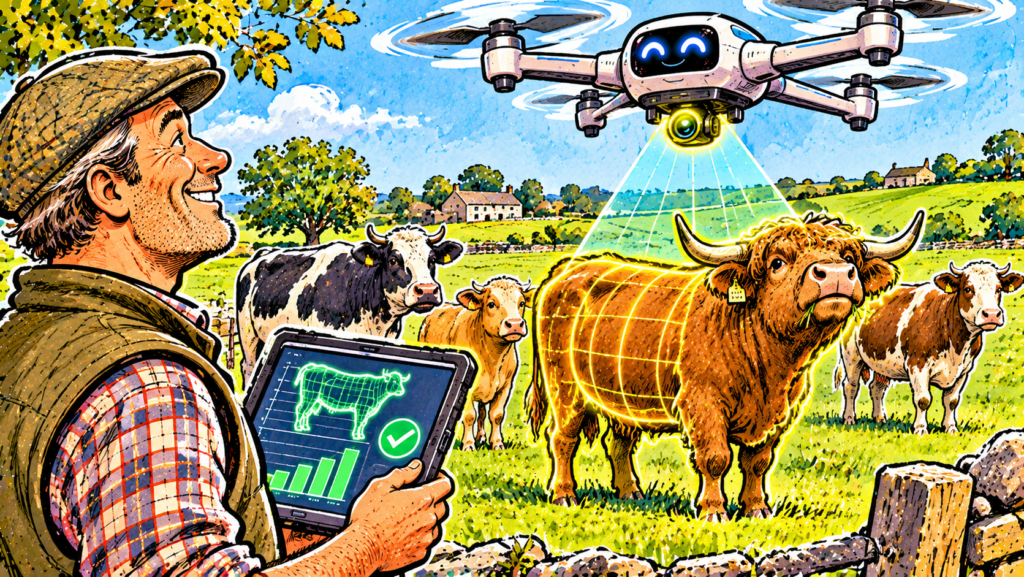
AI cattle monitoring could make it possible to gather useful information about a herd without repeatedly moving animals through a weighing facility. Researchers in Brazil have used photographs taken from a drone to track changes in the body shape of beef cattle over time. The method identified distinct phases of development in a commercial feedlot, although it did not directly determine the weight of each individual animal.
The prospect of observing a herd from above has a practical attraction. Weighing cattle involves more than finding a suitable set of scales. Animals must be moved and handled, staff must be available and the process has to be conducted safely. A method that can provide useful intermediate observations without that disruption could give farmers a more complete picture of how their cattle are developing.
What AI cattle monitoring measures from the air
A research paper published in Computers and Electronics in Agriculture in April 2026 describes the approach developed by Jianglong Yan and colleagues, including researchers associated with Embrapa, Brazil's agricultural research organisation. The team used high-resolution aerial photographs and computer vision to identify cattle and estimate the outlines of their bodies.
The approach does not simply calculate an animal's mass from an image. It uses measurements of body proportions, particularly the relationship between the width and length of an animal, to follow changes in the herd as the cattle develop. That relationship can provide information even where the absolute size of an animal in the image varies because of the camera's position.
A description of the field experiment supplied by FAPESP, the São Paulo Research Foundation, reports that the trial followed 110 Nellore cattle over 112 days at a commercial ranch in Mato Grosso do Sul. The observations revealed an initial period of relatively slow development, a period of faster development and a later slowing of growth.
Those are findings at the level of the observed population. They should not be interpreted as a demonstration that a drone can reliably replace a scale wherever the exact weight of an individual animal is required. The distinction between a proxy measurement and a direct measurement is central to understanding the study's contribution.
Why a cow has to be in the right position
A bird's-eye view might appear to provide an ideal opportunity to measure an animal. But cattle do not arrange themselves for a photograph. They may lie down, curve their bodies, stand close together or move around the enclosure. The angle at which an animal is observed can also distort its apparent proportions.
Instead of attempting to extract a measurement from every animal in every photograph, the researchers devised a way of selecting observations suitable for the analysis. The software detects the animals and identifies their visible outlines. It then filters the results so that measurements are drawn from animals standing in a suitable position, rather than from those whose posture would make a comparison unreliable.
That choice illustrates an important principle of AI-assisted measurement. A larger quantity of data is not necessarily a better source of evidence. If unsuitable observations are combined with useful ones, the resulting average can become less reliable. Establishing a method for excluding measurements that do not satisfy the necessary conditions may be as important as improving the image-recognition system itself.
There is a limitation to consider as well. Animals excluded from an observation may not be representative of the animals included. If cattle in a particular condition tend to rest more frequently or adopt a different posture, a selection process based on standing animals could miss some of the information a farmer would like to know. Repeated observations and comparison with independent measures would help establish when that matters.
Related research into using AI and satellite images to count wildebeest demonstrates the appeal of observing groups of animals from above. Counting a population, however, differs from estimating how its members are developing. Each application requires an appropriate relationship between what is visible in the image and what the observer is trying to establish.
What a growth curve can tell a farmer
A single observation of the average proportions of a group of animals provides a snapshot. A series of comparable observations provides an opportunity to identify a trend. The Brazilian team's experiment was designed around that second objective, following the cattle through the production cycle rather than attempting to learn everything about them from one flight.
There are several reasons why a producer might want a more detailed understanding of a herd's development. A change in growth may lead to questions about feeding arrangements or other aspects of management. A period of slower development could prompt closer examination of the animals or a review of the economic assumptions behind a production plan. The body-shape measurements provide a potential source of information for those decisions.
The study used a mathematical description of how growth changes over time. This helps distinguish different phases rather than assuming that cattle will continue to develop at a constant rate. In a commercial setting, identifying when the rate is slowing could be useful for planning, provided that the measurements are sufficiently reliable and are interpreted in conjunction with other relevant information.
It would be misleading to suggest that a farmer should automatically change feeding or marketing decisions whenever the software identifies a change in body shape. Seasonal conditions, the composition of a group and other circumstances can affect the interpretation. A system that highlights a development requiring attention can be valuable without having the authority to determine the response.
Reducing disturbance is a separate objective
One of the attractions of the aerial method is the opportunity to observe cattle with less physical intervention. When animals are moved through a handling facility, their ordinary activities are interrupted. The process requires preparation and appropriate equipment, and any unnecessary handling places an additional demand on the people responsible for their care.
The use of a drone introduces its own considerations. The research team examined flight conditions in which the cattle did not appear to react to the aircraft. That observation is encouraging for the particular conditions tested, but it is not a guarantee that every herd will respond in the same way to every drone. The characteristics of the aircraft, its flight pattern and the surroundings can all affect the suitability of the operation.
A practical deployment would therefore need to establish conditions under which the animals can be observed without unnecessary disturbance. The equipment also has to be operated by people with suitable knowledge of the location and applicable flight rules. Gathering useful information about an animal should not come at the expense of introducing a new hazard or source of stress.
The aim would be to replace some observations that require handling with a less disruptive alternative where the alternative is adequate. Other tasks may still require the animal to be examined directly. An image can provide useful information about visible characteristics, but cannot capture everything that a person can establish through a proper physical examination.
The challenge of moving between farms
A system tested with one type of cattle and one production arrangement may need adjustments before it can be used in another setting. Animals with different body shapes can produce different image measurements. The environment also matters: closely spaced animals, uneven ground, vegetation and shadows can affect the quality of aerial observations.
A producer considering the approach would want to know whether the software can distinguish a genuine change in development from a change in photographic conditions. Comparing observations collected in a consistent manner is one way to reduce that risk. Testing the results against other evidence from the farm would also help determine which decisions the system can support reliably.
The cost of an aerial observation includes more than the aircraft itself. Staff may need time to plan and conduct flights, examine the output and deal with images that cannot be used. Weather may affect the availability of suitable opportunities. The benefits have to be considered in relation to those practical requirements rather than inferred solely from the performance of the image-recognition model.
Similar considerations arise in the use of agricultural robots on difficult terrain. A technology can demonstrate an attractive ability in controlled or carefully selected conditions without establishing that every farm can adopt it economically. The physical environment is a substantial part of the engineering problem.
Farmers need measurements they can trust
For livestock monitoring, the ability to see how an estimate has been produced can be particularly important. If an average changes unexpectedly, a farmer should be able to examine the observations behind it. Were the animals suitably positioned? Was the set of usable photographs sufficiently representative? Did some aspect of the collection process differ from the previous observation?
An interface that communicates those details could make the measurements more useful than a system that simply displays a confident-looking growth curve. Farmers already have knowledge of their animals and the conditions in which they are kept. Combining that knowledge with a consistent additional source of information is a more promising direction than assuming that an automated measurement should always take precedence.
The same principle underpins other developments in AI-assisted agricultural production. Precision agriculture is most useful when its measurements are connected to practical decisions, including the circumstances in which an established method is still required. An inexpensive observation that cannot answer the relevant question is not necessarily a worthwhile substitute for a more demanding one.
The Brazilian research provides an example of what might become possible between conventional weighing occasions. Rather than making a farmer wait for the next opportunity to move the animals through a handling facility, aerial observations could help identify how the group is changing. The next challenge is to establish how consistently that information can guide decisions in different herds and environments. If it can, the most valuable outcome may be better-informed care and management with fewer occasions on which animals need to be disturbed solely to gather information.
About the Author
Stuart Kerr is Technology Correspondent at LiveAIWire, covering artificial intelligence, cybersecurity and the social impact of emerging technology. LiveAIWire is an independent, human-led technology publication using AI-assisted research, editorial production and original AI-assisted editorial illustrations under his direction.