
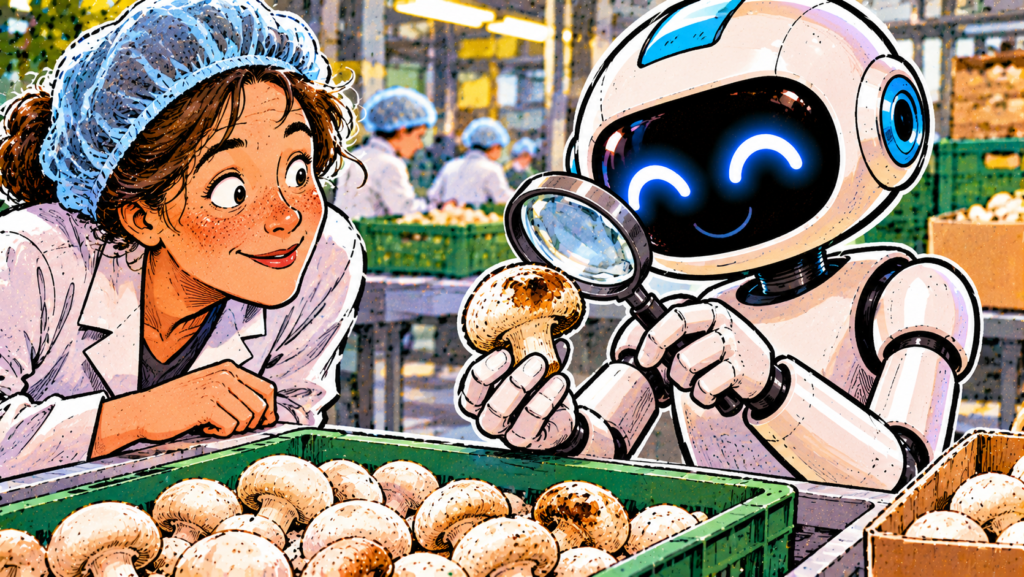
AI mushroom damage detection could give food producers an additional way to investigate deterioration that is difficult to assess with an ordinary photograph. Researchers at Penn State have used a special camera and a new artificial intelligence model to distinguish types of damage deliberately introduced to white button mushrooms. The experiment was conducted under controlled conditions, rather than during the routine operation of a commercial farm or food processing facility.
The choice of mushroom makes a complicated computing problem surprisingly easy to understand. Fresh produce changes after harvesting, and the effects of handling, temperature and other conditions can affect its quality. A method for observing those changes without destroying the product being examined could help producers decide when a problem deserves closer attention.
What the AI mushroom damage detection experiment involved
In its account of the research into crop-stress detection, Penn State describes how scientists exposed mushrooms to different controlled treatments. These included heat, microwave exposure and mechanical damage intended to represent different forms of deterioration. Untreated mushrooms were included for comparison.
The team recorded information using hyperspectral imaging, a technique that divides light into many narrow bands instead of representing the scene using only the familiar red, green and blue components of an ordinary colour photograph. Measurements were collected in 204 bands at eight points in time. The researchers then tested a model designed to examine that large amount of information efficiently.
According to the research description provided by Penn State and published by Phys.org, the model achieved average classification accuracy of 94.47 per cent in the experiment. It also required approximately one tenth of the computational operations used by the comparison image-analysis model. The findings were published in Scientific Reports in 2026.
These results do not establish that the system can reliably detect all kinds of spoilage, contamination or disease in food. They describe the performance of a particular experimental model on mushrooms subjected to particular treatments. The authors identify further testing under real agricultural conditions as a necessary next step.
A camera that records more than an ordinary photograph
When someone looks at a mushroom, they can observe changes such as visible discolouration, differences in shape and obvious signs of damage. A camera designed to record a much wider range of information about reflected light can provide other measurements. Materials and biological tissues may reflect different wavelengths in different ways, including when changes are not readily apparent in their ordinary visual appearance.
The challenge is that such a camera produces a more complicated record than a conventional photograph. Each point in an image may be associated with many measurements. If the aim is also to follow how the object changes, the system needs to compare those measurements with observations made at other times. That becomes demanding even before the computer begins to distinguish one type of deterioration from another.
This is why efficient analysis is important. A producer may want to examine batches of goods or collect information repeatedly rather than take a single detailed photograph for a research project. The time, equipment and energy required to process the observations will affect whether the resulting information is available when it can still support a useful decision.
A model that can make better use of the available computing resources may therefore make a previously inconvenient observation more practical. The improvement is distinct from the sensitivity of the camera. A better algorithm can help interpret the measurements, but cannot create accurate information that the equipment did not record in the first place.
Looking at colour, shape and change together
The Penn State team designed its system around three complementary types of information. It examines the way light is reflected, the distribution of relevant characteristics across the image and the way the recorded characteristics change over time. Each provides a different perspective on the object being examined.
A change in a small area of a mushroom might be particularly relevant when investigating physical damage. A change that develops over successive observations may provide a different clue. An unusual pattern of reflected light may provide information that cannot be obtained from the outline of the mushroom alone. Combining observations gives the model an opportunity to distinguish patterns that would be difficult to interpret from any single type of information.
The researchers also evaluated the contribution of the separate parts of the model. Their findings support the use of the combined information in this experiment. The wider engineering question is whether a similar arrangement can distinguish relevant changes in other products, under conditions in which both the objects and the background are less predictable.
There is a parallel with AI-assisted detection of food fraud using an electronic nose. In that application, measurements of characteristics beyond ordinary visual appearance are used to investigate the identity or quality of a product. The broader principle is that AI can be useful when paired with a suitable sensing method, rather than being expected to infer an object's condition from a conventional photograph alone.
How the technology could help with food quality
Consider a processing facility that wants to investigate whether a particular stage of handling is affecting the condition of fresh produce. An observation before that stage and a comparable observation afterwards could help identify when visible or measurable changes develop. A method that does not require the sample to be destroyed may also allow the same items to be examined later.
That kind of information could help staff distinguish where further investigation is necessary. If unusual measurements repeatedly appear in goods passing through a particular part of the operation, it might prompt a review of equipment, handling practices or the surrounding conditions. If the measurements remain consistent, staff may have greater confidence that the particular process is not introducing the change they are investigating.
This would be an additional source of evidence, rather than a self-contained explanation of what has happened. The experimental treatments were known to the researchers. In a commercial environment, a product may be affected by several factors simultaneously, including circumstances that were not represented in the training data. A system needs to communicate when an observation does not fit the categories it has learned to recognise.
Food producers also need to distinguish quality from safety. A product that is visually unattractive may still be suitable for some uses, while a product with an apparently normal appearance may have a problem that the imaging system cannot identify. The mushroom experiment was not a demonstration that a camera can replace established food-safety checks. Using it for that purpose without appropriate separate validation would extend the evidence well beyond what the researchers tested.
Why the speed of a decision matters
In an agricultural setting, useful information can become less valuable when it arrives too late. If a batch of produce has already moved to a different location, identifying an unusual characteristic may not give the original operator an opportunity to examine the conditions under which it developed. A lengthy analysis may be appropriate for a scientific investigation without being suitable for an operational decision.
The reduction in computational requirements is relevant for that reason. A system that makes fewer demands on its computing equipment may be easier to deploy near the place where observations are collected. But the reported reduction in operations should not be interpreted as a measured reduction in total operating cost, energy consumption or processing time across a commercial installation. Those outcomes depend on the hardware, software and wider process used to obtain and analyse the images.
The ability to act on an observation is equally important. A grower may need to inspect equipment, examine a sample or consult a specialist before changing a process. An alert should provide enough information to make that investigation manageable. Simply reporting that a mushroom appears abnormal may be less useful than identifying the observations that led the system to highlight it.
Other work on AI in food production and distribution raises a related issue. Technology creates value when information travels to the people who can act on it at the appropriate moment. An accurate measurement stored in a system that production staff cannot easily use may contribute little to the decision it was intended to support.
From controlled damage to the unpredictability of a farm
The experiment used controlled interventions so the researchers could compare the resulting measurements with the known treatment. That is an appropriate way to investigate whether the new method can distinguish relevant changes. The conditions in an operating agricultural business are likely to be less orderly, however, and a system may encounter combinations of factors that were not deliberately created in the original experiment.
The next stage of development will need to consider different products, environmental conditions and ways of collecting observations. A model developed with white button mushrooms cannot be assumed to interpret an unfamiliar crop correctly without further research. Differences in structure, appearance and development may affect which measurements are informative.
The equipment will also have to be considered. A camera used in a greenhouse, a food processing facility or on a vehicle may collect information under different lighting and operating conditions. A method that produces reliable results in one of those settings may require changes before it can be used in another. These challenges are practical as well as scientific.
The distinction is familiar in efforts to use AI to map crops on small farms from satellite observations. An algorithm's performance depends partly on the information available to it and the conditions under which that information was collected. The value of the observation needs to be established for the particular decisions that agricultural workers want to make.
Penn State's mushroom experiment is an interesting contribution because it tackles both the collection of richer information and the difficulty of analysing it. More detailed sensing alone may make an agricultural system cumbersome. Faster computation alone may leave the system analysing information that is insufficient to answer the relevant question. Combining the two could eventually give producers a practical way to investigate quality changes earlier. The important evidence will be whether that ability survives outside the controlled experiment and helps growers make better decisions without introducing unnecessary costs or replacing checks that remain essential.
About the Author
Stuart Kerr is Technology Correspondent at LiveAIWire, covering artificial intelligence, cybersecurity and the social impact of emerging technology. LiveAIWire is an independent, human-led technology publication using AI-assisted research, editorial production and original AI-assisted editorial illustrations under his direction.