
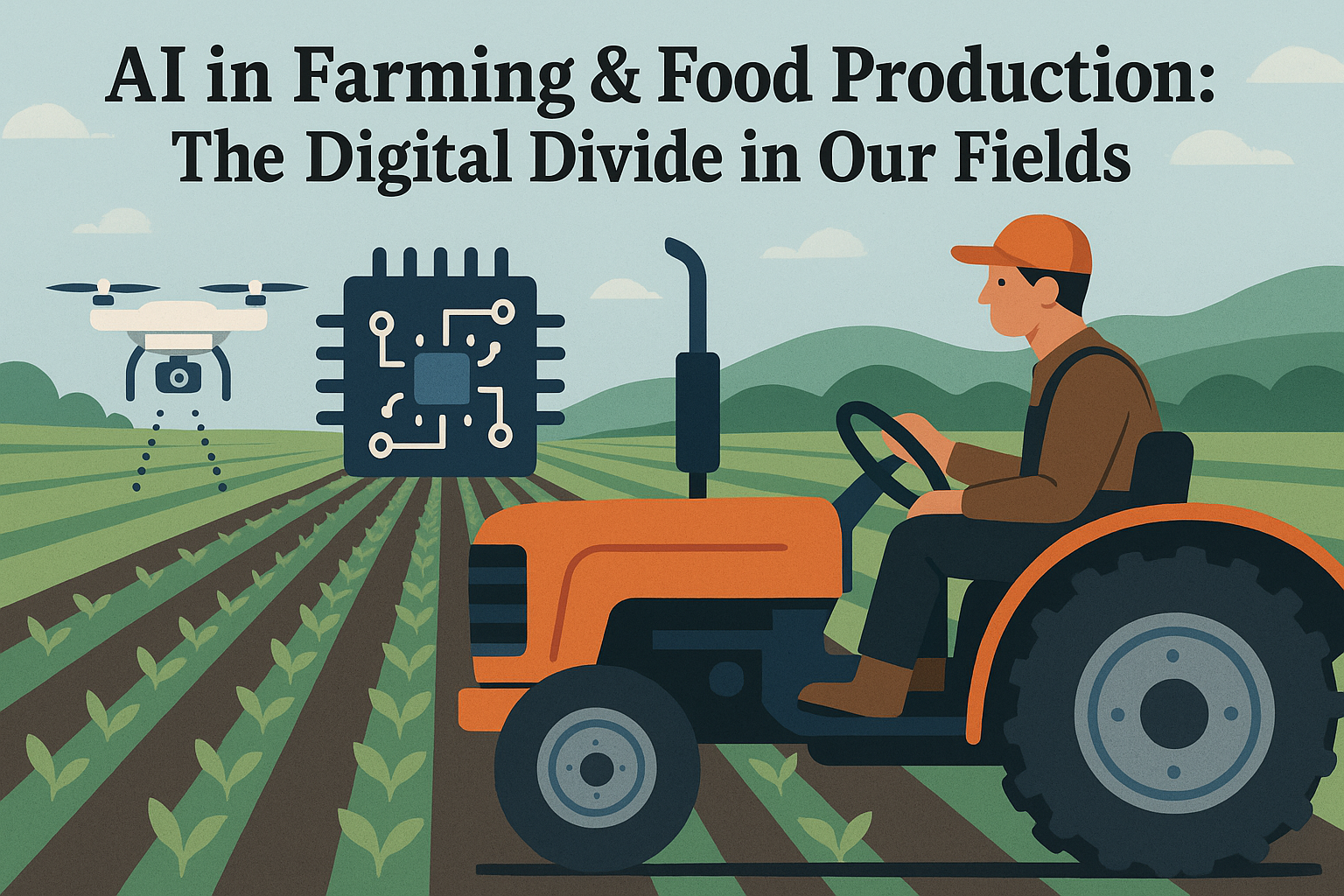
A
wheat farm in Lincolnshire that used to employ six people now runs primarily
with two, supported by AI systems that monitor soil conditions across
hundreds of acres, predict disease outbreaks before visible symptoms appear,
and direct autonomous tractors that plant, spray, and harvest with precision
that human operators cannot match. This is not a vision of future farming; it
is the present, in a county where agricultural AI adoption has accelerated
faster than almost anywhere else in the UK. The question facing the global
food system is not whether AI will transform farming, but whether that
transformation will feed the world more equitably or simply extract more
value from land while displacing the people who work it.
Agriculture faces a convergence of pressures that make
technological transformation both urgent and complex. Climate change is
disrupting traditional growing seasons and increasing the frequency of
extreme weather events. Population growth is increasing demand for food
production. Water scarcity is constraining irrigation in major agricultural
regions. Labour costs in wealthy countries are rising as agricultural
workforces age and younger generations avoid farm work. AI offers tools to address
several of these pressures simultaneously, and the evidence for its
effectiveness in specific applications is increasingly
strong.
Precision Agriculture and Crop Monitoring
The most widely deployed AI in farming is precision agriculture
systems that use satellite and drone imagery, soil sensors, and weather data
to provide crop-specific management recommendations at field or even
sub-field resolution. Instead of applying fertiliser, pesticide, or
irrigation uniformly across an entire field, these systems identify which
areas need treatment and direct resources precisely where they are needed.
The efficiency gains are significant: research published by Wageningen
University consistently finds that precision agriculture reduces input costs
by 15 to 30 percent while maintaining or improving yields.
AI-powered disease and pest detection is one of the most
commercially active areas of agricultural AI. Computer vision systems trained
on images of diseased crops can identify early-stage infections that human
scouts would miss, allowing treatment before significant yield loss occurs.
Apps including Plantix and Cropio allow individual farmers to photograph
plants and receive AI-based diagnostic assessments, extending expert
knowledge to smallholders who previously had no access to it. The UN Food and Agriculture
Organization has supported the deployment of AI disease detection
tools in several African and Asian countries, with early results suggesting
meaningful reductions in crop losses from preventable
diseases.
Autonomous Machinery
Autonomous and semi-autonomous farm machinery is moving from
demonstration projects to commercial deployment. Tractors equipped with GPS
guidance and computer vision can operate with millimetre precision, reducing
overlap and missed areas in field operations. Fully autonomous smaller robots
for tasks including weeding, fruit picking, and crop scouting are being
deployed by early adopters, though labour cost thresholds vary considerably
by crop and region.
The labour implications of autonomous farm machinery are complex.
In high-wage agricultural economies including the UK, Australia, and the
Netherlands, labour shortages are already constraining food production and
driving automation adoption. In labour-surplus agricultural economies across
Asia, Africa, and Latin America, autonomous machinery displaces workers who
have limited alternative employment options. The agricultural AI transition
is not uniform; its social consequences depend heavily on the economic
context in which it is deployed. Policies that condition access to
agricultural AI funding on compliance with fair labour standards,
environmental requirements, and smallholder access provisions could
significantly shape whether the technology serves broad food security or
narrow commercial objectives. Several European countries are piloting such
conditionality frameworks, and their outcomes will be informative for the
wider international debate about how to govern the agricultural AI transition
equitably. in which it is deployed, and the same technology that solves a
labour shortage in one context creates unemployment in
another.
Livestock Monitoring and Animal Welfare
AI is also transforming livestock farming. Sensor systems that
monitor individual animals for health indicators, including temperature,
movement, feeding behaviour, and vocalisation patterns, can detect illness at
early stages when treatment is most effective and least expensive. Computer
vision systems in dairy operations identify lameness and other welfare issues
that stockworkers may miss in large herds. AI heat detection systems improve
reproductive efficiency, reducing the number of animals needed to maintain a
given production level.
The animal welfare implications are genuinely positive in several
respects. Earlier disease detection means less suffering and less antibiotic
use. More precise feeding systems reduce overfeeding and the associated
health problems. However, some welfare advocates raise concerns that
AI-enabled intensification of livestock production, by making very large
operations more manageable, could accelerate the trend toward factory farming
at scales that create new welfare challenges.
What This Means for You
The food on your plate is increasingly produced with AI
involvement, whether or not the packaging mentions it. From the satellite
imagery that monitors crop health to the automated systems that sort and
grade produce before it reaches the supermarket, AI is embedded throughout
the agricultural supply chain. The prices you pay for food will increasingly
reflect the cost structures of AI-enabled farming, which means lower input
costs but potentially higher capital costs concentrated among larger
operators.
The broader food security implications of AI in agriculture depend
on whether the technology is accessible to smallholder farmers in
food-insecure regions or concentrated among large commercial operators in
wealthy countries. The gap between these scenarios is not technologically
determined; it is a function of investment priorities, intellectual property
frameworks, and development policy choices that are currently being made. The
climate resilience dimension of agricultural AI is increasingly important as
extreme weather events become more frequent and more damaging to food production.
AI early warning systems that alert farmers to incoming frost, drought, or
flood conditions with enough advance notice to take protective action
represent a potentially significant adaptation tool. The European Union’s
Farm to Fork strategy, which aims to make the EU food system more sustainable
and resilient, explicitly incorporates AI and digital agriculture as key
enabling technologies, with funding streams for AI adoption by smallholder
farmers that are intended to prevent the benefits of agricultural AI
concentrating exclusively among large commercial operators. Whether these
funding mechanisms succeed in democratising access to agricultural AI across
the diverse range of EU farming contexts will be an important indicator of
whether AI in agriculture serves broad food security goals or primarily
commercial ones. For related analysis, see our coverage of AI
in climate disaster response and the FAO’s digital
agriculture programme.
The interaction between AI agricultural tools and biodiversity
conservation is also an emerging concern. Precision agriculture optimised for
yield maximisation can, if applied without ecological constraints, accelerate
the consolidation of farmland into large monocultures that are efficient by
narrow productivity metrics but damaging to the biodiversity that underpins
long-term agricultural resilience. AI tools designed to incorporate
biodiversity and ecosystem service values into farm management
recommendations, rather than optimising solely for yield and input
efficiency, exist but are not yet mainstream. Embedding ecological
intelligence into agricultural AI is a design choice that researchers and
policymakers are increasingly advocating.
For related analysis of AI in supply chains and food systems, see
coverage of AI
in supply chain management and AI
and the future of food production.
About the Author
Stuart Kerr is a technology correspondent at LiveAIWire, covering
artificial intelligence, digital innovation, and the social impact of
emerging technologies. Follow LiveAIWire for daily analysis at liveaiwire.com.