
DeepMind’s
GraphCast weather forecasting model outperformed the European Centre for
Medium-Range Weather Forecasts’ operational system on nearly all standard
verification metrics when tested in 2023, generating ten-day global forecasts
in under a minute on a single machine that would previously have required a
supercomputer running for hours. Accurate weather forecasting is not a
peripheral concern in climate change management: it is central to the
operation of renewable energy grids, the planning of agricultural responses
to extreme weather, the coordination of disaster preparedness, and the
scientific understanding of climate system dynamics. GraphCast’s performance
was a concrete demonstration that AI is not merely a future possibility for climate
response but an operational tool already improving critical
systems.
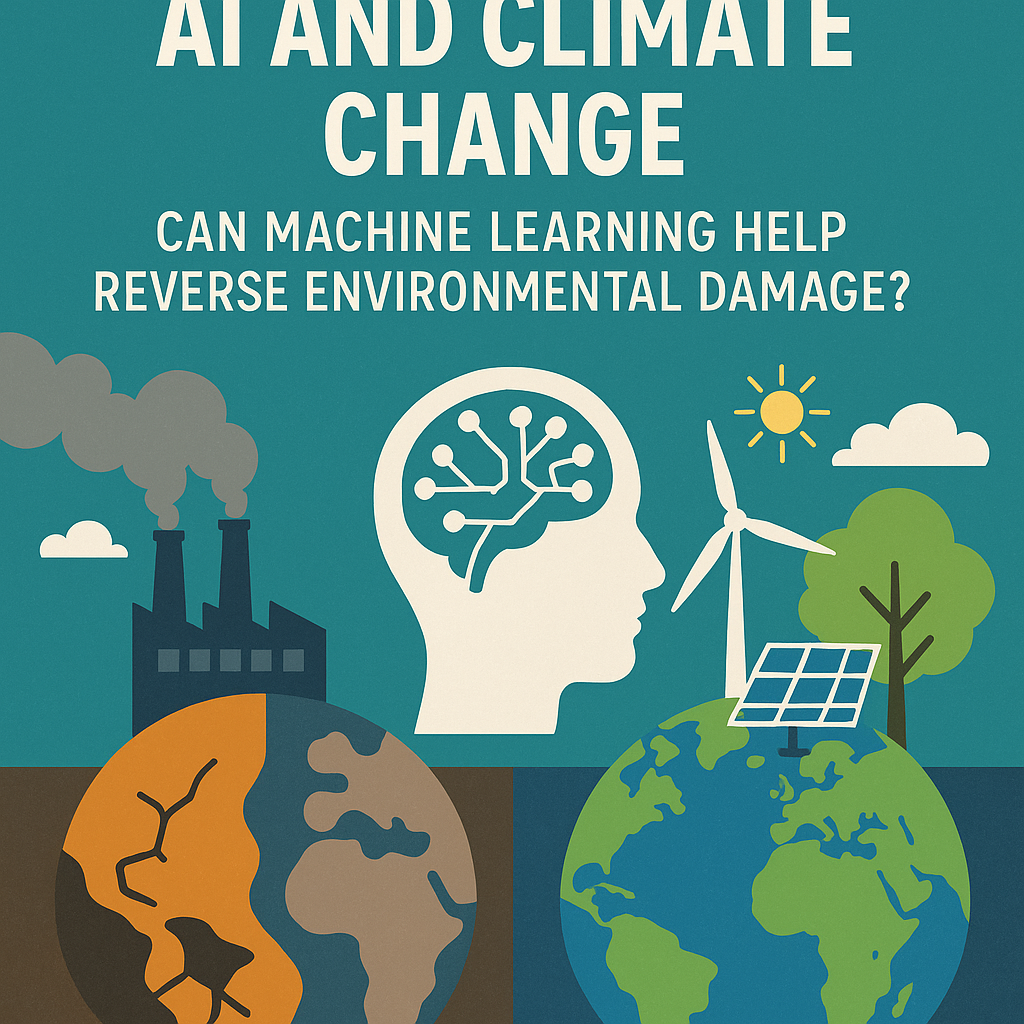
The relationship between AI and climate change is double-edged and
important to understand accurately. On one hand, AI is providing genuinely powerful
tools for climate modelling, renewable energy optimisation, energy
efficiency, and climate adaptation planning that represent some of the
clearest near-term beneficial applications of the technology. On the other,
AI training and inference consume significant and growing quantities of
energy, and the AI industry’s contribution to the carbon emissions it is
supposedly helping to address is a tension that demands honest accounting
rather than convenient omission. Both sides of this relationship are real,
and engaging seriously with AI and climate requires holding both
simultaneously.
Climate Modelling and Scientific Understanding
The most scientifically significant AI contribution to climate
change is in accelerating the modelling of climate system dynamics.
Traditional climate models, which simulate the physical equations governing
atmosphere, ocean, land, and ice interactions, are computationally expensive
and take weeks to run at the resolutions needed for regional climate
projections. AI emulators trained on the outputs of high-resolution physical
models can run equivalent projections thousands of times faster, enabling the
ensemble simulations and uncertainty quantification that robust climate
science requires. Research programmes at the UK Met Office, ECMWF, and NASA
are all integrating AI into their climate modelling pipelines, not to replace
physical models but to extend the range and resolution of projections that computational
budgets allow.
Beyond weather and climate forecasting, AI is accelerating climate
science in multiple directions. Machine learning algorithms applied to
satellite remote sensing data are dramatically improving the monitoring of
greenhouse gas emissions, deforestation rates, methane leaks from oil and gas
infrastructure, and ice sheet dynamics at spatial and temporal resolutions
that previous methods could not achieve. Carbon Mapper, a
partnership between NASA and academic institutions, uses AI analysis of
hyperspectral satellite data to identify and quantify methane emissions from
individual facilities, enabling targeted enforcement action against emitters
that would previously have been undetectable. The AI here is not providing
policy solutions; it is providing the observational foundation on which
effective policy must rest.
Renewable Energy and Grid Optimisation
The electricity grid management challenge created by high
renewable penetration is one where AI provides demonstrable and operational
value. Variable renewable generation requires forecasting, storage dispatch
optimisation, and demand flexibility management that exceeds the capacity of
traditional grid control systems. AI systems managing renewable-heavy grids
in Denmark, Germany, California, and the UK provide improvements in renewable
integration that translate directly into lower carbon emissions from the
electricity sector. National Grid Electricity System Operator in the UK uses
machine learning for wind and solar generation forecasting that enables the
system operator to maintain grid stability at renewable penetration levels
that would have been operationally challenging with conventional forecasting
methods.
The application of AI to energy efficiency in buildings, industry,
and transport represents perhaps the largest aggregate opportunity.
DeepMind’s application of AI to optimise cooling systems in Google’s data
centres reduced cooling energy consumption by approximately 40 percent, a
result subsequently replicated in other facilities and extended to broader
data centre operations management. Applied at scale across commercial
buildings, industrial facilities, and transport networks, AI-driven energy
optimisation could deliver meaningful reductions in energy consumption
without requiring infrastructure replacement or behavioural change. The International Energy Agency
estimates that AI-enabled energy efficiency improvements could reduce global
energy-related emissions by up to 4 percent by 2030, a figure that while
modest relative to overall mitigation needs is larger than many individual
policy measures under serious consideration.
The Carbon Cost of AI Itself
The energy consumption of AI training and inference is a genuine
and growing contribution to carbon emissions that the AI industry has been
slow to disclose and the policy community has been slow to regulate. Training
large language models consumes electricity equivalent to the annual
consumption of thousands of homes. The inference workload of deployed AI
systems, running billions of queries daily, adds further consumption that
grows with adoption. The AI industry’s aggregate energy demand is growing
faster than the renewable energy being added to serve it in most major
markets, meaning that the marginal energy powering AI growth is often not
clean. Addressing this requires both efficiency improvements in AI hardware
and algorithms and mandatory energy and carbon disclosure requirements for AI
providers that create accountability for the environmental cost of the
services they offer. Both are technically achievable; neither is currently
happening at adequate scale.
What This Means for You
The climate implications of AI are real in both directions. AI
tools that improve renewable energy forecasting, reduce building energy
consumption, and accelerate climate science are making meaningful
contributions to the response to climate change that deserve recognition. The
energy and carbon cost of the AI systems generating these benefits is also
real and needs to be managed transparently. As an individual, the most direct
climate-relevant choices involving AI are around which AI services you use
and how, recognising that not all AI use has equal environmental cost, and
supporting organisations that advocate for mandatory AI energy disclosure and
efficiency standards. The governance frameworks needed to ensure AI is
deployed in climate contexts responsibly are developing but not yet
comprehensive. AI systems used in climate adaptation planning, resource
allocation, and early warning require the same accountability, transparency,
and equity standards that other high-stakes AI applications demand, with the
additional urgency that the populations most vulnerable to climate change are
also those least represented in AI development processes. Building climate AI
governance frameworks that centre the needs and rights of climate-vulnerable
communities alongside the technical objectives of the systems is a priority
that international climate finance mechanisms and AI governance initiatives
are beginning to address, though much more concretely than they had done
three years ago. IPCC
reports increasingly incorporate AI as a tool for climate
adaptation that requires governance alongside deployment. For related
analysis, see our coverage of AI’s
hidden carbon cost and the
renewable energy transition.
Concrete local action, including
municipal renewable energy procurement, AI-assisted building energy
management, and smart traffic optimisation, produces measurable emissions
reductions while also building the data infrastructure and institutional
capability needed for more ambitious climate action. Cities and local
authorities that are investing in AI-enabled climate management now are
building competitive resilience advantages that will become increasingly
significant as climate impacts intensify and the cost of adaptation rises.
The C40 Cities
network provides case studies of successful municipal AI climate
deployments that illustrate the practical opportunity at city scale.
About the Author
Stuart Kerr is a technology correspondent at LiveAIWire, covering
artificial intelligence, digital innovation, and the social impact of
emerging technologies. Follow LiveAIWire for daily analysis at liveaiwire.com.