
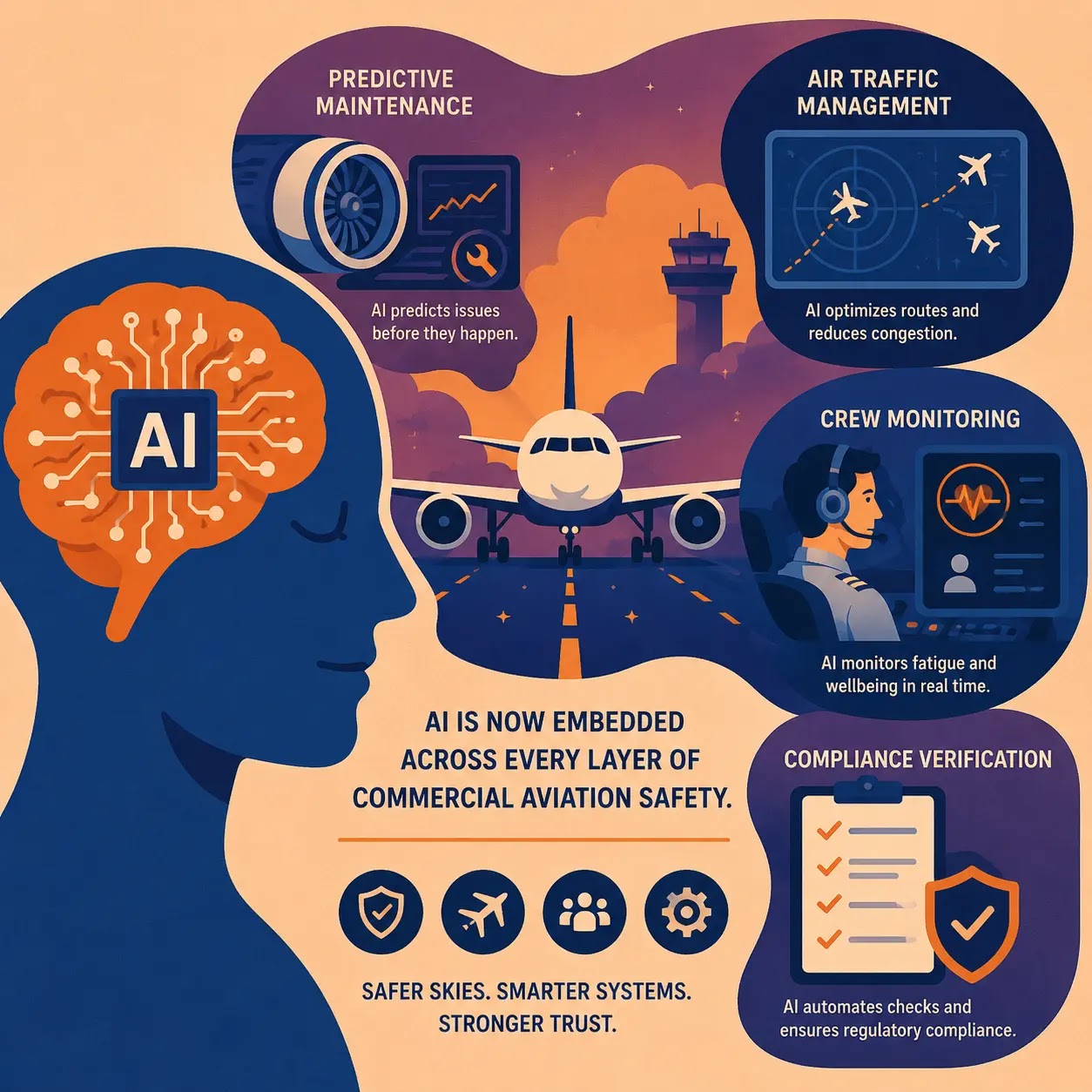
AI aviation safety is advancing faster than most travellers realise. Commercial aviation killed 304 people worldwide in 2024, according to the European Union Aviation Safety Agency’s Annual Safety Review, a figure that puts into perspective how comprehensively safe modern air travel has already become. That number is about to fall further still, not through a single breakthrough but through a quiet revolution in how aircraft are maintained, monitored and coordinated across an airspace carrying more traffic than any human-only system was designed to handle.
The technology is already embedded in global AI aviation safety operations, predicting mechanical failures days before they occur, optimising flight paths in real time, and helping air traffic management systems handle volumes that human operators alone cannot reliably coordinate. What is changing now is scale. Tools that a handful of carriers were piloting in 2022 are reaching commercial deployment across hundreds of airlines simultaneously, driven by regulatory roadmaps from EASA and the FAA that have set out precisely how AI earns its place in certified aviation systems.
Predictive Maintenance and the Economics of AI Aviation Safety
The clearest commercial proof point comes from Airbus’s Skywise Fleet Performance Plus platform, which monitors real-time sensor data from connected aircraft and flags components likely to fail before they do. EasyJet, one of the platform’s large-scale adopters, reported that the AI system helped the airline avoid 44 flight cancellations in July 2024 alone. Across its A320 Family fleet, each connected aircraft saves an average of 8.1 tonnes of fuel annually through more precise flight performance management. Those are not projections. They are operational results from a live carrier with published data.
The sensor volumes underpinning these systems are staggering. GE Aerospace jet engines log approximately 5,000 data points per second, giving AI models enough signal to detect subtle vibration patterns or temperature deviations long before a human technician would flag anything during a scheduled inspection. Rolls-Royce TotalCare and Boeing AnalytX operate on the same principle: convert continuous sensor output into maintenance foresight. Moving from schedule-based to condition-based maintenance removes a category of incident where parts fail between inspections.
Airbus projects that digital and AI-driven efficiencies across its global services portfolio could save airlines up to $83 billion annually by 2044. That figure captures something consistently missed in aviation coverage: the financial case and the safety case are identical. An airline that catches a failing component early pays less and operates more safely.
What Regulators Are Actually Certifying
Safety claims about AI aviation safety require reading against what regulators have actually certified, not what developers have proposed. The EASA Annual Safety Review confirmed Europe recorded three fatal accidents in commercial air transport in 2024 with three fatalities, consistent with its status as one of the safest aviation regions on earth. EASA’s AI Roadmap sets out a tiered certification framework: Level 1 covers AI as an assistance tool to human operators, Level 2 covers human-AI teaming. Neither permits unsupervised autonomous decision-making in safety-critical phases, which is appropriate given where the technology sits.
The FAA’s AI Safety Assurance Roadmap takes the same position, treating AI as a tool rather than a replacement for human authority in the cockpit. Standards body EUROCAE has been working with SAE International on ED-324, a process standard for approving aeronautical products using AI, with early certification focused on supervised non-adaptive machine learning where failure analysis is most tractable. The message from both regulators is not that AI will be indefinitely constrained but that it earns its authority through evidence.
Air Traffic Management and the Coordination Challenge
Beyond the aircraft itself, AI is beginning to address the coordination pressure that growing traffic volumes create. Air traffic management systems are dealing with demand that continues rising while controller workforce capacity does not. The 2025 congestion at Newark demonstrated in public terms what aviation professionals already understood: the infrastructure for managing airspace was not built for current demand, let alone the 3.6 percent annual growth ICAO projects. The AI response is a category of tools that augments controller decision-making by surfacing conflicts earlier, suggesting resolutions faster, and managing information loads that exceed human processing capacity under peak conditions.
Why the 2024 Accident Rise Matters
ICAO recorded 95 accidents involving scheduled commercial flights in 2024, up from 66 in 2023, a rise that coincided with the significant rebound in global traffic volumes following the post-pandemic recovery. ICAO was explicit that the data represents a call for heightened cooperation on safety priorities rather than evidence of systemic failure. The long-term trend in commercial fatalities still points firmly downward when measured against departures, but the year-on-year variation confirms that AI aviation safety investment is not optional, since aviation safety is not self-maintaining. As LiveAIWire’s coverage of how AI is reshaping insurance found, the same pattern of AI systems earning trust through demonstrated evidence rather than marketing claims applies across every regulated, safety-critical industry.
The workers implementing these systems are navigating their own transition, and how AI is reshaping skilled technical workforces is a parallel story across every sector deploying this technology, one LiveAIWire examined in AI at work: augmentation or replacement. Maintenance engineers are not being replaced by predictive AI. They are being redirected from routine inspections toward exception-handling and complex interventions that the models flag but cannot address. That is augmentation in practice, and it matters for workforce planning in an industry where expertise takes years to develop.
The pressure to power all of this computation is itself a story LiveAIWire has covered in the energy crisis of AI, since the same data-hungry models flagging a failing turbine component also sit on the electricity grid squeeze reshaping how every industry deploys AI at scale. The direction in aviation is not in question. What remains is the pace of certification, the standardisation of data across manufacturers and carriers, and the trust infrastructure that allows crews and regulators to rely on AI systems where failure has catastrophic consequences.
The institutional work that will determine how quickly these benefits reach the full global fleet rather than a subset of well-resourced carriers is the standardisation of AI certification across major aviation authorities. An AI safety system certified under EASA standards still requires separate engagement with the FAA, with CAAC in China, and with other national regulators for global deployment. Building mutual recognition frameworks for AI certification, comparable to those already governing aircraft type certification, is the non-technical bottleneck the industry has not yet solved. The technology is ahead of the governance, but governance in aviation has always caught up when the safety case is sufficiently clear.
About the Author
Stuart Kerr is Technology Correspondent at LiveAIWire, covering artificial intelligence, cybersecurity, and the social impact of emerging technology. He publishes daily at LiveAIWire.com.