
By
Stuart Kerr, Technology Correspondent,
LiveAIWire
A single short AI-generated video can
consume as much electricity as 200,000 spam email classifications, according
to the United Nations University analysis published in June 2026. Google
reduced the energy consumed per Gemini prompt by a factor of 33 in a single
year of deployment optimisation. Both facts are true simultaneously, and
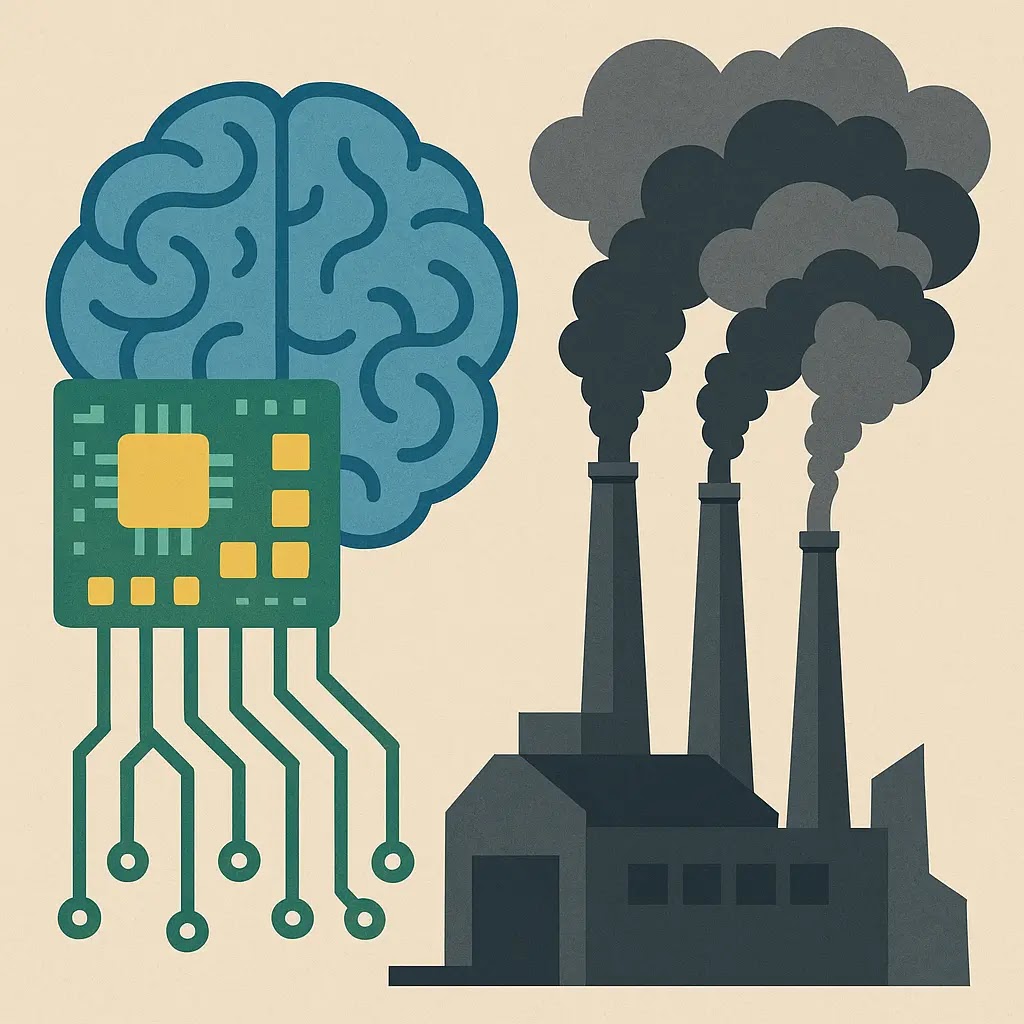
together they define the AI emissions paradox that the environmental debate
around artificial intelligence has not yet fully absorbed. Making AI systems
more energy-efficient per query does not reduce their total energy
consumption. It reduces the cost of each query, which increases the volume of
queries, which increases total consumption. Nineteenth-century economist
William Stanley Jevons observed the same dynamic in coal: the invention of
more efficient steam engines led to more coal use, not less, because
efficiency made coal-powered production cheaper and therefore more
widespread. The Jevons Paradox is not a historical curiosity. It is the
central challenge of AI environmental policy in 2026.
A
review published by Columbia
University’s Earth Institute in May 2026 identified three distinct
phases in AI’s net carbon position. From 2020 to 2025, net carbon reductions
occurred as AI optimisation in manufacturing and energy systems lowered emissions.
From 2025 to 2035, a rebound effect is projected in which AI infrastructure
emissions rise significantly while the optimisation benefits level off.
Between 2035 and 2045, a return to net benefits is possible if grid
decarbonisation speeds up and infrastructure growth stabilises. The
implication is that the current period, now, is the worst stretch of AI’s net
environmental impact even as the narrative about AI as a climate solution
reaches its loudest. The gap between the story and the data is not
small.
Why Efficiency Does Not Equal
Reduction
The mechanism behind the rebound is
straightforward when laid out clearly. In 2022, ChatGPT had roughly 1 million
active users. By 2026, that figure exceeded 900 million weekly active users.
Even if the energy per query has fallen by a factor of ten over that period,
a thousand-fold increase in user volume produces a hundred-fold increase in
total energy consumption. This is not a hypothetical projection. It is the
trajectory that has already occurred. Google can truthfully report that its
Gemini models use dramatically less energy per query than they did a year
ago. It cannot truthfully report that its total AI energy consumption has
fallen, because the volume growth has substantially exceeded the efficiency
gain.
The United
Nations University researchers who identified the rebound effect
coined a specific warning: “A lot of people think that the environmental
footprint of AI reduces, as technology improves and processes become more
efficient. But that is only a partial picture of the overall problem.” The
other part of the picture is that cheap, efficient AI gets used for more
things, in more places, at more scale. Product defaults determine the energy
cost of most AI interactions rather than explicit user choice. A model set to
return long, detailed responses with high resolution outputs by default will
consume far more energy than one set to return concise outputs, regardless of
the user’s actual need. These design choices are made by product teams
optimising for engagement and user satisfaction, not by energy policy teams
optimising for environmental impact.
What Smarter Models
Actually Do to the Equation
The relationship between model
sophistication and energy consumption is not linear in the direction most people
assume. A single large model capable of handling a wide range of tasks uses
different energy profiles for simple versus complex queries. But the
existence of a capable model generates demand for use cases that simpler
models could not enable, which means smarter models tend to expand the total
space of AI application rather than simply performing existing applications
more efficiently. This is the supply-side version of the rebound: better
models create new markets rather than just serving existing ones more
efficiently. The research covered in the
full environmental accounting of AI systems shows the demand side
of this, where total energy grows even as per-unit consumption falls. The
smarter-model rebound is the supply-side complement: more capability
generates more demand rather than substituting for existing
demand.
The Policy Response That Could Actually Work
The
environmental policy tools that address the Jevons Paradox in other domains
apply to AI with some adaptation. Carbon pricing that reflects the true
environmental cost of AI inference would shift the economic incentives that
currently drive product defaults toward high-energy outputs. Disclosure
requirements that separate AI from non-AI energy use in data centre reporting
would make the rebound effect visible in company accounts rather than hidden
in aggregate figures. Efficiency standards that set minimum performance
thresholds per unit of energy consumed, similar to appliance efficiency
standards, would drive the model compression and optimisation work that
reduces per-query cost even under high-volume scenarios.
Understanding
how smaller,
more efficient AI models are already challenging large ones on
capability provides context for why the technical path to reduced emissions
exists and is not being taken at the scale environmental impact requires. And
the work on AI
accelerating renewable energy deployment represents the positive
side of the ledger that the paradox does not erase but also does not make
automatic. The paradox is specific: efficiency gains in AI do not
automatically produce reduced total emissions. Policy, design choices, and
energy procurement decisions determine whether the efficiency gains translate
into environmental benefit or simply enable greater scale at the same or
higher total cost. The data in 2026 says they have mostly enabled greater
scale.
The Model Choice Dimension
The
Jevons Paradox operates at the system level, but individual model choices
compound or mitigate it at the product level. The energy consumed by an AI
query varies by orders of magnitude depending on the model called, the length
of the output requested, and the resolution of any generated media. Calling a
frontier large model for a task that a small model handles adequately is not
just an efficiency oversight. At scale, it is an environmental decision that
aggregates across millions of queries per day. A systematic review of model
selection published in late 2025 found that optimal model selection during
inference, choosing the smallest model capable of adequate performance on
each specific task, could reduce AI energy consumption by 30 to 60 percent
without meaningful quality degradation for most production workloads. This
result is significant because it requires no new hardware, no new
architecture, and no new research: it requires only the operational
discipline to match model capability to task requirements rather than
defaulting to the most capable available model for every
query.
The rebound effect does not negate this efficiency
gain; it operates at a different level of the system. Better model selection
per query reduces per-query cost, which the rebound suggests will increase
query volume. But lower per-query cost through model selection is
categorically different from lower per-query cost through capability
improvement, because model selection reduces total energy without expanding
the capability frontier. An AI system that costs less per query because it
uses a smaller model for appropriate tasks is not opening new markets that
generate new demand; it is serving existing demand more efficiently. The
rebound primarily operates on capability improvements because those
improvements enable new use cases. Efficiency gains from appropriate model
selection are less susceptible to the same rebound dynamic, which makes them
a more reliable tool for actual emissions reduction than headline
improvements in frontier model efficiency.
About the
Author
Stuart Kerr is Technology Correspondent at
LiveAIWire, covering artificial intelligence, cybersecurity, and the social
impact of emerging technology. He publishes daily at
LiveAIWire.com.