
By Stuart Kerr, Technology Correspondent, LiveAIWire
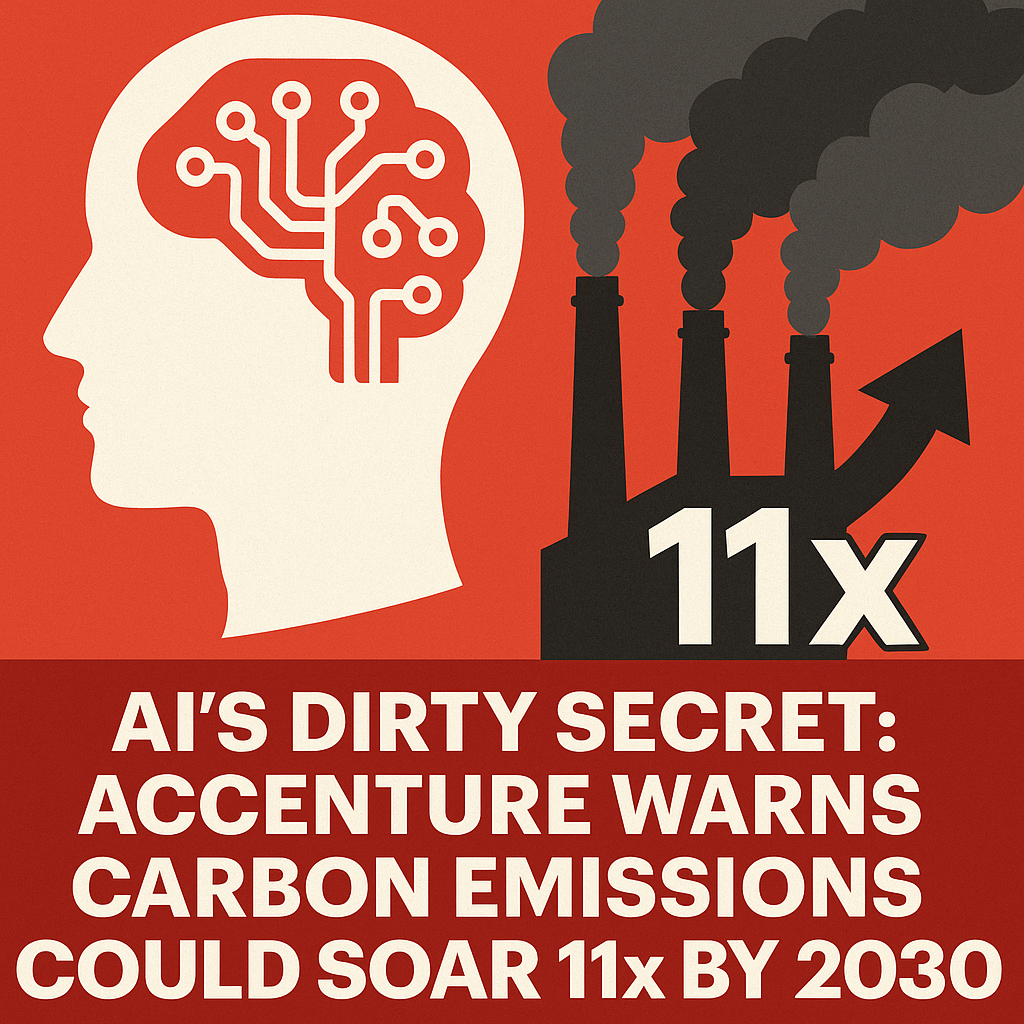
Global electricity demand from data centres is on course to roughly double from 485 terawatt-hours in 2025 to 950 terawatt-hours by 2030, according to the International Energy Agency, and AI-focused facilities are growing three times faster than that already-steep average. Accenture, in a separate and widely cited analysis, has gone further, warning that AI-driven data centre carbon emissions specifically could rise elevenfold this decade, reaching 3.4 percent of global emissions by 2030.
Both figures point to the same underlying story: AI’s environmental cost is no longer speculative, and no longer hidden in footnotes. It is now the subject of dedicated modelling from the world’s leading energy authority and one of its largest consultancies, published within months of each other, and both arrive at the same uncomfortable conclusion. The industry building AI is expanding faster than the clean energy needed to power it responsibly.
Table of Contents
What Accenture’s Warning Actually Says
Accenture’s *Powering Sustainable AI* report estimates that AI data centres could consume 612 terawatt-hours of electricity over the next five years, roughly equivalent to Canada’s entire annual power consumption, while requiring more than 3 billion cubic metres of water annually for cooling, a volume exceeding the total freshwater withdrawals of countries like Norway or Sweden. Matthew Robinson, managing director of Accenture Research and a co-author of the report, told Fortune that the modelling was built from projected AI chip deployment adjusted for utilisation, combined with regional data on electricity generation and emissions.
Robinson was candid about the intent behind the warning. He said the point of the exercise was to open a conversation about the actions still available to avoid this outcome, adding plainly that Accenture does not want to be proven right. That framing matters: this is not a prediction Accenture considers inevitable, it is a warning meant to change behaviour before the numbers become real.
What This Means for You
If you use AI tools regularly, the emissions attached to any individual query are genuinely tiny, and falling fast. The IEA’s own analysis found that energy use per AI task has dropped by roughly an order of magnitude annually in recent years, to the point that a simple text query now consumes less electricity than running a television for the same stretch of time. The practical concern is not your ChatGPT habit. It is the aggregate buildout: the hundreds of billions of dollars flowing into ever-larger data centres to serve growing demand for far more energy-intensive tasks, video generation, complex reasoning, and autonomous agents, which can use hundreds or even thousands of times more energy per query than a simple text response.
The Efficiency Paradox
This is the central tension in the IEA’s most recent report, published in April 2026. Software and hardware efficiency is improving at a pace the agency calls unprecedented in energy history. If every conventional internet search were replaced by a simple AI text query, the IEA estimates total electricity consumption would come to under 4 terawatt-hours a year, less than 1 percent of current data centre demand. Yet aggregate demand keeps climbing anyway, because new, far more energy-intensive AI applications keep launching faster than efficiency gains can absorb them.
The scale of investment driving this is difficult to overstate. The five largest technology companies alone spent more than 400 billion dollars on data centre infrastructure in 2025, a figure the IEA expects to jump by a further 75 percent in 2026. Capital expenditure from just these five firms now exceeds global investment in oil and natural gas production combined, a comparison that says as much about the scale of the AI buildout as any emissions statistic.
Why the Grid Cannot Keep Up
The physical constraints are becoming as important as the financial ones. AI server power density increased elevenfold between 2020 and 2025, and the IEA projects a further fourfold increase by 2027, meaning a single server rack the size of a household refrigerator could soon draw as much power as 65 homes. Grids built over decades were never designed to absorb that kind of concentrated, rapidly fluctuating demand, and the IEA warns that roughly a fifth of planned data centre projects worldwide could face delays simply because the surrounding grid cannot connect them fast enough.
This is not an abstract future problem. As LiveAIWire’s earlier reporting on the AI energy crisis detailed, Microsoft’s own data centre electricity consumption grew 34 percent in a single fiscal year, contributing to the company missing its carbon reduction targets three years running, while major cloud providers have generally declined to publish AI-specific energy figures separate from their broader cloud operations, making independent verification of any individual company’s AI footprint difficult.
Data Centres in Space and Other Escape Routes
The scramble to find electricity for AI has pushed some of the industry’s most prominent figures toward proposals that would have sounded absurd a few years ago. As LiveAIWire has reported on Elon Musk’s push for orbital data centres, a startup called Starcloud has already launched an Nvidia chip into orbit aboard a SpaceX rocket and reported training an AI model there, betting that constant sunlight and the cold of space could eventually undercut the cost of cooling hardware on the ground. Google has outlined a similar satellite-based programme of its own, targeting prototype launches for 2027.
These projects remain a genuine long shot rather than a near-term fix, constrained by launch costs, radiation, and the impossibility of sending a technician to repair a failed part in orbit. But their emergence at all is itself a signal of how acute the terrestrial power constraint has become. Some of the same pressure is also visible in the broader infrastructure story LiveAIWire has tracked across Google, Amazon and Meta, where the drive to secure computing capacity has repeatedly outpaced the industry’s stated sustainability commitments.
The Physical Reality Behind the Interface
Much of this remains invisible to the people using AI every day, which is part of the problem. As LiveAIWire’s reporting on AI’s hidden infrastructure has explored, the servers, cooling systems and transmission lines underpinning every chatbot response are deliberately located far from where that response is read, making the environmental cost of a single query almost impossible for an ordinary user to picture, let alone weigh against its convenience.
Accenture’s recommended response centres on what it calls the Sustainable AI Quotient, a metric intended to help organisations weigh money invested, energy consumed, emissions produced and water used against the actual value an AI deployment delivers, rather than treating capability gains and environmental cost as separate conversations. The firm’s broader advice, choosing appropriately sized models rather than defaulting to the largest available, shifting workloads to times and places where cleaner power is available, and investing in more efficient cooling, is sound in principle. Whether it changes outcomes depends on whether the companies racing to build AI infrastructure are willing to slow down even slightly to apply it.
A Race With No Sign of Slowing
That willingness looks limited so far. Meta’s chief executive has publicly framed rapid data centre construction as a matter of national competitiveness against China, and figures within the current US administration have pushed to streamline permitting for both data centres and the power generation needed to feed them, arguing that a cautious approach risks ceding ground in the AI race entirely. Against that political backdrop, environmental caution is competing with an argument about geopolitical urgency, and urgency has generally been winning.
None of this means the emissions trajectory Accenture describes is locked in. The IEA’s own modelling explicitly treats data centre demand as sensitive to policy choices, financing conditions, and how quickly bottlenecks in chip manufacturing and grid connections are resolved, not as a fixed destiny. But every credible model published so far, from a global energy authority with no commercial stake in the outcome and a consultancy that counts many of these same technology companies as clients, agrees on the direction of travel. The question for the rest of this decade is not whether AI’s energy and carbon footprint will keep growing. It is whether the efficiency gains and policy interventions available can grow fast enough to keep pace with it.
About the Author
Stuart Kerr is Technology Correspondent at LiveAIWire, covering artificial intelligence, emerging technology, and their impact on business, society, and everyday life. LiveAIWire publishes original AI journalism every weekday at liveaiwire.com.