
A
bakery owner in Bristol now uses AI to predict daily customer demand accurate
enough to reduce food waste by nearly a third. An independent retailer in
Edinburgh uses AI-generated social media content to compete with the
marketing budgets of national chains. A small accounting firm in Leeds has
automated routine tax return preparation, allowing its two partners to serve
three times as many clients without additional staff. These stories are real,
they are becoming less exceptional, and they represent the genuine
opportunity that AI presents to small businesses that can navigate the
adoption challenges successfully.
The UK has approximately 5.5 million small and medium-sized
enterprises, accounting for around 60 percent of private sector employment
and over half of private sector turnover, according to the Federation of
Small Businesses. If AI productivity gains accrue primarily to large
corporations, the competitive gap between large and small businesses will
widen considerably. If they are accessible to small businesses, the gains
could be transformative for both individual businesses and the broader
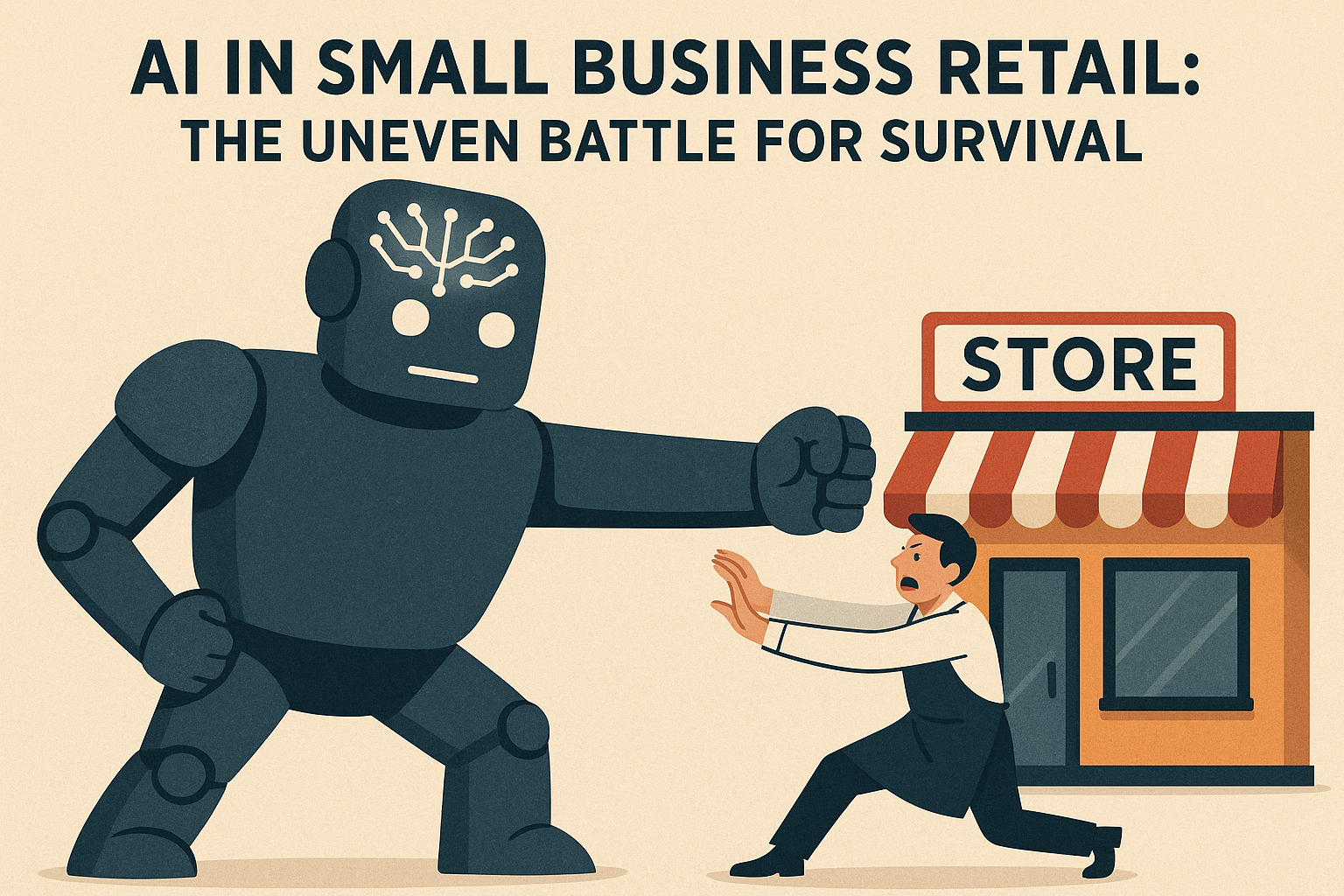
economy. The evidence so far suggests a genuinely uneven picture: some small
businesses are capturing significant AI benefits, while many others are
falling further behind.
Where Small Businesses Are Winning with AI
Customer-facing AI applications have proven most accessible to
small businesses because they are available through low-cost subscription
services that require minimal technical expertise to deploy. AI-powered
chatbots for customer service, appointment booking, and basic query handling
are available for tens of pounds per month and can handle customer
interactions that would previously have required human staff. Small
businesses in sectors including hospitality, retail, and professional
services are using these tools to extend their service hours and
responsiveness without proportional increases in staff costs.
AI content generation has been genuinely democratising for small
business marketing. Tools including Canva’s AI features, Jasper, and similar
platforms allow small retailers to produce professional-quality marketing
content at a fraction of the previous cost. Independent retailers who
previously could not afford professional copywriting or graphic design can
now produce credible digital marketing at a scale that allows them to maintain
visibility in competitive markets. The quality ceiling of AI-generated
marketing content is rising; the cost floor is falling.
Inventory management and demand forecasting are increasingly
accessible to small retailers through platforms including Shopify and
Lightspeed, which have integrated AI forecasting directly into their
point-of-sale and inventory systems. AI-driven demand forecasting reduces
over-ordering and stock-outs, improving both cash flow and customer experience
for independent retailers who previously relied on manual forecasting or
experienced intuition.
Where the Risks Bite
The risks of AI adoption for small businesses are different in
character from those facing large organisations, and in some ways more acute.
Large organisations have legal, compliance, and technology teams to evaluate
AI tools before deployment. Small businesses typically do not, meaning that
problematic AI products reach their operations with less scrutiny. AI-powered
hiring tools that produce discriminatory outcomes, customer service chatbots
that make commitments the business cannot meet, or AI accounting tools that
produce errors that create tax liability are all genuine risks for small
business operators who lack the expertise to identify problems before they
cause harm.
Data privacy is a particular concern. Small businesses collecting
customer data to train or operate AI tools have the same legal obligations as
large corporations under GDPR, but typically have significantly less legal
and compliance support. The Information Commissioner’s
Office has published guidance for small businesses on AI and data
protection, but survey data consistently shows that awareness of these
obligations among small business operators is low. A data breach or
compliance failure that a large corporation can absorb as a cost of business
can be existential for a small one.
The competitive dynamics of AI adoption also create structural
risks for small businesses in certain sectors. In retail, the AI capabilities
available to large e-commerce platforms, including personalised
recommendations, dynamic pricing, and logistics optimisation, are
substantially more sophisticated than anything available to independent
retailers through accessible tools. The gap between what Amazon’s AI can do
and what a small retailer can deploy through commercial platforms is growing,
not shrinking, and it is reflected in the continuing market share shift from
independent retail to platform retail across most categories.
Financial Services and AI Credit
Small businesses’ access to finance is also being affected by AI.
AI-powered lending platforms including Funding Circle and iwoca use machine
learning to assess small business credit risk using real-time transaction
data, providing faster decisions and, in some cases, credit to businesses
that traditional bank models would decline. This is genuinely beneficial for
creditworthy small businesses that traditional credit scoring underserves.
The risk is that AI credit models optimised for default prediction may
systematically underserve businesses in sectors or regions with limited
historical data, reproducing the access gaps of the traditional system rather
than correcting them.
What This Means for You
If you run a small business, the practical case for engaging with
AI tools is strong for specific, well-defined applications. Customer service
automation, content generation, demand forecasting, and accounting automation
all have evidence of genuine benefit and accessible price points.
Prioritising applications where the cost of errors is low and the efficiency
gain is clear, and building AI literacy gradually rather than attempting
comprehensive adoption, is the approach most likely to produce durable
benefit. For related analysis of AI in business and the economy, see our
coverage of the
AI automation divide and AI
in financial services. The platform dependency risk deserves
particular attention for small businesses considering AI adoption. The AI
tools most accessible to small businesses are predominantly provided by a
small number of large technology platforms including Google, Microsoft, Meta,
and a handful of specialist providers. Dependence on a single platform for
customer communications, inventory management, accounting, and marketing
creates concentration risk that can materialise rapidly when platforms change
their pricing, discontinue products, or experience outages. Small businesses
that have migrated core operations to AI-platform tools and subsequently
found themselves unable to use those tools due to platform changes or account
suspension have found recovery difficult and expensive. Building AI
capability on open-source foundations or across multiple providers where
possible is a risk management principle that small business advisers
including the Federation of Small Businesses recommend to members considering
significant AI adoption.
The opportunity is real, the risks are manageable with reasonable
care, and the cost of not engaging is increasingly the cost of being left
behind. Small businesses that approach AI adoption strategically, starting
with high-value, low-risk applications and building internal capability
before attempting more complex deployments, consistently report better
outcomes than those that adopt tools reactively in response to competitive
pressure or vendor marketing. The Federation of Small Businesses
has developed resources specifically for small business owners evaluating AI
adoption, including practical guidance on due diligence for AI tool
selection, data protection compliance, and building internal capability
without disproportionate investment. These resources represent a practical
starting point for the majority of small business operators who recognise
that AI engagement is necessary but are uncertain where to
begin.
Building AI capability gradually,
testing tools on low-stakes applications before committing to deeper
integration, and maintaining the ability to revert to non-AI processes if a
tool underperforms are all principles that reduce the risk of AI adoption
going wrong in ways that damage the business. The small businesses that have
integrated AI most successfully are those that treated adoption as an ongoing
learning process rather than a one-time procurement decision, and that
invested in internal capability to evaluate and manage the tools they adopted
rather than depending entirely on vendor support.
About the Author
Stuart Kerr is a technology correspondent at LiveAIWire, covering
artificial intelligence, digital innovation, and the social impact of
emerging technologies. Follow LiveAIWire for daily analysis at liveaiwire.com.