
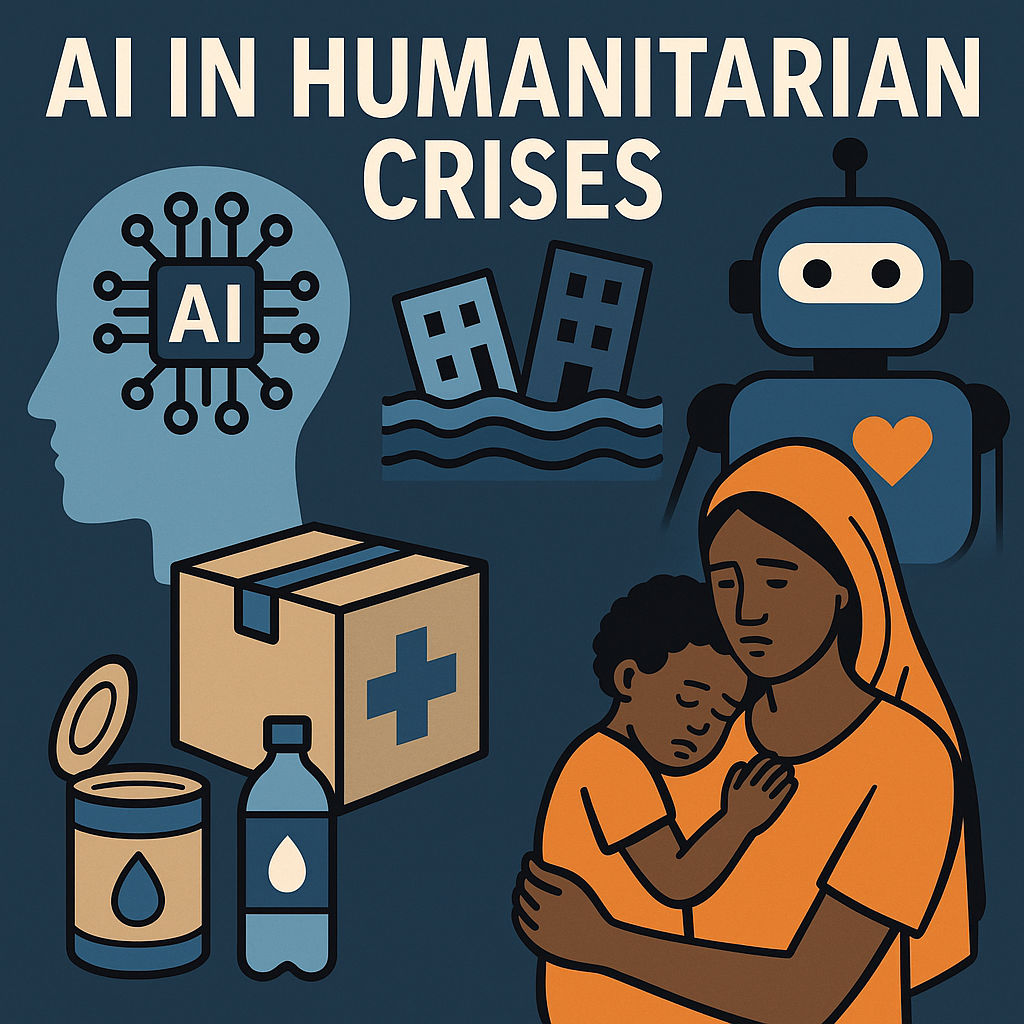
When
conflict or natural disaster displaces millions of people, humanitarian
organisations face an impossible operational challenge: allocate limited
resources across vast, rapidly changing situations with incomplete
information, under time pressure, with lives in the balance. AI is
increasingly positioned as a solution to this challenge, and the question of
whether that positioning is justified has profound consequences for how the
global humanitarian system operates and who it serves.
The humanitarian sector spent approximately 30 billion dollars
annually in the years before 2024, according to the UN Office for the
Coordination of Humanitarian Affairs, serving over 300 million people across
complex emergencies. The gap between needs and resources is vast and growing,
driven by climate change, conflict, and economic fragility. If AI can make
humanitarian operations even marginally more efficient, the humanitarian case
for deployment is strong. The challenge is ensuring that efficiency gains do
not come at the cost of the principles, specifically humanity, neutrality,
impartiality, and independence, that legitimate the humanitarian enterprise
and distinguish it from other forms of political and commercial activity.
Where AI Is Being Deployed
Needs assessment is one of the most active areas of AI application
in humanitarian contexts. Machine learning models combining satellite
imagery, mobile data, and historical vulnerability indicators can produce
needs estimates for affected populations faster and more comprehensively than
traditional survey-based approaches. The World Food Programme uses
AI-assisted analysis tools in several operations to identify food-insecure
populations and model supply chain requirements.
Cash and voucher assistance programmes, which have become the
dominant modality of humanitarian assistance in many contexts, use AI for
beneficiary identification and fraud detection. These systems process
biometric and socioeconomic data to determine who receives assistance and in
what amounts. The accuracy and fairness of these systems are therefore not
technical questions alone but ethical ones of the highest order. Errors that
exclude eligible beneficiaries translate directly into food insecurity,
medical deprivation, or homelessness for people with no alternative source of
support.
Predictive analytics for crisis anticipation is perhaps the most
ambitious application. The UN’s Centre for Humanitarian Data has developed
anticipatory action frameworks that use AI models to predict the likelihood
of crises reaching certain severity thresholds, triggering pre-positioned
responses before the crisis fully materialises. Evidence from flood response
applications in Bangladesh and drought response in East Africa suggests that
anticipatory action can significantly reduce humanitarian impact and cost.
UN OCHA’s
published evaluations of these programmes show measurable improvements in
outcomes compared to reactive response in comparable events.
The Accountability Problem
Humanitarian AI faces an accountability challenge distinct from
commercial AI contexts. When an AI system makes an error in a commercial
context, the consequences are typically financial. When an AI system makes an
error in a humanitarian context, excluding a food-insecure family from
assistance, misidentifying a beneficiary as fraudulent, or generating a false
assessment of population needs, the consequences can be severe deprivation
for already vulnerable people.
Current frameworks for AI accountability in humanitarian contexts
are inadequate. Most AI systems deployed in humanitarian operations are
developed by commercial providers under contracts limiting liability. The
affected populations who bear the consequences of errors have very limited
mechanisms for challenging algorithmic decisions. The Principles for Digital
Development and the ICRC’s guidelines on humanitarian data governance provide
frameworks, but they are voluntary and inconsistently implemented. The gap
between stated principles and operational practice is wide enough to drive
meaningful harm through. The humanitarian sector’s credibility depends on its
ability to demonstrate that it holds itself to the standards it articulates,
and the current pattern of principled statements accompanied by inadequate
implementation creates a legitimacy deficit that affects trust with the
communities humanitarian organisations exist to serve. Closing this gap
requires investment in accountability mechanisms, not just investment in AI
capabilities, and the two need to scale together rather than
separately.
Data and Power Asymmetries
The data needed to train and operate humanitarian AI systems is
generated primarily by affected populations, people in situations of extreme
vulnerability who have little choice about whether to provide their
biometric, locational, and personal data. This creates a significant power
asymmetry. The data flows upward to international organisations and their
commercial technology partners; the benefits of AI-derived efficiency are
supposed to flow back down to affected populations, but this feedback loop is
rarely subject to meaningful accountability. Research by Oxfam and other
humanitarian watchdog organisations has documented cases where data collected
ostensibly for humanitarian purposes was subsequently used in ways that
affected communities had neither consented to nor been informed
of.
What This Means for You
The interaction between AI humanitarian tools and the communities
they serve raises questions about agency and self-determination that the
humanitarian sector is only beginning to grapple with. Affected communities
are typically positioned as data sources and beneficiaries rather than as
participants in the design and governance of AI systems that shape their
access to assistance. Participatory design approaches, in which community
members are involved in defining requirements and evaluating outputs, have
been piloted by several humanitarian organisations with promising results,
but they require more time and resources than standard deployment approaches
and are not yet mainstreamed. The principle that affected populations should
have meaningful agency over the systems that affect their lives is a
fundamental humanitarian value that AI deployment practices frequently
violate in practice even when they formally endorse it.
The application of AI to humanitarian crises is one of the areas
where the technology has the most potential to reduce human suffering, and
one where the stakes of getting governance wrong are highest because the
people affected have the least power to hold decision-makers accountable. The
gap between what is technically possible and what is operationally
responsible in humanitarian AI is not primarily a technical gap; it is a
governance gap. Closing it requires institutional commitments, funding
decisions, and accountability mechanisms that the humanitarian sector and its
donors have so far not consistently provided at the scale the problem demands
to reduce human suffering, and one of the areas where inadequate governance
could cause the most harm to the most vulnerable people. The organisations
doing this work best combine genuine technical capability with deep
engagement with affected communities, transparent accountability mechanisms,
and a commitment to humanitarian principles.
The question of who
benefits from humanitarian AI is not merely philosophical. Aid organisations
that deploy AI systems developed by commercial technology companies create
dependencies that affect their operational independence and their data
governance. The intellectual property embedded in commercial AI systems,
including the training data, model architecture, and optimisation choices,
belongs to the vendor, not the humanitarian organisation. When a vendor
discontinues a product or changes its pricing, the aid organisation loses
access to capabilities it may have integrated into core operations. Building
genuinely open-source humanitarian AI infrastructure is a priority that the
sector has identified but underfunded relative to its importance for
long-term operational resilience and independence from commercial
interests.
For donors, policymakers, and civil society advocates, the
priority should be investing in governance infrastructure alongside technical
infrastructure, ensuring that AI in humanitarian contexts serves the people
it claims to help. For related analysis, see our coverage of AI
in disaster response operations and AI
in supply chain logistics.
About the
Author
Stuart Kerr is a technology correspondent at LiveAIWire, covering
artificial intelligence, digital innovation, and the social impact of
emerging technologies. Follow LiveAIWire for daily analysis at liveaiwire.com.