
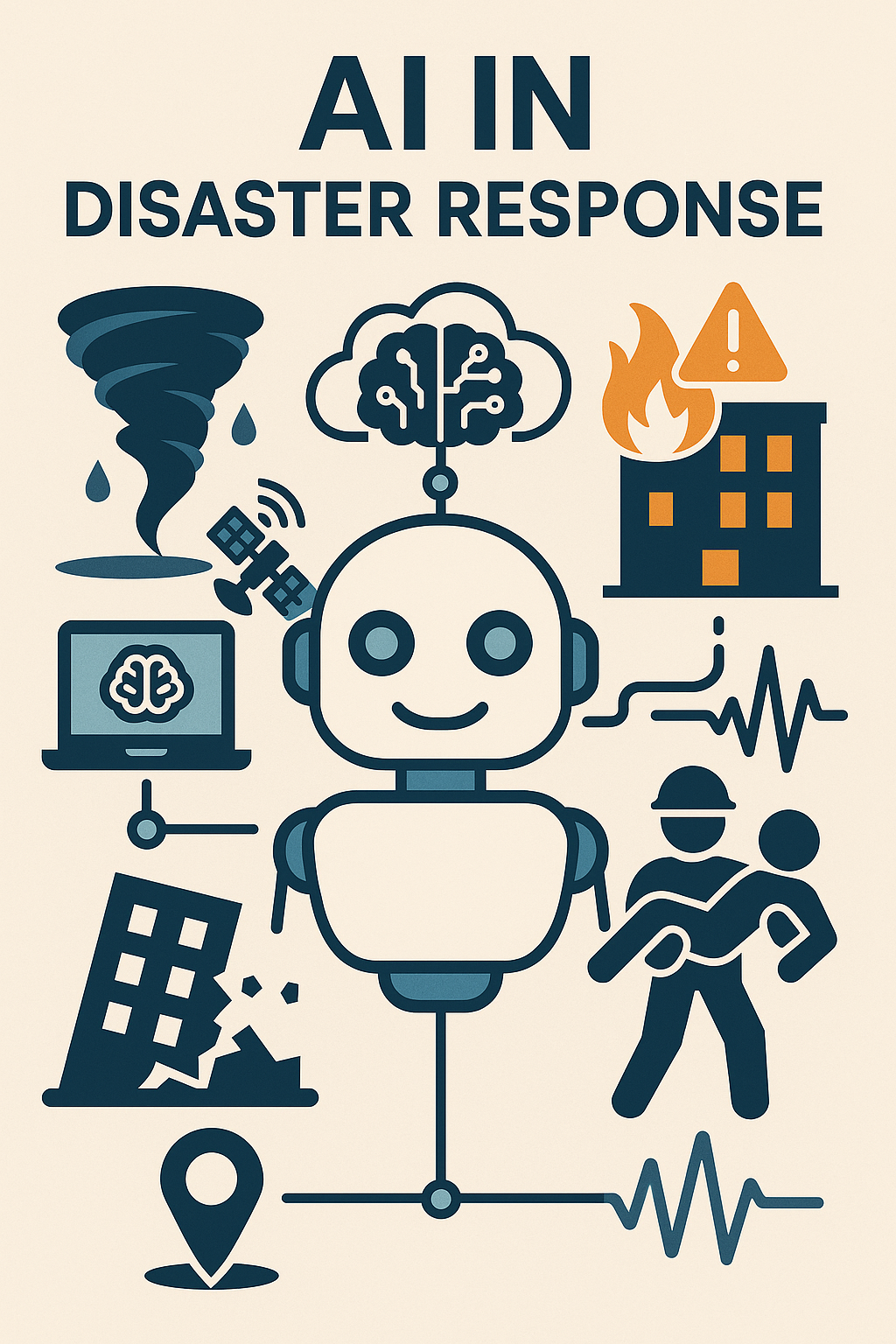
When
a major earthquake struck Turkey and Syria in February 2023, killing more
than 50,000 people, AI systems were already being deployed to analyse
satellite imagery, prioritise search-and-rescue locations, and coordinate the
largest international relief operation in years. Whether they saved lives or
created dangerous false confidence is a question that disaster response
experts are still debating, and the answer matters enormously as climate
change increases the frequency of catastrophic events.
The case for AI in disaster response is intuitive. Emergencies
generate overwhelming volumes of data, including satellite images, social
media reports, sensor readings, and resource inventories, faster than human
coordinators can process them. AI systems that synthesise this information
and surface actionable intelligence could meaningfully accelerate response
times. In the minutes and hours after a disaster, faster decisions translate
directly into lives saved. The challenge is distinguishing between
applications where AI demonstrably helps and those where it provides only the
appearance of improved capability.
What AI Can Do Well
Satellite image analysis is the area where AI has demonstrated the
clearest disaster response value. Machine learning models trained on pre- and
post-disaster imagery can rapidly assess structural damage across entire
affected areas, a task that previously required days of expert manual
analysis. After Hurricane Ian struck Florida in 2022, AI models processed
satellite imagery to produce damage maps within 24 hours. Assessments of
equivalent scope would previously have taken weeks.
The UN Office for the Coordination of Humanitarian Affairs uses AI
tools developed through its Centre for Humanitarian Data to analyse satellite
imagery and social media during crisis events. These systems can identify
population displacement patterns, infrastructure damage, and emerging needs
before traditional assessment missions reach affected areas. The speed
advantage alone represents significant humanitarian value in contexts where
every hour affects survival rates.
AI is also improving early warning systems for natural disasters.
Machine learning models trained on seismic, atmospheric, and oceanographic
data are enhancing flood forecasting, tropical storm track prediction, and
earthquake early warning. Google’s
flood forecasting initiative, which uses AI to predict river
flooding in South Asia and Africa, has demonstrated meaningful improvements
in forecast accuracy and lead time compared to traditional hydrological
models. Early evaluations suggest the system has provided actionable advance
warning to millions of people in regions with limited meteorological
infrastructure.
Where the Technology Fails
The limitations become apparent in the messy operational reality
of disaster response. AI systems trained on data from previous disasters may
perform poorly in novel situations with different characteristics. Satellite
imagery that works well for earthquake damage assessment in one urban context
may not generalise to informal settlements in another region. Data quality is
highly variable, and in many of the areas most vulnerable to disasters, the baseline
data needed to train and calibrate AI models is sparse or
outdated.
Connectivity is a fundamental constraint. AI-assisted coordination
systems require data infrastructure that disasters frequently destroy. After Cyclone
Idai struck Mozambique in 2019, telecommunications networks were down across
much of the affected area. Precisely the conditions under which AI
coordination tools would have been most valuable were precisely when they
could not function. This is not a solvable problem through better AI design;
it is a structural constraint that limits where AI-assisted response is
viable.
There are also concerns about how AI recommendations interact with
human decision-making under pressure. Research on algorithmic authority
suggests that humans in time-pressured situations often default to following
AI recommendations even when those recommendations are incorrect, a risk that
could prove fatal in disaster contexts where situations change rapidly and AI
models may be operating outside their training distribution. The interaction
between AI confidence levels and human override behaviour is poorly studied
in disaster contexts.
The Governance Question
Who controls AI disaster response systems matters enormously. When
commercial AI platforms are deployed in humanitarian contexts, questions
arise about data ownership, liability for errors, and whether the priorities
embedded in these systems reflect the needs of affected populations or the
interests of developers. Organisations including the International Federation of Red
Cross and Red Crescent Societies and UN agencies have developed
ethical frameworks for AI in humanitarian response, but these remain
voluntary and implementation is inconsistent. For more on AI in high-stakes
humanitarian decision-making, see our coverage of AI
in humanitarian crises and AI
in critical infrastructure.
What This Means for You
If you live in an area vulnerable to flooding, wildfires,
earthquakes, or severe storms, AI early warning systems are already part of
the infrastructure designed to protect you, even if you are unaware of them.
Improved flood forecasting and wildfire spread prediction are being
operationalised by meteorological services and emergency management agencies
in many countries.
Training data quality is a persistent challenge for disaster
response AI. The most data-rich disasters are those that have occurred in
well-documented regions with established monitoring infrastructure, primarily
wealthy countries and major cities. The disasters occurring most frequently
in the coming decades, driven by climate change, will disproportionately
affect regions in the Global South where historical data is sparse,
infrastructure is limited, and AI training data is least representative of
actual conditions. Addressing this data gap requires investment in baseline
data infrastructure in vulnerable regions, a priority that has been
identified but underfunded in international climate adaptation finance.
Organisations including the ICRC
are working with technology partners to build more representative training
datasets for disaster contexts, but the scale of investment needed
substantially exceeds current commitments.
The honest assessment is that AI is a genuinely useful tool in
disaster response, and that the humanitarian community is right to invest in
developing it thoughtfully. The evidence base for specific applications,
particularly satellite image analysis and flood forecasting, is solid enough
to justify operational deployment with appropriate human oversight. Other
applications, particularly behavioural prediction and needs assessment in
data-sparse environments, require more caution and more investment in
validation before being relied upon for consequential decisions, not a
panacea. It works best in specific, well-defined tasks such as image
analysis, pattern recognition, and logistics optimisation, and requires human
oversight and local knowledge to be deployed responsibly. The disasters of
the coming decades, intensified by climate change, will test both the
technology and the governance frameworks surrounding it far more severely
than anything seen so far.
International coordination on AI disaster
response standards is nascent but developing. The Sendai Framework for
Disaster Risk Reduction, which provides the global framework for disaster
risk governance, is being updated to incorporate AI-specific provisions
following advocacy from humanitarian and technology organisations. The
challenge is translating framework language into operational standards that
affect how AI is actually deployed in the field by the diverse array of
national and international actors who respond to disasters. Progress has been
slower than the pace of AI deployment in operational contexts, creating a
governance gap that is wider today than it was when AI disaster response
tools first became commercially available.
The communities most at risk from future disasters are also
frequently those least well served by existing AI training data, a gap that
developers and humanitarian agencies are only beginning to systematically
address.
About the Author
Stuart Kerr is a technology correspondent at LiveAIWire, covering
artificial intelligence, digital innovation, and the social impact of
emerging technologies. Follow LiveAIWire for daily analysis at liveaiwire.com.