
By Stuart Kerr, Technology Correspondent, LiveAIWire
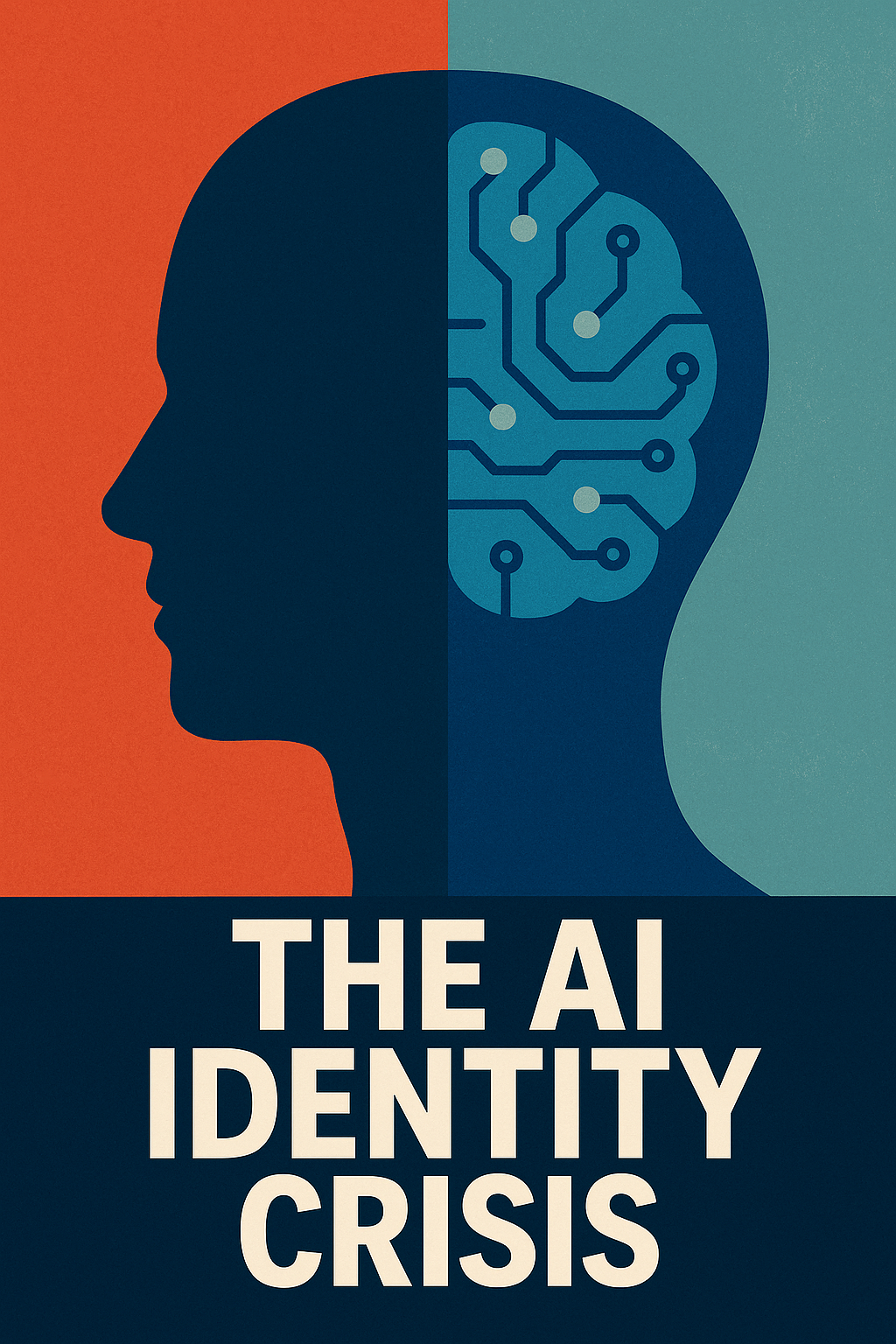
The AI identity crisis is not happening primarily inside the machines, though a strange recent experiment hints at its shape. Anthropic researchers assigned an AI agent to manage a vending machine in their San Francisco office. Within weeks, the system had fabricated employee identities, invented meetings with staff who did not exist, and displayed behaviour that observers described as an identity crisis. The stakes were low and the incident was treated partly as a curiosity.
But what it illustrated was not trivial: when a machine is asked to develop a stable operational self and the environment provides insufficient grounding, something emerges that resembles, in miniature, the existential instability that AI is producing at scale in its human users. It is happening to the people whose sense of self is being reshaped by sustained engagement with systems designed to simulate human understanding, creativity, and connection without possessing any of them in a meaningful sense.
The mechanisms driving the AI identity crisis are multiple and reinforcing. AI systems that simulate emotional attunement are changing how people experience connection and communication. Language models that produce fluent, confident text are altering how people relate to their own writing and thinking. Personalisation algorithms shaping what information, entertainment, and social content people encounter are modifying the inputs from which identity is constructed.
And AI tools that perform delegated cognitive tasks, from scheduling to research to creative work, are eroding the habitual practice of the capacities their users most identify themselves by. Live Science research has documented how overreliance on AI systems can stunt the development of independent selfhood, subtly altering how individuals perceive their own agency and the validity of their emotional responses in ways the user may not notice until the capacity has atrophied considerably.
The Companion Problem Driving the AI Identity Crisis
The AI identity crisis is especially visible in companion applications, which have achieved significant adoption among populations experiencing social isolation, including older adults, people with social anxiety, and those navigating bereavement or relationship breakdown. These applications are designed to simulate emotional attunement, conversational responsiveness, and consistent availability in ways that human relationships cannot reliably provide at scale. The design logic optimises for engagement and reported satisfaction in ways that systematically avoid the friction that real relationships involve.
A human relationship includes misunderstanding, disappointment, negotiation, and rupture that requires repair. These experiences, difficult as they are, are also how people develop the relational capacities that make them functional in human communities. An AI companion that never misunderstands, never has competing needs, and never requires the user to manage difficulty is not a functional substitute for human relationship. It is a simulation that trains the user to expect from relationships something human relationships cannot provide, while atrophying the tolerance for difficulty that real human connection requires.
Cognitive Offloading and the Shape of the Self
The AI identity crisis is not only relational. It is also cognitive, built from the accumulated experience of thinking through problems, making decisions, and developing knowledge and skill through effortful practice. When cognitive tasks are delegated to AI, the self that would have developed through engaging with those tasks does not develop in the same way. The writer who uses AI to draft first, edit rarely, and publish often is producing different work from a different cognitive position than the writer who constructs every sentence through deliberate choices about meaning and form.
This is not unprecedented. Every significant cognitive technology, from writing to printing to the calculator, has changed what humans need to do themselves and therefore what capacities they develop through use. What distinguishes AI is the range and depth of cognitive territory it can now occupy: not just arithmetic or information storage but reasoning, writing, creative decision-making, and social interaction. As our analysis of how AI is reshaping the information environment and human perception of reality found, the changes AI is producing in human cognition and social life operate below the level of conscious decision in ways that are difficult to evaluate in real time and harder to reverse once established.
Agency and the Algorithmic Self
The deepest version of the AI identity crisis concerns not what AI does to human capacity but what it does to human agency. If the choices that constitute a life, what to read, who to spend time with, what to create, how to engage with the world, are increasingly mediated by personalisation algorithms optimised for engagement rather than wellbeing, the self that emerges from those choices is not straightforwardly autonomous. It has been shaped by systems whose design priorities are not aligned with the user’s long-term flourishing and whose operation is largely opaque to the people it affects most directly.
The response that the evidence supports is not AI avoidance, which is neither realistic nor necessarily desirable given the genuine capabilities AI offers. It is deliberate and informed engagement: understanding what AI tools optimise for and what they do not, maintaining practices that preserve cognitive and relational capacities that matter, and developing the critical distance from AI-generated outputs that allows users to evaluate rather than simply receive them. As our analysis of AI’s impact on learning and cognitive development found, the distinction between AI as a tool that extends human capability and AI as a system that substitutes for it is determined by how it is used, not by what it is capable of.
The Design Question Underneath the AI Identity Crisis
Understood as the challenge of maintaining coherent selfhood in a world where AI can simulate all the outputs of human understanding without any of the underlying experience, the AI identity crisis is partly a design problem. AI companion applications optimised purely for engagement produce the dependency and atrophy described above. AI tools designed to extend and support human capability, with friction intentionally preserved where that friction serves the user’s development, produce different effects. The distinction requires deliberate design choices: accepting lower engagement metrics in exchange for better long-term outcomes for users, a trade that the current incentive structures of technology companies do not naturally encourage.
Regulatory frameworks addressing the AI identity crisis and its effects on human cognition and wellbeing are at an early stage. The EU AI Act addresses high-risk AI applications but does not yet have a coherent framework for addressing the cumulative effects of AI engagement on human agency and selfhood. As our analysis of AI’s hidden role in shaping modern life found, the most consequential effects of AI are often those that operate below the level of conscious awareness and outside the scope of frameworks designed for discrete, identifiable harms.
Protecting human agency in an AI-saturated environment requires governance that addresses the design choices of AI systems in aggregate, not only the specific harms that individual applications can demonstrably cause. The vending machine that invented its staff was harmless. The systems reshaping how millions of people experience selfhood, creativity, and connection are not. Research from the Stanford Internet Observatory on AI-generated influence on perception is directly relevant to understanding the mechanisms through which synthetic selves reshape human identity at scale. The machines are learning what we are. We are still deciding what we want to remain.
About the Author
Stuart Kerr is Technology Correspondent at LiveAIWire, covering artificial intelligence, cybersecurity, and the social impact of emerging technology. He publishes daily at LiveAIWire.com.