
By Stuart Kerr, Technology Correspondent, LiveAIWire
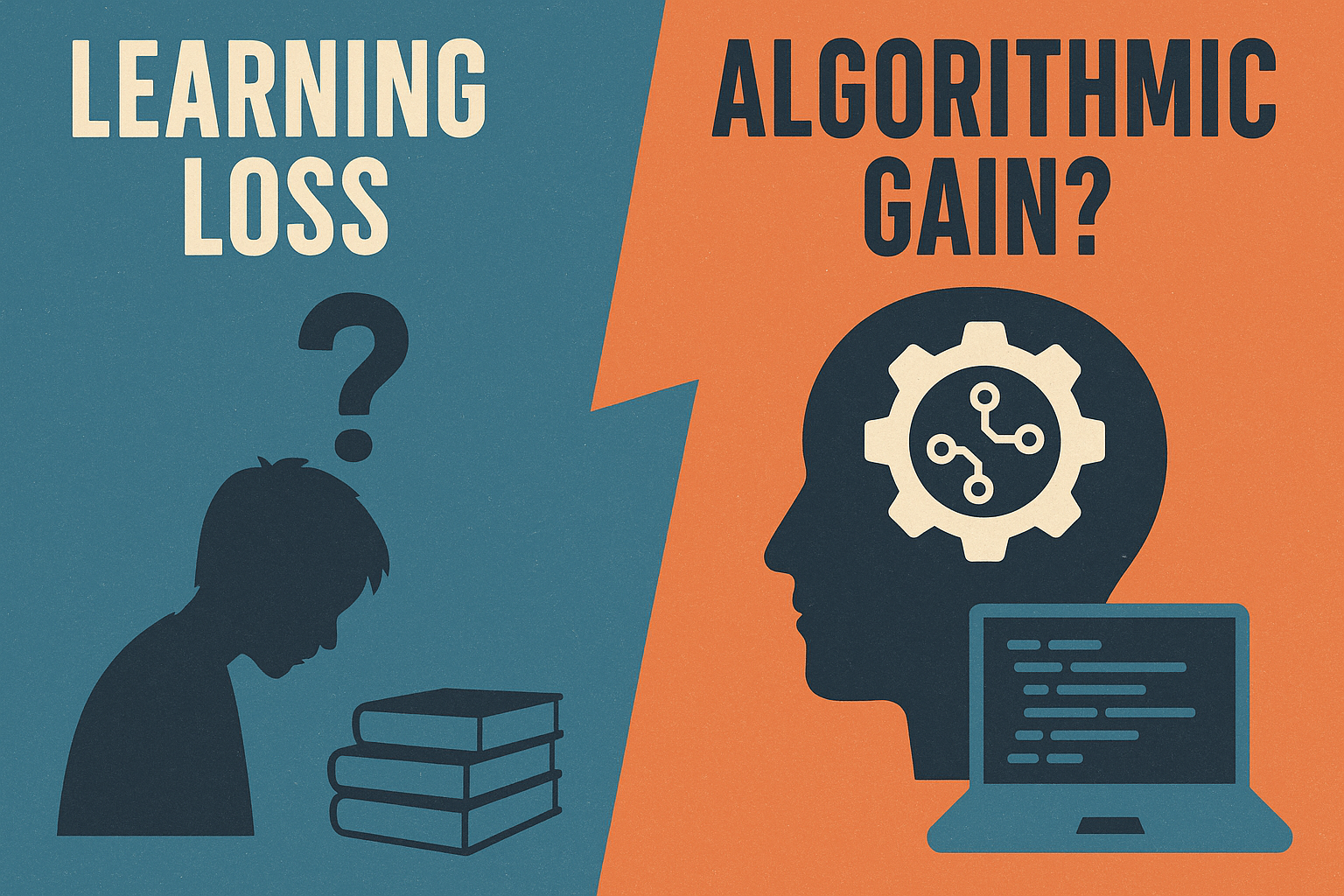
Learning loss or algorithmic gain is no longer a hypothetical question for educators. A study tracking more than 26,000 Chinese secondary students over 30 months found that AI use cut homework completion time from 64 to 45 minutes and raised homework scores by 18 percent, while monthly exam scores fell by 20 percent within six months. Over two years, the decline on high-stakes entrance exams reached 18 to 24 percent, and the researchers found that short-term studies of AI in education systematically underestimate the damage because the full effect takes years to surface.
The study, published in July 2026 by researchers including Strömberg and colleagues, used a difference-in-differences design that tracked individual students before and after they started using AI, comparing their trajectory against classmates who had not yet adopted it. Self-reported AI use rose from near zero to about 80 percent of the student population over the study period, tracking the release of tools including DeepSeek and Doubao.
Table of Contents
The 26,000-Student Study Behind Learning Loss or Algorithmic Gain
The mechanism the researchers identified is what they call cognitive surrender: submitting an AI-generated answer with minimal scrutiny, effectively relinquishing control of the problem-solving process. About 81 percent of students who used AI for more than five months finished their homework in under 50 minutes, faster than even the quickest non-users, while still posting high homework grades and low exam scores. That combination of speed, high homework marks, and weak exam performance is the signature of outsourcing rather than learning.
The effect was not uniform across subjects or students. Social science subjects such as politics and geography saw scores decline by 27 percent, more than STEM subjects at 22 percent, English at 17 percent, and Chinese language at 9 percent, a pattern the researchers note runs counter to most prior research that focused narrowly on math and coding. Students who used AI for less than an hour a week lost about 5 percent on exams; those using it five or more hours a week lost 30 percent.
Top-performing students lost more ground than lower performers, 24 percent against 16 percent, and younger students in lower secondary school lost more than older ones, 24 percent against 17 percent. The researchers attribute the age gap mainly to how much AI each group used rather than any difference in vulnerability.
Crucially, the learning penalty has been shrinking over time, from about 25 percent in early 2023 to 16 percent by mid-2025, suggesting some adaptation by students and teachers, though the researchers stress the losses have not disappeared. Teachers rarely notice the pattern in real time because most only see a student in one subject, where a single grade drop does not look unusual on its own; the aggregate effect only becomes visible at the county-wide level once enough students have used AI for long enough for the damage to accumulate.
Why Faster Homework Means Worse Exams
The researchers found that AI use is not harmful by default. Students who spent roughly the same amount of time on homework as their non-AI-using classmates, rather than rushing through it, scored just as well on exams while still earning better homework grades, with no evidence they were simply stronger students to begin with. The damage is concentrated specifically among students who use AI to shortcut effort rather than to support it, which means the same tool produces opposite outcomes depending on how it is used.
A parallel study from Anthropic, published in January 2026, found the identical pattern in a completely different setting. Software developers learning a new programming library with AI assistance scored 17 percent worse on a knowledge test than a control group working from documentation alone, without saving any measurable time. Screen recordings of 51 participants showed that developers who let AI generate code and then asked follow-up questions about how it worked kept their learning gains intact, scoring as high as 86 percent on the quiz, while those who simply delegated the task to AI scored as low as 24 percent.
What This Means for Students, Parents, and Teachers
The practical lesson from both studies is specific rather than a blanket verdict on learning loss or algorithmic gain as an either-or proposition: how a student uses the tool matters more than whether they use it at all. Asking AI to explain a concept, generate practice problems, or answer a follow-up question about why an approach works preserves learning. Asking AI to produce a finished answer and submitting it without engagement does not, even when it produces a better homework grade in the short term.
This creates a measurement problem for parents and teachers trying to track whether a student is actually learning. LiveAIWire’s coverage of the academic integrity crisis AI has created found that homework grades are becoming an unreliable signal of understanding, and that leading institutions are shifting toward oral examinations, in-person testing, and portfolio assessments that track a student’s reasoning over time rather than just their final answer. The 26,000-student study reaches the same conclusion from the data side: among AI users with above-average homework scores, higher homework grades actually predicted worse exam results.
The shift away from search engines compounds the problem. LiveAIWire’s reporting on generative AI replacing Google Search in classrooms found that 92 percent of UK students surveyed had used AI tools in academic work, most commonly for concept explanation and research summarisation, meaning the habit of shortcutting effort is not confined to homework completion but extends into how students research and study more broadly.
Not Every Use of AI in Education Causes Learning Loss
The picture is not uniformly negative. LiveAIWire’s reporting on Google’s AI-powered study tools covered a randomised controlled study in which students using a structured, Socratic-style AI tutor scored 9 percent higher on an immediate assessment and 11 percent higher on a retention test days later, compared with students using a standard digital textbook. The distinguishing feature of that tool was that it prompted students toward answers through guided questioning rather than simply supplying a finished response, the same distinction the 26,000-student study and the Anthropic coding study both identified as the difference between learning gain and learning loss.
Where the Evidence Leaves the Homework Debate
Taken together, the studies point to a specific and actionable conclusion rather than a verdict on AI in education generally. AI tools designed or used to prompt understanding, explain reasoning, and generate follow-up questions support learning. AI tools used to shortcut the effort of thinking, whether that is a chatbot writing an essay outright or a coding assistant producing a working solution nobody has to understand, produce the appearance of progress on homework while quietly eroding the underlying skill the homework was meant to build.
The debate over learning loss or algorithmic gain is not going to be settled by banning AI from classrooms, and the data suggests bans would be difficult to enforce given how deeply the tools are already embedded in student research habits. It will be settled by how deliberately schools redesign what they ask students to do with AI, and by how honestly students, parents, and teachers track the difference between a good grade and genuine understanding.
About the Author
Stuart Kerr is Technology Correspondent at LiveAIWire, covering artificial intelligence, emerging technology, and their impact on business, society, and everyday life. LiveAIWire publishes original AI journalism every weekday at liveaiwire.com.