
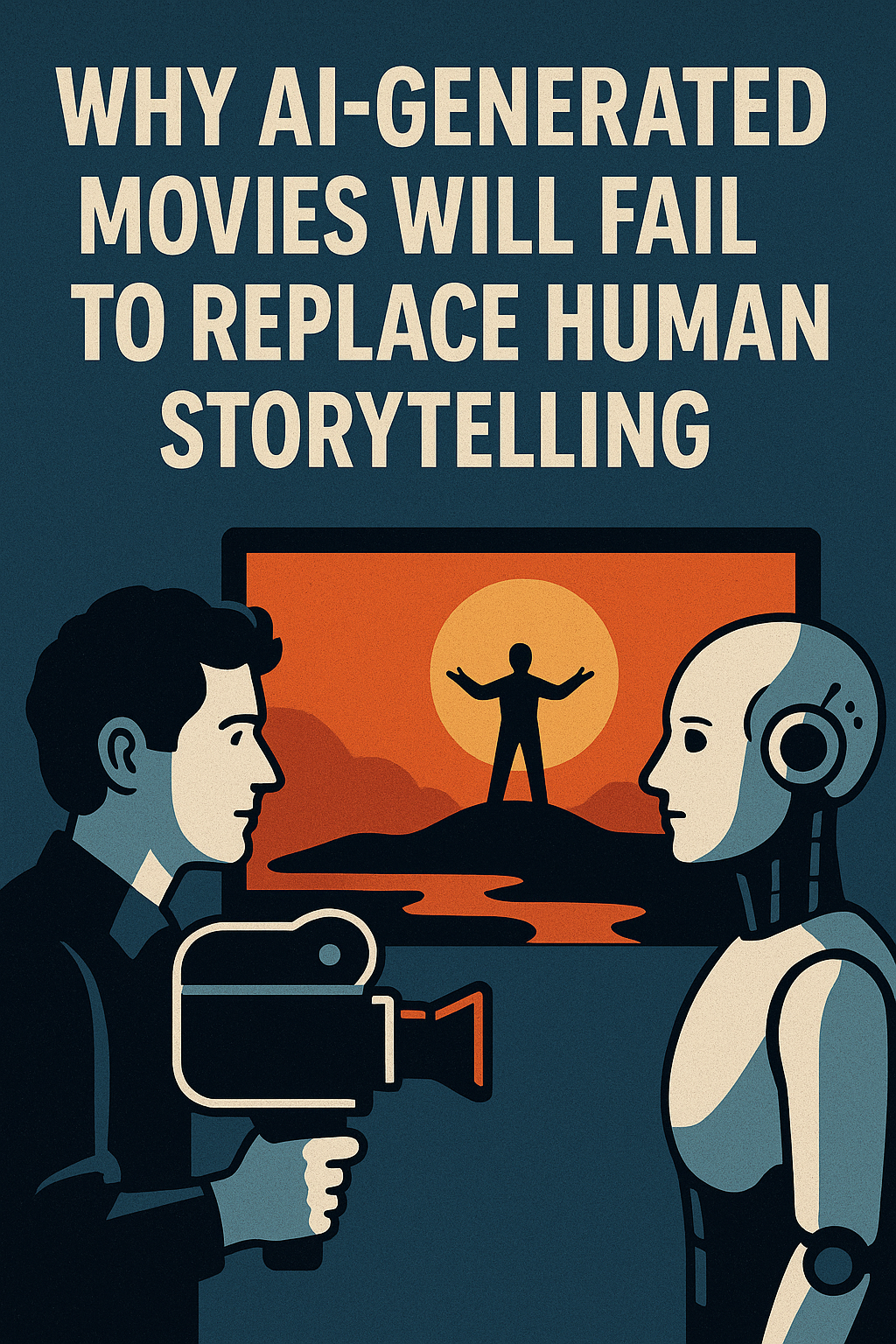
The
first fully AI-generated feature film premiered at a minor film festival in
2024. The promotional materials described it as a landmark in creative
history. The audience response was polite and the critical response was
revealing: technically impressive, emotionally inert. The film had the
surface characteristics of cinema, structured scenes, recognisable dialogue
patterns, visual coherence, and a three-act structure, without the underlying
quality that makes films worth watching. It was film-shaped content rather
than film. This distinction, between the formal properties of a medium and
the human significance that makes those formal properties worth having, is
the one that advocates of AI-generated cinema consistently underestimate and
that the history of artistic media consistently validates.
The case for AI-generated cinema is made primarily in terms of
cost reduction and production speed. Creating visual content that would
previously have required a large crew, expensive locations, and months of
post-production can now be achieved in a fraction of the time and at a
fraction of the cost using generative AI for visuals, dialogue, and music.
Studios facing escalating production costs and writers’ rooms demanding fair
compensation for their labour find the economics of AI content generation
genuinely attractive. The question is whether the economic efficiency of AI
content production translates into the cultural value that cinema at its best
creates, and the evidence so far suggests a significant and perhaps
fundamental gap.
What Cinema Actually Is
Understanding why AI struggles with cinema requires understanding
what cinema actually does that makes it valuable. The films that endure, that
are watched decades after their release, that change how audiences understand
themselves and the world, do so because they embody specific human
perspectives, experiences, and insights that emerge from particular
individuals engaging seriously with particular human situations. Christopher
Nolan’s films reflect specific obsessions with time, memory, and moral
ambiguity that arise from his particular sensibility. Greta Gerwig’s work
expresses specific perspectives on femininity, ambition, and contradiction
that emerge from her specific experience and vision. Akira Kurosawa’s cinema
reflects a specific Japanese post-war consciousness that is inseparable from
the historical moment and personal history that produced it.
AI systems trained on existing cinema can produce content that
statistically resembles the films it was trained on. It cannot produce the
specific perspective, the genuine insight, or the particular human truth that
makes the best films worth the hours they require. This is not a technical
limitation that will be solved by larger training datasets or more
sophisticated architectures. It is a reflection of what storytelling is: the
communication of human experience, from one human consciousness to another,
through a medium that has developed specific conventions for doing this
effectively. AI has no experience to communicate. It has patterns derived
from the experiences of others, which it can recombine in formally coherent
ways that lack the motivating insight that makes those patterns
meaningful.
The Technical Ceiling
Current AI video generation, from systems including Sora, Runway,
and Kling, produces visually impressive short-form content that demonstrates
significant capability advances over what was possible two years ago. The
limitations become apparent when these systems are asked to maintain
narrative coherence over the duration of a feature film, create characters
whose behaviour is consistent and motivated over time, or produce the kind of
precise visual storytelling in which every edit, every composition, and every
performance choice serves a specific dramatic purpose. Film critics who have
evaluated AI-generated long-form content consistently identify the same
issues: visual coherence without narrative drive, technically accomplished
sequences without dramatic purpose, and characters who behave consistently
with their context but not with any coherent inner life that makes their
choices meaningful.
The writers’ and directors’ strike of 2023, which produced
specific contractual protections against AI replacement of human creative labour
in Hollywood productions, reflected the film industry’s understanding that
the threat of AI to their livelihoods was real even if its replacement of
storytelling quality was not. The distinction between AI replacing the
economic function of human creatives and AI replacing the creative value they
produce is one that the contracts negotiated by the Writers Guild of America
and the Directors Guild of America were careful to preserve. The WGA agreement
specifically limits the use of AI in script development while permitting AI
tools that assist rather than replace human writers, drawing exactly the line
that the artistic argument suggests is the right one.
The Future Relationship Between AI and Cinema
The most productive relationship between AI and cinema is not
replacement but augmentation. AI tools that reduce the cost of visual
effects, accelerate pre-visualisation, assist with scheduling and production
logistics, and enable filmmakers with limited budgets to realise visual
ambitions that were previously inaccessible are genuine contributions to
cinema’s creative ecosystem. A director who can use AI to visualise ten different
versions of a scene in the time it previously took to visualise one is a more
empowered creative, not a redundant one. The history of cinema is a history
of new technologies extending the range of what filmmakers can express, from
sound to colour to CGI, and AI belongs in that tradition as a tool in the
service of human vision rather than a substitute for it.
What This Means for You
As a cinema audience, you are already encountering AI-assisted
filmmaking in ways you may not recognise: de-aging visual effects,
AI-generated background environments, AI-assisted colour grading and sound
design. These applications enhance rather than replace human creative labour,
and the films they support are better for their inclusion. The scenario in
which AI generates complete films without meaningful human creative direction
is both technically further away and creatively less interesting than its
advocates suggest. The risk worth watching is not AI replacing cinema but
studios using AI to reduce investment in the human creative labour that
produces the quality that makes cinema worth watching, while substituting
AI-generated content that meets audience attention without earning their engagement.
For related analysis, see our coverage of AI
in media content creation and AI
and creative rights.
The economic argument for AI-generated cinema deserves engagement
rather than dismissal. Rising production costs have made original risk-taking
content increasingly difficult for major studios, and AI tools that reduce
specific production costs without replacing human creative direction could
support more experimental work by making it less financially threatening. The
distinction that matters is between AI as a cost-reduction tool in service of
human creative vision and AI as a substitute for human creative vision in
service of cost reduction alone. The former has genuine potential to benefit
cinema; the latter is what the most ambitious AI cinema advocates are
proposing, and what the evidence of current AI-generated content quality
suggests will not achieve the cultural value that justifies cinema’s place in
human experience. The British Film Institute
has published analysis of AI’s impact on UK film that distinguishes carefully
between these scenarios, providing policy recommendations calibrated to
support beneficial applications while managing the risks of wholesale
creative substitution.
The audience research that would
definitively test the claim that AI-generated cinema is less emotionally
engaging than human-directed cinema does not yet exist in sufficient volume
to be conclusive. What does exist is the consistent critical and audience
response to AI-generated short-form content, which documents the technically
impressive but emotionally limited character of current AI creative outputs,
and the historical evidence from other creative media where algorithmic
generation of content that meets formal criteria has consistently failed to
match the cultural resonance of human-created work in the same genre. These
are strong indicators rather than proof, and the AI cinema advocates who
argue that the situation will change as AI capabilities improve are making a
claim about future capabilities that current evidence cannot definitively
refute.
About the Author
Stuart Kerr is a technology correspondent at LiveAIWire, covering
artificial intelligence, digital innovation, and the social impact of
emerging technologies. Follow LiveAIWire for daily analysis at liveaiwire.com.