
Associated
Press produces over 50,000 quarterly earnings reports annually using AI, a
volume of financial journalism that its human staff could not generate at
equivalent speed or scale. The Guardian uses AI to produce automated match
reports for lower-league football games that would not otherwise receive any
coverage. Bloomberg’s Cyborg system assists reporters in processing and
contextualising financial data for stories that blend AI-generated analysis
with human editorial judgement. These are not experimental deployments at the
technological frontier; they are established production workflows at major
media organisations that have been operating for years and are now being
extended significantly as AI capabilities improve and the cost of not
adopting becomes commercially unacceptable for most
publishers.
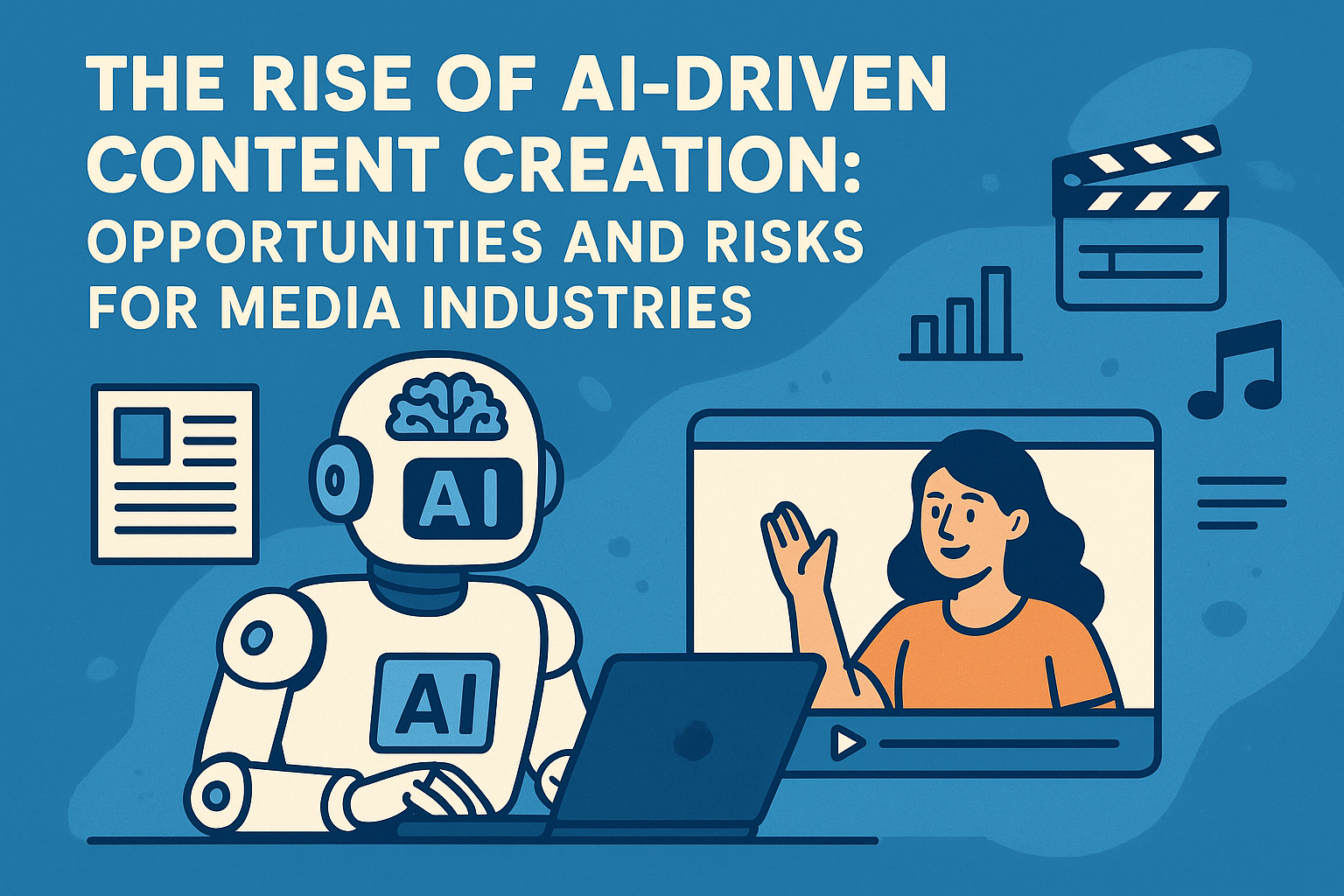
The rise of AI-driven content creation in media is accelerating
along two parallel tracks that have quite different implications for
journalism quality and democratic function. The first is AI automation of
structured, data-driven content: earnings reports, sports statistics, weather
summaries, and election results that can be generated reliably from
structured data inputs. This automation is largely beneficial; it frees human
journalists from repetitive production tasks while expanding the volume of
content that news organisations can provide. The second track is AI
generation of narrative content, opinion, analysis, and
investigative-adjacent material that previously required human reporting and
editorial judgement. This track is where the risks to journalism quality and
public interest accountability are concentrated.
Structured Content Automation: The Established Case
The case for AI automation of structured journalistic content is
strong and increasingly well-evidenced. Natural language generation systems
trained on templates and data produce financial results coverage, sports match
reports, and real estate listings that are accurate, timely, and readable.
Readers of AP’s earnings reports cannot reliably distinguish AI-generated
from human-written content when both are based on the same financial data.
The efficiency gain is substantial: an AP journalist who previously spent
four hours covering quarterly earnings across ten companies can now spend
that time on the analytical and contextual work that AI cannot perform, while
the routine coverage is handled automatically.
The extension of this model to local news has significant
implications for communities that have lost local news coverage as regional
publishers have contracted. AI-generated reporting on local government
meetings, planning applications, and court cases, based on publicly available
documents, could partially address the local news desert that has developed
in many UK communities as local papers have closed or reduced coverage. The
Local Democracy Reporting Service, which already uses AI tools to assist
human reporters in covering local democratic processes, represents one model
for how automated content generation can be paired with human oversight to
serve communities with limited local media resources.
The Narrative Content Risk
The risks concentrate where AI moves from structured data to
narrative content requiring contextual judgement, source relationships, and
editorial responsibility. Several publishers have experienced significant
reputational damage from AI-generated narrative content containing factual
errors, fabricated citations, and misleading claims produced with the
confident fluency that characterises current large language models. CNET’s
retraction of multiple AI-generated personal finance articles following
fact-checking by independent journalists illustrated the scale of error that
can occur when AI narrative generation is deployed without adequate human
editorial oversight. The Press Gazette
has documented dozens of similar incidents at publishers ranging from
regional newspapers to major digital outlets across the UK and
internationally.
The broader concern is not individual errors but systematic
reduction in the quality of the information environment. When AI-generated
content that superficially resembles journalism displaces human reporting,
the investigative, source-based, accountability journalism that serves
democratic functions is crowded out by content that mimics its form without
performing its function. Readers who cannot reliably distinguish AI-generated
content from human reporting cannot make informed judgements about the
reliability of what they read, and the brand trust that publications have
built through decades of editorial investment is eroded by AI shortcuts that
reduce costs while reducing quality.
Regulatory and Industry Responses
The regulatory framework for AI in media is developing slowly
relative to the pace of deployment. The EU’s AI Act includes transparency
requirements for AI-generated content that apply to media organisations,
requiring disclosure when AI has played a substantial role in producing
content. In the UK, the Information Commissioner’s Office has issued guidance
on AI and editorial responsibility under data protection law, but there is no
specific statutory requirement for AI disclosure in journalism. The National
Union of Journalists has called for negotiated agreements on AI use in
newsrooms that protect editorial standards and journalist employment, with
variable success across different publishers.
Industry self-regulation initiatives, including the Reuters
Institute’s responsible AI in journalism framework and the UK news
publishers’ joint guidelines on AI editorial use, provide guidance that the
most responsible publishers are implementing. The challenge is that the
competitive pressure to reduce costs is most intense at the publishers least
likely to invest in responsible AI governance, meaning that self-regulation
is systematically weakest where it is most needed. For related analysis, see
our coverage of AI’s
human cost in journalism and AI
and democratic information.
What This Means for You
Media consumers are navigating a content environment in which AI
involvement is increasingly pervasive and insufficiently disclosed. Treating
all content with equivalent trust regardless of whether it is AI-generated or
human-reported is an adaptation that most readers have not yet made, and the
publications that trade on this gap between apparent and actual editorial
investment are exploiting reader trust in ways that damage both individual
readers and the broader information ecosystem. Developing habits of source
verification, byline scrutiny, and scepticism about data-heavy content from
publications known to have cut editorial staff significantly are practical
responses to an environment that requires more critical reading than was
necessary a decade ago. The economics of quality journalism are not going to
improve simply because readers prefer it. Quality journalism requires
economic models that generate sufficient revenue to sustain the
investigative, source-based, accountability reporting that distinguishes
journalism from content production. Subscription models, where readers pay
directly for journalism they value, provide better incentives for quality
than advertising models optimised for clicks. Philanthropy and public funding
provide additional support in contexts where market economics alone cannot
sustain public interest journalism. AI can reduce costs, but only human
editorial investment, funded at adequate scale, can maintain the quality that
makes journalism worth reading. The Reuters
Institute for the Study of Journalism publishes annual analysis of
news media economics and AI adoption that provides the most rigorous ongoing
assessment of how these dynamics are playing out across different markets.
Publications that are transparent about their AI use and demonstrably
maintain human editorial oversight deserve both reader loyalty and the
commercial support that loyalty brings.
The advertising model that funds
most free online journalism creates incentives that are structurally
misaligned with quality, because engagement-maximising content is not always
the same as the most accurate, most important, or most socially valuable
content. AI that further reduces the cost of producing engagement-optimised
content without improving the incentives for quality journalism may worsen
this structural problem. The Press Gazette
annual analysis of UK publisher AI policies provides the most current mapping
of how different organisations are navigating these trade-offs.
About the Author
Stuart Kerr is a technology correspondent at LiveAIWire, covering
artificial intelligence, digital innovation, and the social impact of
emerging technologies. Follow LiveAIWire for daily analysis at liveaiwire.com.