
By Stuart Kerr, Technology Correspondent, LiveAIWire
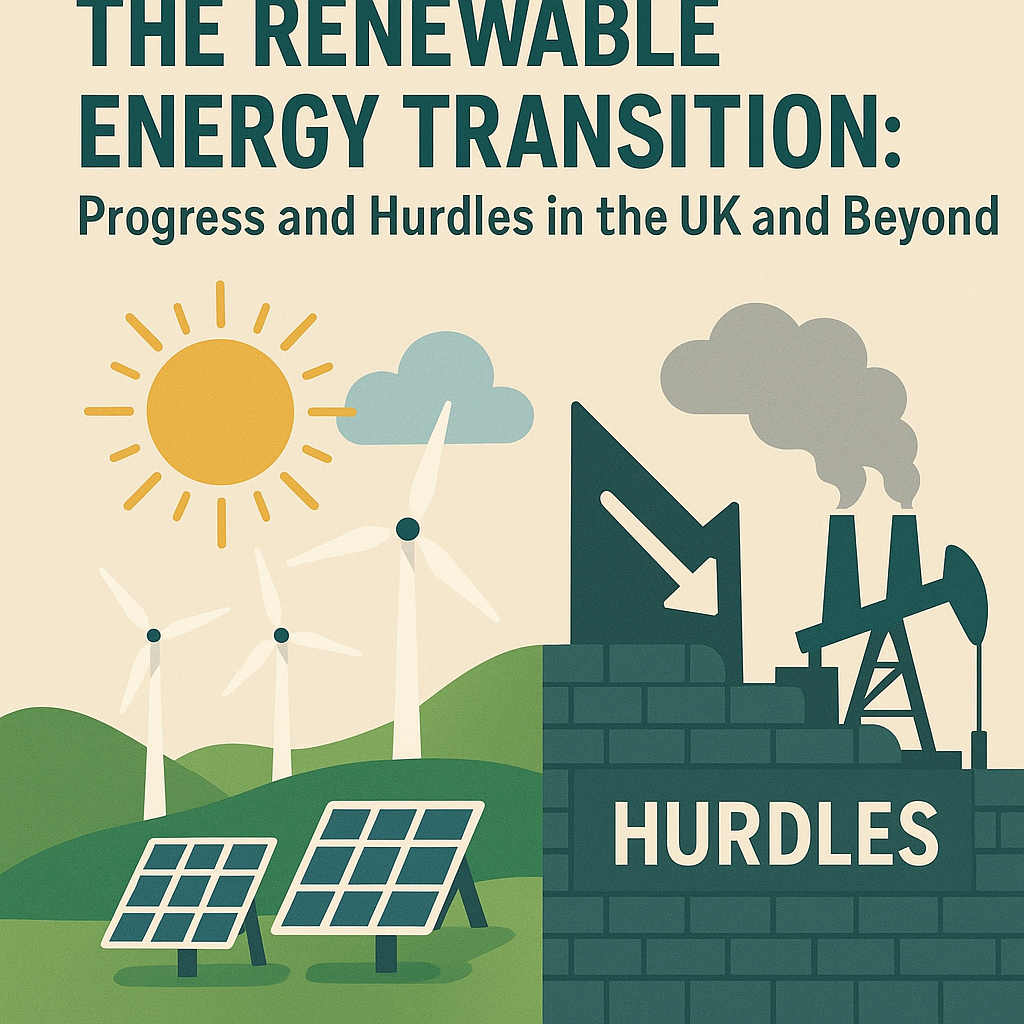
The renewable energy transition generated more than 42 percent of the United Kingdom’s electricity in 2023, the highest proportion in its history, a transformation that would have seemed implausible a decade ago. Wind power alone contributed a quarter of total electricity generation, with offshore wind farms stretching across the North Sea representing one of the largest and most ambitious infrastructure projects in British history. The transition is real, it is measurable, and in several important respects it is ahead of schedule. It is also incomplete, contested, and facing genuine technical, economic, and political challenges that cheerful headline figures tend to obscure.
The global picture is more complicated than the UK story. Renewable capacity is being added faster than at any point in history, driven by dramatic cost reductions in solar and wind technology that have made new renewable generation cheaper than new fossil fuel generation in most markets. But total emissions from the energy sector continue to rise in absolute terms, because the growth in global energy demand is outpacing the growth in clean generation.
Completing the renewable energy transition is not simply a matter of building enough wind and solar; it requires replacing existing fossil fuel infrastructure, addressing the intermittency challenges of variable renewable generation, and managing a political economy that has powerful incumbents with strong incentives to slow the transition.
UK Renewable Progress: The Numbers
The UK’s renewable energy progress is most visible in electricity generation, where the policy environment, particularly the Contracts for Difference scheme that de-risks investment in new renewable projects, has driven rapid capacity growth. Offshore wind capacity has grown from near zero in 2000 to approximately 14 gigawatts in operation by the end of 2023, with a substantial pipeline of further projects in development. The Crown Estate’s leasing rounds for new offshore wind sites have attracted significant investment from international energy companies, reflecting commercial confidence in the UK’s offshore wind resource and policy framework.
Solar capacity has grown substantially, though the UK’s latitude limits its potential relative to southern European countries. Onshore wind has grown more slowly than offshore, partly reflecting planning restrictions that have made new onshore wind development in England significantly more difficult than in Scotland, Wales, and Northern Ireland. The National Grid Electricity System Operator has published analysis showing that achieving the government’s 2035 clean power target requires accelerating deployment of all low-carbon technologies, including onshore wind, solar, and battery storage, substantially beyond current planning approval rates.
The Intermittency Challenge
The fundamental technical challenge of the renewable energy transition is intermittency: these sources generate electricity when conditions are favourable, not necessarily when demand is highest. Managing a high-renewable electricity system requires investment in storage, interconnection, and flexible demand management that goes substantially beyond what is needed for a fossil fuel-based system. The engineering challenge is solvable, but it requires additional investment and system complexity that adds to the cost of the renewable energy transition.
Battery storage is the most rapidly advancing solution. Utility-scale battery installations in the UK have grown from negligible capacity in 2018 to over 3 gigawatts by 2024, and the pipeline of projects in development would take this to approximately 20 gigawatts within a few years, providing significant buffering capacity for the electricity system. Long-duration storage technologies, including pumped hydro, hydrogen, and compressed air storage, are needed for seasonal balancing but are at earlier stages of commercial development.
AI is playing an increasingly important role in managing the complexity of high-renewable electricity systems. Machine learning models that forecast wind and solar generation, optimise storage dispatch, and manage demand flexibility across millions of connected devices are enabling the electricity system to operate reliably at renewable penetrations that would have been operationally challenging without AI-assisted control systems, a capability LiveAIWire has examined more broadly in our coverage of AI critical infrastructure.
Heat, Transport, and the Hard Sectors
Electricity decarbonisation, while central to the renewable energy transition, represents only part of the net zero challenge. Heat accounts for approximately 40 percent of UK energy consumption and remains overwhelmingly dependent on natural gas through the existing gas grid. The transition from gas heating to heat pumps, district heating, or hydrogen is technologically feasible but requires investment at a scale and speed that the current policy framework has not yet mobilised. The UK’s Climate Change Committee has consistently flagged heat decarbonisation as the area where policy ambition most significantly lags behind what the government’s own net zero targets require.
Transport electrification is proceeding faster than most predicted, driven by falling electric vehicle costs, expanding charging infrastructure, and the 2030 ban on new petrol and diesel car sales. However, aviation, shipping, and heavy freight remain technically and economically challenging to decarbonise, and they represent a significant fraction of transport emissions that battery electrification alone cannot address.
What This Means for You
The renewable energy transition is affecting your electricity bill, your heating choices, and potentially your transport options in ways that will intensify over the coming decade. Electricity prices in the UK have been affected by both the transition costs and the exposure to gas price volatility that the transition is designed eventually to eliminate. As renewable penetration increases and storage capacity grows, the long-run economics of clean electricity are expected to improve significantly.
The transition period, however, involves costs and disruptions that policy needs to manage fairly, particularly for lower-income households who spend a higher proportion of their income on energy and have less flexibility to invest in energy efficiency or low-carbon heating, an unevenness that echoes the distributional questions LiveAIWire has traced in our coverage of the AI automation divide.
The political economy of the energy transition presents challenges that technological progress alone cannot resolve, and fossil fuel interests remain significant in many countries, consistently seeking to slow or qualify transition policies.
The Political Economy of the Renewable Energy Transition
International coordination through mechanisms including the Paris Agreement and the Global Stocktake process is essential for managing the competitive dynamics of the renewable energy transition, but it is proceeding unevenly and faces sustained pressure from governments with significant fossil fuel interests. The International Energy Agency has published analysis showing that current national commitments under the Paris Agreement remain insufficient to achieve the 1.5 degree pathway, and its World Energy Outlook identifies accelerating energy efficiency improvements, ending approval of new fossil fuel supply projects, and tripling renewable energy deployment by 2030 as minimum requirements for a credible net zero pathway.
The UK’s own Climate Change Committee publishes an annual progress report that provides the most authoritative assessment of whether government policies are on track, and it makes clear that the current policy framework, while improved, remains insufficient for the legally binding net zero target.
The gap between stated ambitions and implemented policies is, by the Committee’s own assessment, wider than it has been at any previous point since the target was set, a governance lag comparable to what LiveAIWire has documented in our coverage of AI in disaster response, where climate-driven emergencies are also outpacing the policy frameworks meant to manage them. Closing that gap requires political will that goes beyond the current trajectory, and engaging with that gap honestly, rather than celebrating headline renewable statistics in isolation, is what a serious accounting of the renewable energy transition actually requires.
About the Author
Stuart Kerr is Technology Correspondent at LiveAIWire, covering artificial intelligence, cybersecurity, and the social impact of emerging technology. He publishes daily at LiveAIWire.com.