Reistance
By Stuart Kerr, Technology Correspondent
Published: 27 June 2025 | Last updated: 9 May 2026
Contact: [email protected] | Follow @LiveAIWire on X
Author Bio: https://liveaiwire.com/p/to-liveaiwire-where-artificial.html
AI Is Now Both the Tool of Protest and the Tool of Control
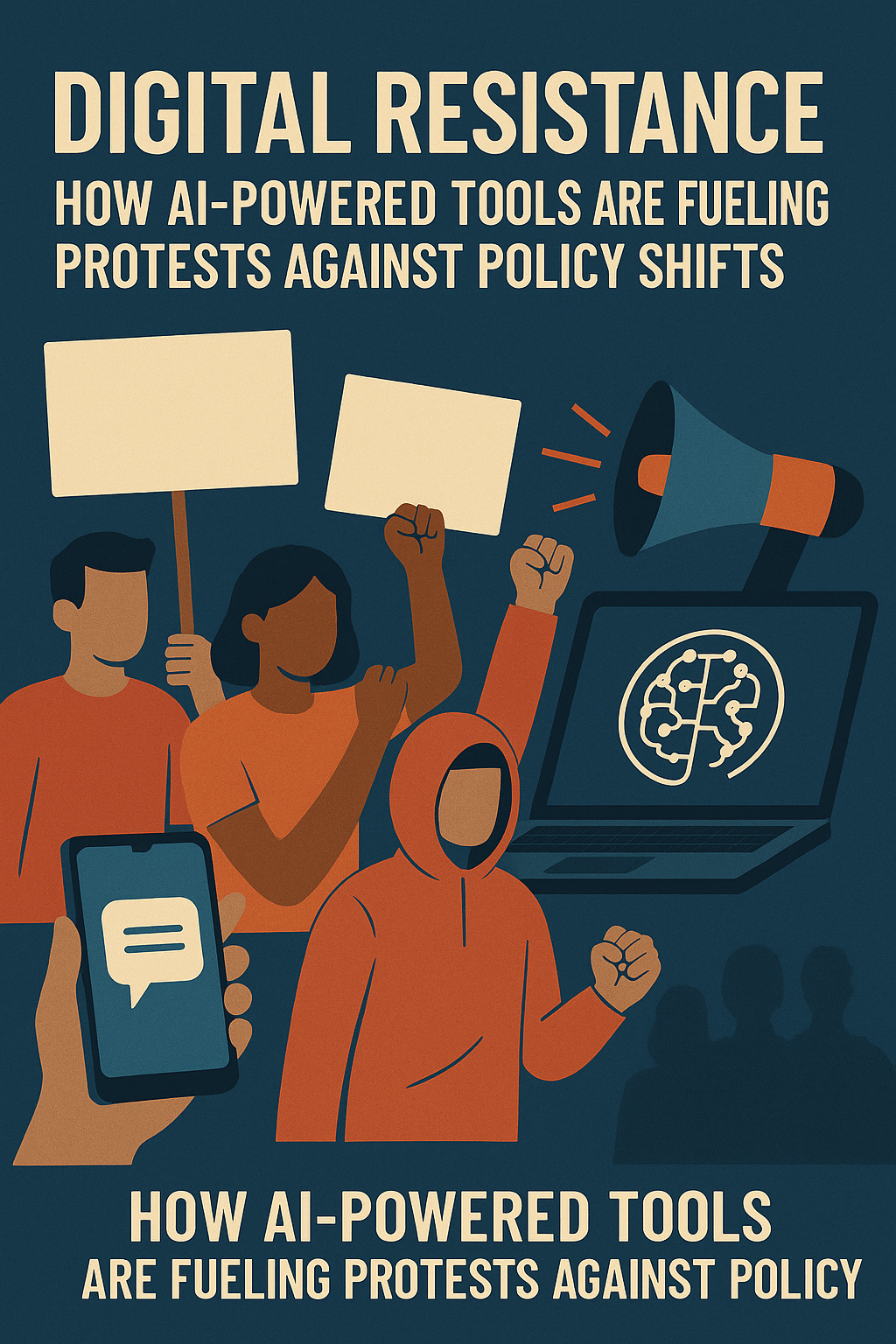
Digital resistance powered by AI has reached a genuinely new phase in 2026, and the story has taken a remarkable turn. When this article was first published in June 2025, the focus was on how AI tools were empowering activists to organise more effectively than ever before. That is still true. But 2026 has added a striking new dimension: AI itself has become one of the primary targets of protest, even as governments use AI surveillance tools more aggressively than ever to monitor and suppress dissent. The technology has become both weapon and battlefield simultaneously.
In February 2026, hundreds of people marched past the London headquarters of OpenAI, Google DeepMind, and Meta in one of the largest protests against AI to date. In March, an unlikely coalition of MAGA Republicans, democratic socialists, labour activists, and church leaders in the United States signed a Pro-Human AI Declaration, articulating the principle that AI should serve humanity rather than replace it. Protesters chalked messages around OpenAI’s San Francisco headquarters asking what the safeguards were, following the company’s deal with the Pentagon. According to Stanford’s 2026 AI Index, AI development is accelerating faster than society’s ability to govern or respond to it, and a growing number of people are no longer willing to watch from the sidelines.
AI as an Activist’s Ally
The tools available to activists have continued to expand since 2025. Platforms like ProtestAI and CrowdVoice use machine learning to analyse social media, identify trending issues, and suggest optimal protest locations. A June 2025 Reuters report highlighted how activists in Brazil used ProtestAI to coordinate climate marches, reaching 100,000 participants in São Paulo. Real-time translation tools such as DeepL’s AI-powered app enable cross-border collaboration at a scale that was previously impossible, allowing activists in different countries to share strategies instantly and coordinate actions across language barriers, as demonstrated during the 2025 global privacy campaign against EU data laws.
AI-generated visuals created by tools like DALL-E 3 have produced viral protest imagery, including posters for a 2025 Hong Kong rally against surveillance technology that garnered 500,000 shares on X. A 2025 Pew Research survey found that 65 percent of activists globally now use AI tools in their organising, up from 20 percent in 2022.
Case Studies of Impact
In April 2025, US students used an AI tool called RallyBot to organise campus demonstrations against education funding cuts. RallyBot, developed by a Stanford startup, automates permit applications and predicts police response patterns based on historical data. A 2025 Wired report noted that RallyBot increased turnout by 40 percent compared to manual planning.
In India, farmers protesting agricultural reforms leveraged AI-driven drones to monitor police movements during a 2025 Delhi march. Drones equipped with facial recognition helped protesters avoid confrontations, but they also raise significant privacy concerns among non-participants. Such examples underscore AI’s ability to amplify activism while introducing new risks that cut in multiple directions.
The Surveillance Arms Race
What has changed dramatically since mid-2025 is the scale and boldness of government counter-surveillance. A 2025 Amnesty International report revealed that China deployed AI surveillance to track Hong Kong protesters, using facial recognition to identify and detain organisers. In the United States, an Electronic Frontier Foundation analysis found that more than 50 law enforcement agencies, including Border Patrol, ran hundreds of searches through automated licence plate recognition networks specifically tied to protest activity. Clearview AI, which has scraped billions of faces from the internet into a facial recognition database, is now used by ICE, the Army, and hundreds of law enforcement agencies with little meaningful legal constraint.
Privacy is a parallel concern. A 2025 TechCrunch investigation found that some AI organising platforms shared user data with third-party advertisers, sparking widespread backlash and raising serious questions about whether the tools activists rely on can actually be trusted.
A 2025 BBC report noted that France and Canada are developing AI systems to monitor protest activity, raising fears of overreach. Across Africa, internet shutdowns used to suppress civil unrest have doubled in less than a decade according to the African Digital Rights Network, with governments increasingly combining connectivity blackouts with AI surveillance to contain movements before they can grow.
The Counter-Tools Fighting Back
The activist response has been inventive. Encrypted AI planning tools like Signal’s AI-driven planner obscure user identities. Crowdsourced mapping projects have catalogued tens of thousands of surveillance cameras across the United States and Europe. Dedicated platforms allow citizens to check whether their vehicle licence plates have appeared in law enforcement surveillance logs. In some cities, community campaigns have successfully pressured local governments to cancel surveillance contracts, though cancelling one contract rarely removes the underlying infrastructure, since private cameras and data-sharing agreements persist independently of municipal decisions.
The chilling effect of surveillance is itself now a subject of formal international scrutiny. The UN Special Rapporteur on Freedom of Peaceful Assembly and Association launched an investigation into AI surveillance impacts on protest rights, with a final report due at the UN Human Rights Council’s 62nd Session in June 2026.
The Ethical Stakes Are Higher Than Ever
The use of AI in protests raises serious ethical and legal questions. AI-generated content, including protest videos and imagery, can spread misinformation if not clearly labelled. As explored in AI Bias Guardrails: Why August 2026 Is the Deadline That Changes Everything, the frameworks governing how AI can be used against citizens are still being written. The EU’s AI Act requires transparency for AI-generated content, but enforcement remains patchy. A 2025 Supreme Court ruling in the US upheld the right to use AI for protest planning but left unclear whether governments can regulate its use in public spaces.
A 2025 Gallup poll found that 58 percent of Americans support AI in activism but want strict privacy protections, reflecting the same tension between utility and trust that runs through every dimension of this debate.
The future of digital resistance will be shaped by who builds the better tools fastest. Right now that contest is genuinely open. People want a say in how AI transforms their lives, and as 2026 has shown, a growing number of them are no longer content to wait for permission to demand it.
About the Author
Stuart Kerr is a technology journalist and correspondent at LiveAIWire. Follow him on X at @liveaiwire.