
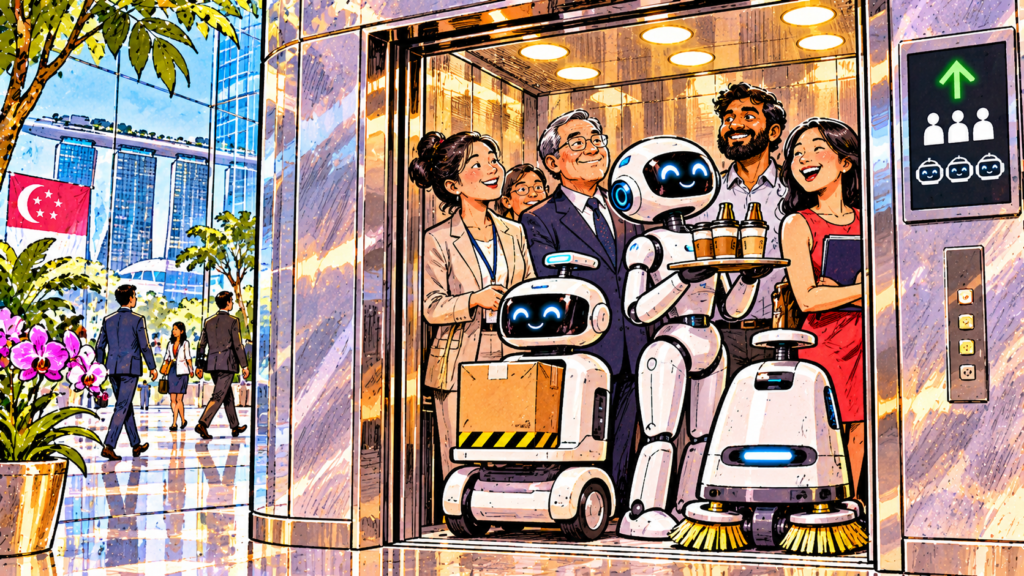
AI smart buildings could make a robot's journey between floors rather less complicated. On 26 November 2026, Singapore telecommunications company Singtel and the Government Technology Agency of Singapore signed an agreement to introduce a shared digital platform at One Comcentre, a new headquarters development expected to be completed by the end of 2028. It will provide a setting in which the partners can explore how robots interact securely with building infrastructure.
The physical problem is easy to understand. A delivery robot might travel down a corridor without difficulty, yet be unable to reach another floor because it cannot operate a lift. A robot that arrives at a controlled doorway may encounter a similar barrier. Unless the equipment can communicate appropriately, a human being has to intervene or the robot's useful operating area remains limited.
What AI smart buildings need to connect
The announcement from GovTech Singapore describes a memorandum of understanding to deploy the Open Digital Platform at the new development. The platform was created by GovTech and JTC Corporation to allow different systems to exchange information through common interfaces. The project will combine that capability with Singtel's communications and AI technology.
Connecting several systems in a building is not the same as giving every device access to everything. A robot that delivers a parcel needs to be able to reach its destination, but it does not need unrestricted access to records about the people who work in the building. The project specifically identifies trusted interactions between robots, AI services and infrastructure as an area of focus.
For a facilities manager, the opportunity extends beyond delivery. Heating and cooling equipment, lighting and security systems all produce information about what is happening in a building. Combining the appropriate information could allow staff to make more informed operational decisions and identify maintenance requirements before a fault becomes disruptive. The value will depend on how reliably the connections work and whether the resulting information is useful.
A building has rules that a robot must understand
Consider a lift in an ordinary office. It serves people whose requirements vary throughout the day. Workers may have to reach a meeting quickly, visitors may be unfamiliar with the building, and somebody using a wheelchair may need priority access to an appropriately sized lift. A robot should not automatically be able to command the same equipment whenever that suits its own schedule.
A building-wide coordination service could establish a way for the machine to request a journey and for the lift management system to decide how it fits alongside other requests. The same principle applies to access-controlled doors. Even when the robot has correctly identified the room it wants to reach, authorisation to enter should come from the system responsible for access, rather than from the robot's own interpretation of its assignment.
That distinction is closely related to the challenges of AI agents and authorisation. A machine may have a legitimate task without having permission to take every action that would make the task easier. Physical buildings make the difference between capability and authority particularly visible.
It also means that building management cannot depend on an assumption that every robot always knows its exact location and understands the people around it. A blocked corridor, a power interruption or a lift taken out of service can change the options available. Systems need predictable behaviour when requests cannot be satisfied.
A shared platform rather than a different connection for each machine
GovTech already describes the Open Digital Platform in its smart-city technology information for businesses. The system provides a digital foundation for the Punggol Digital District and is intended to integrate operational equipment and services. One Comcentre will be an early deployment in the private sector, giving the partners a different environment in which to explore these ideas.
The advantage of a common interface is that a building owner may not have to negotiate a completely different technical arrangement for every new machine. In principle, manufacturers can build equipment to communicate with the relevant shared service, while the organisation establishes permissions and operating rules in a consistent manner.
There is a commercial question behind that architecture. Building owners need confidence that the equipment they buy can continue working as software changes or suppliers are replaced. A costly physical installation cannot be treated in quite the same way as an application on a phone that a user can delete and replace. Compatibility, maintenance and the ability to restore service after a fault will affect whether the approach proves attractive.
What would make a robotic office worthwhile?
For the people working inside a building, the benefits of better coordination should be tangible. They might include less waiting, more reliable equipment and fewer interruptions caused by machines that cannot complete their assigned tasks. A robot that repeatedly needs someone to rescue it or operate a door on its behalf may simply transfer the work to a different employee.
There is also an opportunity to compare different uses of robotics. Delivering goods, supporting facilities staff and inspecting equipment present different challenges. The important issue is which tasks actually benefit from greater autonomy and which are better handled by a person. Research into robots that recognise their own uncertainty points to the importance of knowing when a machine needs assistance.
The signed agreement does not establish that a working fleet of robots is already sharing the lifts at One Comcentre. The development is still in the future and the partners have announced what they intend to explore, not measured results from the completed building. The project will need to demonstrate that devices from different suppliers can coexist safely and that the technology makes the work of facilities teams more manageable.
The larger ambition is to turn the building into an environment that machines can use with appropriate permissions, rather than simply placing autonomous devices inside an environment designed entirely for people. The most revealing moment may be an ordinary delivery to another floor. If the robot can request a lift, respect the building's rules and complete the journey without inconveniencing everyone else, the sophistication behind that simple action could become a useful model for future offices.
About the Author
Stuart Kerr is Technology Correspondent at LiveAIWire, covering artificial intelligence, cybersecurity and the social impact of emerging technology. LiveAIWire is an independent, human-led technology publication using AI-assisted research, editorial production and original AI-assisted editorial illustrations under his direction.