
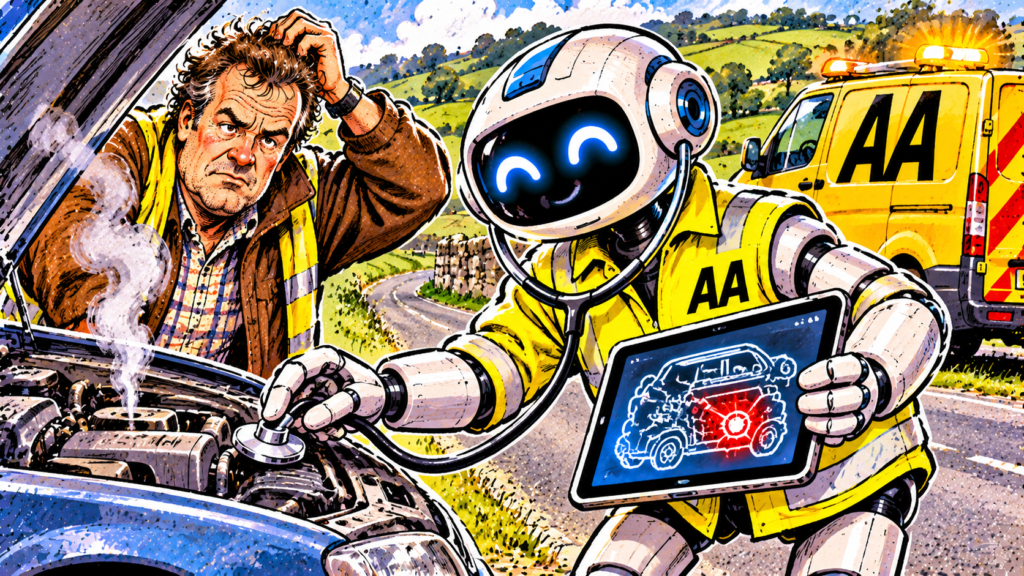
AI breakdown diagnosis is being tested by the AA to help its patrols arrive better prepared. Instead of asking a stranded motorist to identify a fault they may know very little about, the recovery service wants to extract useful clues from the driver's description of what happened. Microsoft described the work on 24 November 2026, but the new approach is still being introduced and its full effect on roadside waiting times has not been established.
A car that has stopped unexpectedly presents two problems. There is the mechanical fault itself and there is the interruption to a person's journey. The second can become considerably more difficult if the first patrol to arrive discovers that the necessary equipment or replacement part is somewhere else. Better assessment before dispatch could prevent some of that duplication, even when the physical repair remains exactly the same.
How AI breakdown diagnosis would change a call-out
In its account of the AA's roadside technology programme, Microsoft explains how the organisation is testing the use of free-text descriptions of symptoms alongside previous fault information. The ambition is to build a more useful picture of a vehicle before deciding which member of the recovery team should attend. Information about each job is also being brought together in a digital record for the mechanic.
Think of a driver who hears an unusual noise and then finds the car will not start. They may not be able to distinguish between a starting problem and a fault in the wider electrical system. A conventional form may offer choices that do not quite describe the experience. Asking for an account in the driver's own words could capture observations which would otherwise be lost, even if the driver cannot name the affected component.
This is a very different task from asking a chatbot how to mend a vehicle. The intended output is information to support an operational decision by the recovery company. The motorist should not need to act as a mechanic or carry out an inspection in an unsafe location. A useful system has to make decisions with incomplete information and recognise when there is too little evidence to narrow down the problem.
Getting the right person there matters as much as getting there quickly
Roadside assistance involves matching a moving workforce to jobs whose requirements are not always apparent at the beginning. One call might require straightforward help, while another might need specialist diagnostic equipment or recovery rather than a repair. Sending the nearest available person is an attractive starting point, but distance is only one of the considerations.
A useful decision-support tool would weigh the consequences of being wrong. If the likely fault is straightforward, there may be an opportunity to dispatch a suitably equipped mechanic promptly. If the symptoms could indicate something more serious, the sensible choice might be to prioritise expertise and recovery capability. There is little value in a short estimated arrival time if the result is another lengthy wait for a different vehicle.
The AA's existing guidance for motorists who break down illustrates why the location and circumstances matter too. A car park presents a different situation from a busy road. Getting people to safety and arranging appropriate help remain more important than collecting elaborate details about a suspected mechanical fault. Technology designed for a routine service visit cannot simply be transferred unchanged to every emergency.
A better record for the next repair
One of the more interesting aspects of the project is what happens after the mechanic arrives. The actual fault may confirm the initial assessment or reveal that an entirely different issue caused the symptoms. Recording that discrepancy gives the organisation an opportunity to compare its earlier judgement with the physical result.
Without such a feedback process, a system could appear useful simply because its recommendations sound sensible. The real test is whether mechanics discover that the information helps them prepare, diagnose faults and finish work, and whether cases where the suggestion was wrong are being identified. A confident guess that sends a team in the wrong direction is a cost, not an efficiency.
There is a parallel with AI-assisted road inspections: recognising a possible problem is valuable when it helps a person prioritise a real intervention. It is much less valuable when the recognition process becomes an additional administrative burden that workers must complete on top of the original task.
What motorists should expect from a phased rollout
The company's approach is being developed in stages, with work in its Mobile Mechanics service preceding a broader frontline deployment. That makes practical sense: different jobs expose a system to different kinds of uncertainty. A planned repair and an unexpected roadside incident do not necessarily offer the same quality of information or opportunity to ask additional questions.
Connected vehicles could eventually provide useful information directly, where the motorist agrees to share it. That is a prospective extension rather than a claim that the AA can already predict the next breakdown for every driver. Information about a vehicle may be sensitive when combined with details about its owner or journeys. The organisation will need to make clear which information is necessary for assistance and what additional uses are optional.
The broader question of who controls AI agents' access to information becomes particularly relevant when a service moves from reading a person's description to accessing connected equipment. Permission for one task should not automatically become unlimited permission for others.
For now, the most meaningful evidence would be an improvement in completed repairs, the frequency of repeat dispatches and the experience of motorists who need help in difficult circumstances. The Microsoft account provides a useful description of the direction of travel, but does not establish those improvements across the entire recovery network. A driver whose car fails does not need to know which model is handling the paperwork. They need an appropriate person to turn up and resolve the problem. That is the outcome against which the experiment should ultimately be judged.
About the Author
Stuart Kerr is Technology Correspondent at LiveAIWire, covering artificial intelligence, cybersecurity and the social impact of emerging technology. LiveAIWire is an independent, human-led technology publication using AI-assisted research, editorial production and original AI-assisted editorial illustrations under his direction.