
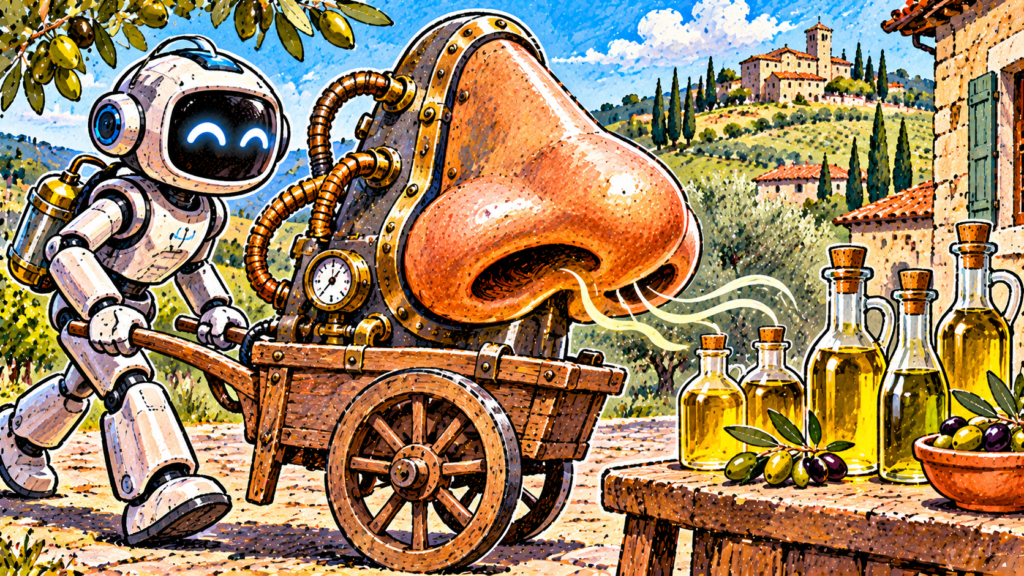
AI food fraud research is beginning to offer an alternative to some of the lengthy analytical procedures used to check whether an expensive food product contains what its label promises. A study of commercial avocado oil illustrates how a relatively inexpensive set of electronic sensors, combined with machine learning, might help identify products that deserve closer examination.
The peer-reviewed research, published in the Journal of Agriculture and Food Research in May 2026, examined 25 commercial oils. Only 40 per cent met both sets of compositional standards the researchers examined. Their electronic-nose classification models reported accuracy above 95 per cent in the study. Those findings concern the selected samples and experimental methods, not the prevalence of fraud across all avocado oil sold to consumers.
How AI food fraud detection can use an artificial nose
An electronic nose does not smell an oil in the way a chef does. It uses sensors whose responses vary according to the substances they encounter. The resulting collection of signals provides information that software can examine for patterns. The objective is to establish whether those patterns are associated with particular properties of the oil.
The researchers compared the sensor information with results obtained through conventional laboratory analysis of the samples’ chemical composition. That reference matters because the electronic system needs something more dependable than the appearance of a bottle or the wording on its label to learn what constitutes a potential problem.
A machine-learning model can then be evaluated on its ability to distinguish different kinds of sample using the sensor readings. In principle, that might allow a testing organisation to screen a larger range of products and direct more expensive analysis towards samples that give cause for concern.
The electronic nose is therefore best understood as a possible screening tool. A suspicious reading could justify additional investigation rather than being treated automatically as proof that a supplier has committed fraud.
Why the contents of a bottle are harder to judge than the label
A shopper can compare the appearance and price of different oils with relative ease. Establishing their precise composition is another matter. Products that look similar may differ in ways that are difficult to identify through ordinary examination at home. The consumer depends on the accuracy of information provided throughout the supply chain.
That dependence creates an asymmetry. A business with access to specialist equipment and knowledge can investigate the composition of an ingredient in ways that most shoppers cannot. The person standing in front of a supermarket shelf has to make a decision using the available label, their experience and their confidence in the retailer.
A potential benefit of lower-cost screening is that it could move testing closer to the ordinary purchasing decisions made by retailers and distributors. Instead of reserving specialist analysis for exceptional investigations, a business might have the option of examining a wider selection of incoming products.
That is an interesting possibility for the food supply chain, but it requires more than a small research experiment. A testing method needs to perform reliably across the kinds of oil that genuinely appear in commerce, including products that differ because of legitimate variation rather than adulteration.
The same distinction between detecting a pattern and understanding what it means arises in automated food sorting. Recognising a characteristic is only the beginning. A business needs to decide how that recognition affects the treatment of the product.
A high laboratory score is not a guarantee for supermarket shelves
A separate systematic review published in September 2026 examined 83 records concerning AI-assisted detection of food adulteration, mislabelling and substitution. Although laboratory classification performance was frequently very high, the reviewers found that 68 of the records reported no external validation. None documented routine monitoring or validation across different laboratories, and just one described testing in a genuine industrial environment.
The findings establish a distinction between demonstrating that a technique can detect a particular problem and establishing that it prevents that problem in ordinary commerce. The reviewers also found insufficient evidence for a proposed association between impressive accuracy results and overfitting. In other words, their criticism is not that every high score must be spurious.
A model may genuinely perform well on a carefully collected set of samples. The difficulty is determining what happens when the same procedure is applied to different supplies, equipment and working conditions. Without that additional evidence, the reported accuracy should remain attached to the experiment rather than becoming a broad promise about consumer protection.
Why genuine oil can also produce unusual readings
Consider a hypothetical retailer purchasing oil from different legitimate producers. Even if the suppliers have correctly described their products, the samples might not be identical. There may be differences associated with production or storage. A system that has learned from a narrow collection of examples could have difficulty deciding whether an unfamiliar pattern is evidence of wrongdoing or an ordinary variation.
That makes the selection of reference material important. A useful screening method must have enough examples of acceptable products to avoid treating every unusual measurement as a sign of fraud. It must also be challenged with samples that are difficult to distinguish from acceptable products, rather than only examples that are obviously different.
Manufacturers and laboratories would want to know how the sensors behave over time. A piece of equipment may respond differently after being used extensively or when operated under different environmental conditions. A procedure that depends on a particular instrument must include ways of checking that the instrument is working as intended.
These requirements explain why a headline accuracy figure is rarely enough information to choose a testing system. Businesses need to understand the conditions under which the method was evaluated, how errors are distributed and whether the consequences of those errors are acceptable for the proposed use.
Suspicion must lead to an investigation, not a verdict
A false warning could lead a retailer to question an entirely legitimate delivery. That creates costs for the supplier as well as the retailer. Products may have to be held while additional work is carried out. If a public accusation is made prematurely, the consequences may extend well beyond the batch that was examined.
The opposite error also matters. An unreliable system could indicate that a product meets expectations when the composition actually warrants investigation. A business that assumes the screening result is definitive might reduce other checks that would otherwise have identified the problem.
The appropriate threshold for raising an alert will depend on how the system is used. A laboratory might accept additional false alarms when the next step is an inexpensive confirmatory test. A decision that immediately excludes a product from sale requires a different assessment of the evidence and its consequences.
Work on sharing information for food safety offers a related area of interest. Results become more useful when the organisations receiving them understand their origin and limitations. A simple warning is less informative than a record explaining what was measured and which further checks are necessary.
What better testing might mean for the shopper
The most direct benefits would probably be felt through improvements in purchasing and quality assurance rather than through a new device in every kitchen. A consumer does not necessarily need to know which statistical model was used to screen an oil. They need confidence that the claims on the bottle are backed by sensible checks.
It is possible to imagine a retailer explaining how it tests products from its suppliers and what happens when a result is unusual. Such transparency would be more informative than a label simply declaring that a product has been checked by AI. The quality of the testing process, including its limitations and independent checks, is what gives the assurance meaning.
There is a parallel with the use of AI in food manufacturing. The value of a new technology depends on where it fits into an established process and whether it actually improves the result. Putting artificial intelligence into a factory or laboratory is not itself evidence that the finished product is better.
The evidence that would make an electronic nose worth trusting
A convincing next step would involve testing the technique on material from sources that were not part of its original development. Independent organisations could assess whether they obtain comparable results using an agreed procedure. Trials in commercial environments could also reveal difficulties that are unlikely to appear during carefully managed laboratory work.
It would be useful to establish how much a screening programme costs after including calibration, staff time, confirmatory analysis and the handling of incorrect warnings. A low-cost sensor could still become expensive if it produces an impractical number of questionable results. Conversely, a useful screening tool might justify its cost without replacing the conventional laboratory methods used to confirm suspected problems.
The avocado oil research offers a tangible example of how artificial intelligence could help interpret information obtained from inexpensive sensors. Its promise should be measured against the real difficulty of detecting food fraud: finding the problematic product without unfairly rejecting legitimate products, and then ensuring the evidence reaches somebody who can investigate it properly.
For consumers, that is a more meaningful ambition than the promise of an electronic nose that can supposedly tell the truth about any bottle. A reliable system would form one part of a wider process that makes the contents of the bottle as trustworthy as the label.
About the Author
Stuart Kerr is Technology Correspondent at LiveAIWire, covering artificial intelligence, cybersecurity and the social impact of emerging technology. LiveAIWire is an independent, human-led technology publication using AI-assisted research, editorial production and original AI-assisted editorial illustrations under his direction.