
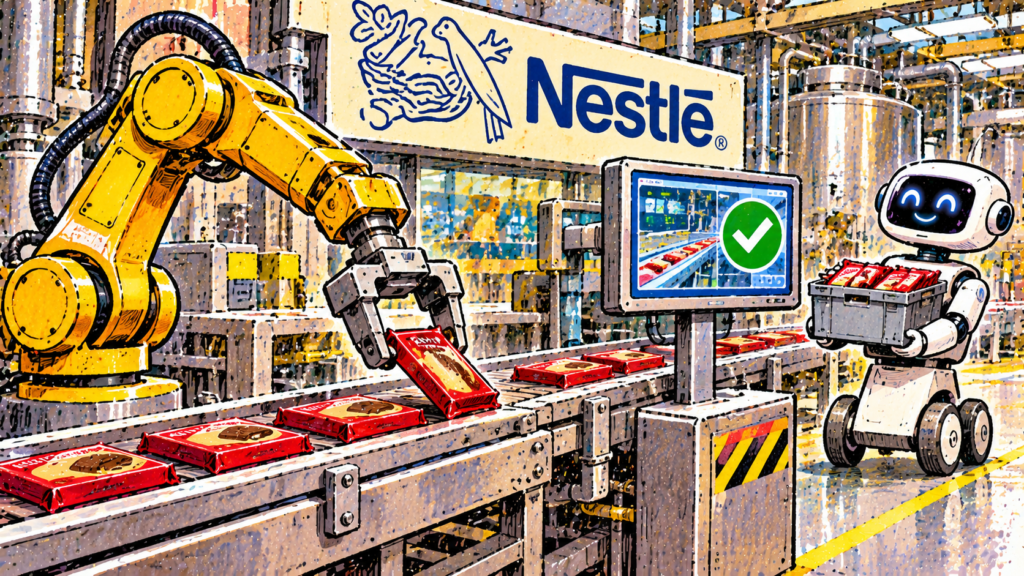
Nestlé AI research is moving closer to the equipment that makes everyday food and drink. The company has opened a Deep Tech Center in Orbe, Switzerland, where engineers will bring artificial intelligence together with sensors, connected systems and robotics. The aim is to develop and test technology for manufacturing, product development and consumer experiences before extending successful applications across the business.
The company's announcement on 20 November describes a facility equipped for prototypes and pilot-scale testing. This is an investment in developing applications, rather than evidence that every Nestlé production line has already become autonomous. The difference matters for a company whose products depend on consistent quality at industrial scale.
What Nestlé AI could do on a production line
Manufacturing food involves much more than moving finished items along a conveyor belt. Ingredients can vary, equipment can behave differently over time, and the finished product must meet defined requirements. The challenge for a manufacturer is to recognise relevant changes early enough to take appropriate action.
A sensor might record information about the behaviour of a machine. Software could examine patterns in those readings and flag a change that deserves investigation. A robot could carry out a repetitive physical operation, while staff monitor the process and deal with exceptions. These are examples of how the different technologies might fit together, rather than descriptions of equipment confirmed to be operating at particular Nestlé sites.
The company says it intends to use sensors and robotics to support quality and efficiency and handle repetitive or physically demanding work. Translating those ambitions into dependable systems is an engineering task, involving both the behaviour of the machines and the practical requirements of the people responsible for them.
This is a more consequential use of artificial intelligence than generating a new advertising slogan. An inaccurate suggestion in a brainstorming document can be revised. An inappropriate adjustment to physical machinery may have consequences for the product and the people working nearby.
Why a testing centre is an important part of the plan
A prototype is an opportunity to discover whether a promising idea works under controlled circumstances. It is also an opportunity to discover why it does not. Equipment designed for industrial use needs to be evaluated under the conditions in which it will actually operate.
Consider a hypothetical system that identifies unusual products on a line. It might perform well when lighting is consistent and items are presented in a predictable way. Changing the equipment, packaging or position of the camera could affect its accuracy. The software may therefore need adjustment before the same approach can be used in another facility.
A dedicated pilot facility allows engineers to investigate that problem before asking operational staff to depend on a new system. It also creates an environment where the consequences of false alarms and missed defects can be examined alongside any improvements in speed.
The broader subject of AI in the food supply chain illustrates why a successful experiment at one stage should not automatically be equated with an improvement across the entire process. A faster operation may be useful, but only if it fits the surrounding work.
The technology behind a familiar product
The announcement also covers consumer-facing ideas, including personalised experiences and product development. For someone who buys coffee, the more visible result might eventually be a connected machine that offers a more relevant selection of drinks. Other uses of the technology may be almost invisible to shoppers.
That distinction is worth considering. A customer may care more about a product being consistently good than about the system involved in producing it. A machine that helps maintain consistency could therefore matter even if the packaging never mentions artificial intelligence.
Separate reporting on the technology partnerships identifies Microsoft and Boston Dynamics as companies involved in the initiative. The partnership offers an indication of the range of expertise being brought together, from software to physical machines. It does not, by itself, establish which particular robot will be deployed in which factory or when.
Physical automation has its own constraints. Equipment must be maintained, operators trained and the consequences of unusual circumstances considered. Recent developments in food-sorting robots help illustrate why handling objects that vary in size and shape is a different problem from processing information on a computer.
What happens to the work people do?
Nestlé presents its use of robotics partly as a way to shift people away from repetitive or strenuous operations. There are plausible benefits for workers if machines can take on genuinely demanding physical tasks. But the announcement does not establish what the eventual effect on particular jobs will be.
Introducing automation can also create work that did not previously exist in the same form. Someone needs to monitor the machinery, understand why it has stopped, deal with unexpected materials and decide when a result requires human investigation. The details depend on how the system is designed and integrated.
The question for workers is not simply whether an employer has purchased a robot. It is how the employer plans to organise the job around the machine, what training is available and how responsibility is divided when things go wrong. Those are operational decisions that cannot be settled by a technology announcement.
The difference between a plan and a proven result
Nestlé’s centre will be complemented by a hub in Shenzhen, according to its announcement. This suggests the company is building a way to investigate new technologies systematically, rather than commissioning an isolated demonstration.
The evidence to look for next is specific. Which applications move from trials to production? Do they maintain quality under varying conditions? Are the improvements sustained after the system has been in use? Does the technology actually reduce demanding work, and how is that change experienced by employees?
For consumers, the most interesting outcome may turn out to be an improvement they hardly notice. The food is dependable, the products work well and the supply is consistent. Artificial intelligence is only one part of achieving that, but the opening of the Orbe facility shows that a major food company considers it worth testing in the physical world.
About the Author
Stuart Kerr is Technology Correspondent at LiveAIWire, covering artificial intelligence, cybersecurity and the social impact of emerging technology. LiveAIWire is an independent, human-led technology publication using AI-assisted research, editorial production and original AI-assisted editorial illustrations under his direction.