
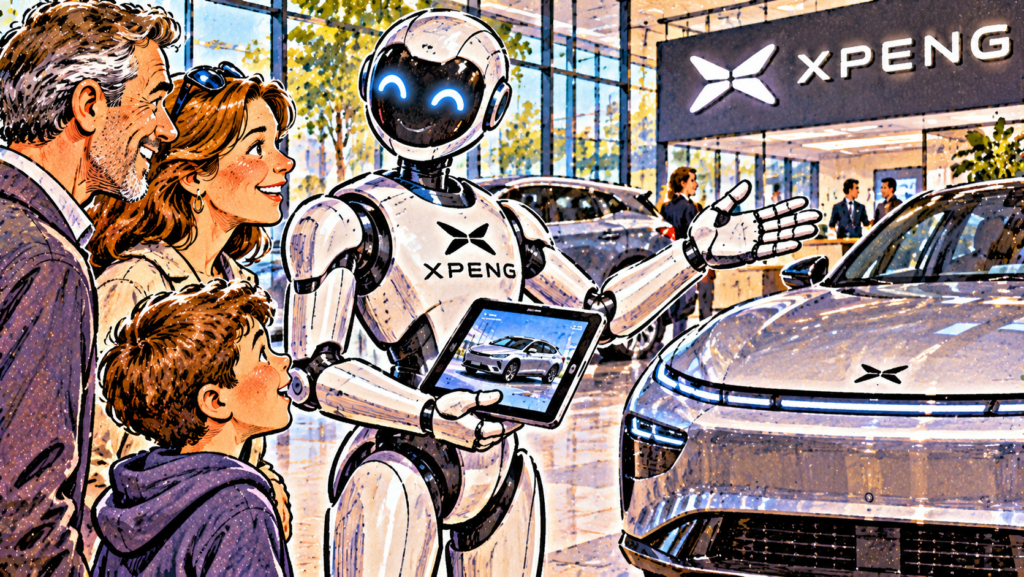
The XPENG IRON humanoid robot could soon be greeting people who arrive to look at a new electric car. At its AI Day on 25 November 2026, the Chinese carmaker said its machine was scheduled to begin training as a store assistant during the first quarter of 2027, with a public release targeted for the following quarter.
XPENG is presenting the robot as part of a wider technology strategy that connects its work on intelligent vehicles with machines that can move through the physical world. These are company plans and descriptions of capabilities, not independently verified evidence that the robot can already serve ordinary showroom customers without supervision.
Why a car showroom is an interesting job for XPENG IRON
A showroom offers a considerably different challenge from a demonstration on a stage. The robot needs to function in a space occupied by visitors who may have no idea what it can do. People may interrupt it, step in front of it or ask it questions that bear little resemblance to the examples used during training.
At the same time, a retailer can define a manageable set of duties. Directing a customer towards a particular vehicle, helping with a straightforward information request or summoning a salesperson are tasks that have clearer boundaries than the broad promise of a robot capable of doing anything a person can do.
That makes the proposed deployment a useful test of commercial robotics. A showroom can reveal whether a machine is sufficiently dependable to become part of the working environment rather than a novelty that customers watch for a few minutes. It also offers a setting where human colleagues could intervene when the machine encounters something unfamiliar.
What the carmaker brings from its vehicles
XPENG describes a technology architecture in which rapid physical responses and more deliberate planning work together. Its approach encompasses perception, computing, control and the mechanisms that physically move the robot. The company says IRON can navigate, receive tasks through spoken or app-based instructions, report unusual conditions and return to charge.
Some of those capabilities have obvious counterparts in intelligent vehicles. A car and a humanoid robot both need to interpret surroundings, make decisions and translate them into movements. But the similarities should not obscure the differences. A robot with arms can interact with objects and people at close range in ways that create a different set of safety and reliability questions.
Suppose a visitor approaches the robot while it is turning towards another person. What should the machine do if the visitor moves unexpectedly? A polite spoken response would be of secondary importance to the machine’s ability to stop or alter its movement safely. The physical requirements cannot be treated as an afterthought to a convincing conversation.
The distinction is also relevant to developments in robotic touch and dexterity. A machine that appears to understand a request still needs the sensory information and mechanical control to carry it out correctly.
Making a robot and making it useful
The showroom plan follows an earlier stage in XPENG’s manufacturing programme. On 8 September, the company announced that IRON robots had begun coming off its production lines. It described the facility as designed to support greater production scale, with extensive automation and quality checks.
Manufacturing is an essential part of any plan to put robots into workplaces, but production and successful deployment measure different things. A newly assembled robot may meet hardware specifications while still needing extensive development for its intended role. A machine that performs well in one store may face different practical difficulties when moved to another.
There is a further distinction between building a collection of identical machines and making them straightforward to maintain. A shop manager will care about the process for reporting a fault, how quickly it can be resolved and whether the robot can be removed safely from service. Those questions become more important as the machine becomes less of an exhibition piece and more of an everyday tool.
A new colleague or a moving information terminal?
Retail businesses will have to establish why the human-shaped design is useful for the specific role. For a simple enquiry, a touchscreen may be perfectly adequate. A humanoid could potentially offer advantages where it must move between locations or interact naturally with spaces already designed for people.
There is also a temptation to overestimate what a robot understands because it looks and behaves somewhat like a person. Customers might assume it can answer a contractual question, negotiate a price or make a commitment on behalf of the retailer. A sensible system would make the limits of its responsibilities clear and refer such requests to an appropriate member of staff.
Developers exploring robots that recognise uncertainty and request assistance are addressing a problem that could become particularly visible in this kind of workplace. Knowing when to ask for help may prove more valuable than producing an impressive response to every request.
The evidence to look for in 2027
The proposed training period is important because it gives the company an opportunity to learn what actually happens when the robot is placed in its intended environment. Useful evidence would include the tasks it completes without intervention, the circumstances in which it needs assistance and the way the business manages unexpected interactions.
It would also be useful to know whether the robot improves the experience for staff and customers after the initial excitement has passed. A robot may attract visitors during its first appearances, but that does not automatically establish an enduring business case.
For now, XPENG has outlined a timetable and an ambition. The showroom will offer a more demanding measure of progress than another polished demonstration. The machine needs to become useful in the presence of customers who are there to buy a car, not to admire a robot.
About the Author
Stuart Kerr is Technology Correspondent at LiveAIWire, covering artificial intelligence, cybersecurity and the social impact of emerging technology. LiveAIWire is an independent, human-led technology publication using AI-assisted research, editorial production and original AI-assisted editorial illustrations under his direction.