
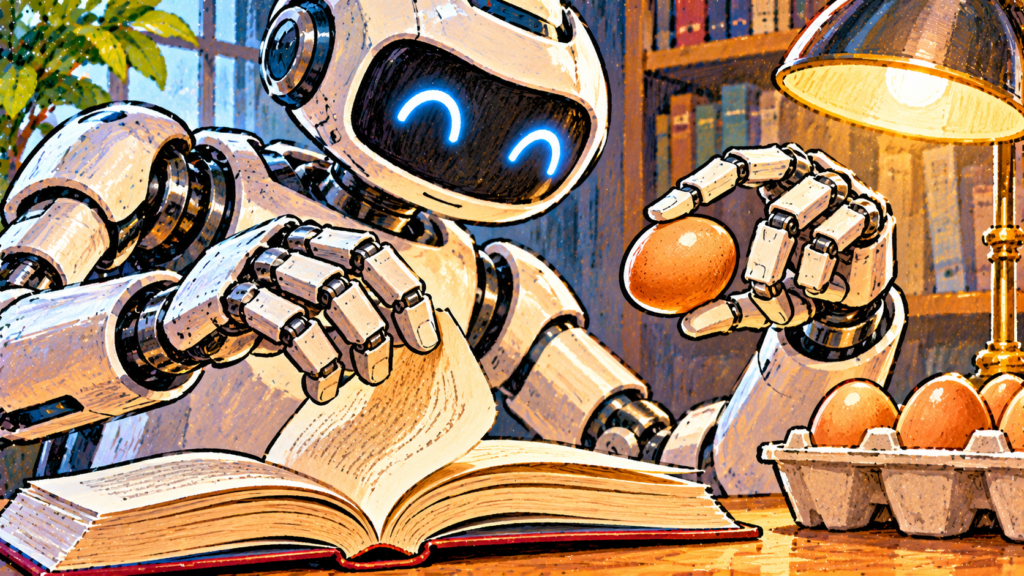
Robot fingertip touch has helped a research system handle tasks as familiar as turning a page, moving an egg and applying toothpaste. Panasonic and its academic and industry partners developed an artificial intelligence approach that combines visual information and instructions with rapid corrections based on contact at the fingers. Across a set of twelve physical tasks, the team reported substantially better performance than its strongest comparison system, although failures remained common.
The Panasonic research announcement of 5 November 2026 describes a system called T-Rex that is designed for dexterous two-handed manipulation. The name is less interesting than the challenge it addresses. Moving an object without crushing it, dropping it or pushing another object out of position requires a machine to respond to what is physically happening as it works.
That is something people do routinely without consciously considering how complicated the process is. If a piece of paper starts to slide between someone’s fingers, they may change their grip before even looking at it. The robot has to obtain useful information about the contact and turn it into an appropriate movement through its sensors and software.
Why robot fingertip touch matters when cameras are not enough
A camera provides information about the position and appearance of an object. It can help a robot find an item, determine which way it is facing and choose where to bring its hand. Once the fingers meet the object, however, there are important things that may not be visible.
A finger can obscure the very point at which pressure is being applied. A flexible surface may begin to deform beneath the grip. Something that looks stable in a photograph may actually be moving slightly as the robot attempts to lift it. When the object is delicate, continuing with the originally planned motion without adjustment may be a poor choice.
Touch sensors provide another route to understanding these events. They can supply information associated with contact, force and deformation. The relevant problem for the robot is how to use those signals without losing the broader understanding of the task provided by the camera and instructions.
Previous work on robot tactile skin has explored ways of obtaining useful contact information from sensitive surfaces. T-Rex addresses a related but distinct challenge: using information from the fingertips to adjust actions during complex tasks involving both hands. Improving the sensor and improving the system that acts on its readings are complementary pieces of engineering.
Giving two hands a common purpose
Opening a book seems straightforward until one tries to describe the movements in sufficient detail for a machine. One hand may need to hold the book steady while the other separates the desired sheet and lifts it. The hands have related responsibilities, but the correct action of one depends on what is happening at the other.
The same issue applies to many tasks in workshops and homes. One object is held while another is fitted into it. A container is stabilised while its lid is moved. Something flexible may change shape as both hands interact with it. An exact movement planned in advance can become unsuitable as soon as one of those conditions changes.
A system designed to carry out the entire operation needs enough information to recognise when the current approach is not working. If a sheet does not separate cleanly, the robot may have to change the position of a fingertip without losing the stability provided by the other hand. If an object shifts, a correction may need to take account of both arms.
This is why a demonstration that involves apparently unremarkable everyday objects can be more informative than a robot performing a highly choreographed motion. The difficulty is not how impressive the movement looks but how well the machine handles the consequences of interacting with the object.
Learning from physical contact
The team’s original T-Rex research paper describes an approach in which the robot learns from examples containing information about contact. The researchers assembled a hundred hours of robot manipulation data and developed a method of incorporating rapidly changing touch information into a system that also uses vision and instructions.
The principle is easier to understand by considering the different kinds of information involved. A robot needs a general plan for achieving the goal, such as moving an item into a new position. It also needs to respond to small changes as it executes that plan. Trying to use every signal in the same manner may make it difficult to deal efficiently with both requirements.
The research uses different update rates for these purposes. The system can produce an overall movement based on visual and language information while using tactile feedback to make faster corrections. It is an attempt to combine deliberate action with responsiveness, rather than treating the two as competing approaches.
The training process is important because the same touch signal may have different implications in different circumstances. Pressure that is appropriate for a sturdy object may be excessive for a fragile one. A movement that helps secure a grip might be inappropriate if the object is supposed to slide between the fingers.
Learning from examples allows the robot to develop a response to patterns encountered in the training process. It does not mean the machine has acquired human understanding of fragility or pain, or that it will necessarily know what to do with an unfamiliar object.
Better results are not yet good enough for every job
Panasonic reported an average success rate of 65 per cent across the twelve evaluated tasks, compared with 35 per cent for its previously strongest comparison system. In an evaluation without tactile information, the result was 42 per cent. These figures refer to the team’s experimental tasks, not to the performance of a general-purpose household robot.
The gap between those results is encouraging for the particular research question. Removing touch information reduces performance, suggesting that the contact signals are contributing useful information rather than simply adding hardware to the machine.
The absolute rate also gives an important indication of the work that remains. A system that fails a substantial share of its evaluated attempts cannot be assumed to handle delicate or valuable items dependably without oversight. An occasional laboratory failure may be acceptable when researchers are investigating a technique. The same failure may be unacceptable in a production environment where damaged items or interrupted work create costs.
Different activities also have different tolerances for error. A robot that fails to turn a book page may be able to try again without serious consequences. Handling an object that can break or damage its surroundings may require an additional safeguard. An average result across several tasks does not establish that those risks are equally well managed.
What changes when a robot meets an unexpected object?
A capable manipulation system should ideally respond to variations rather than depend on the exact conditions in a demonstration. The surface of an item might be slippery, the position of an object slightly different from usual or a flexible material folded in an unfamiliar way.
These kinds of variation are particularly relevant to research on robots learning to fold laundry, because objects that can change shape introduce uncertainty while the task is under way. An item does not necessarily remain in the position or configuration the machine initially observed.
Touch could help reveal some of those changes, but useful information alone does not guarantee an appropriate response. The system must interpret the signal and select an action, while knowing enough about the limitations of its own training to avoid making a poor situation worse.
A further design question is how the robot recognises that it should stop. Research into robots that recognise uncertainty and request help addresses a useful complementary capability. A machine may not need to solve every unfamiliar problem autonomously to be valuable. In some settings, recognising the need for a human intervention could be an essential part of reliable operation.
From the laboratory to the workshop
Panasonic identifies manufacturing and logistics as possible future areas for the technology, particularly where objects are fragile or tasks involve fine control of force. In these settings, a robot may be able to help with inserting or removing parts, handling materials or completing operations that require careful adjustment.
Real deployment would introduce requirements that the reported comparison does not settle. The organisation using the machine would need to evaluate the range of objects it encounters, the consequences of errors, the available safeguards and the effect of normal wear on sensors and equipment.
It would also need a practical way of examining failed attempts. Knowing that a machine did not complete a task is useful, but understanding whether the failure arose from a poor initial plan, an incorrect interpretation of touch or a mechanical problem could be necessary to improve it.
The appeal of robots capable of delicate physical work is understandable. Yet a good demonstration is best regarded as evidence for a particular capability, rather than a promise that a machine can already work safely in a busy home or factory.
What this research offers is a clear reason for developing systems that do more than look at the world. A robot may recognise an egg from a photograph and know where it is supposed to put it. The more demanding part begins when its fingers close around the shell. Learning how to respond to that contact could be one of the steps that makes more useful physical automation possible.
About the Author
Stuart Kerr is Technology Correspondent at LiveAIWire, covering artificial intelligence, cybersecurity and the social impact of emerging technology. LiveAIWire is an independent, human-led technology publication using AI-assisted research, editorial production and original AI-assisted editorial illustrations under his direction.