
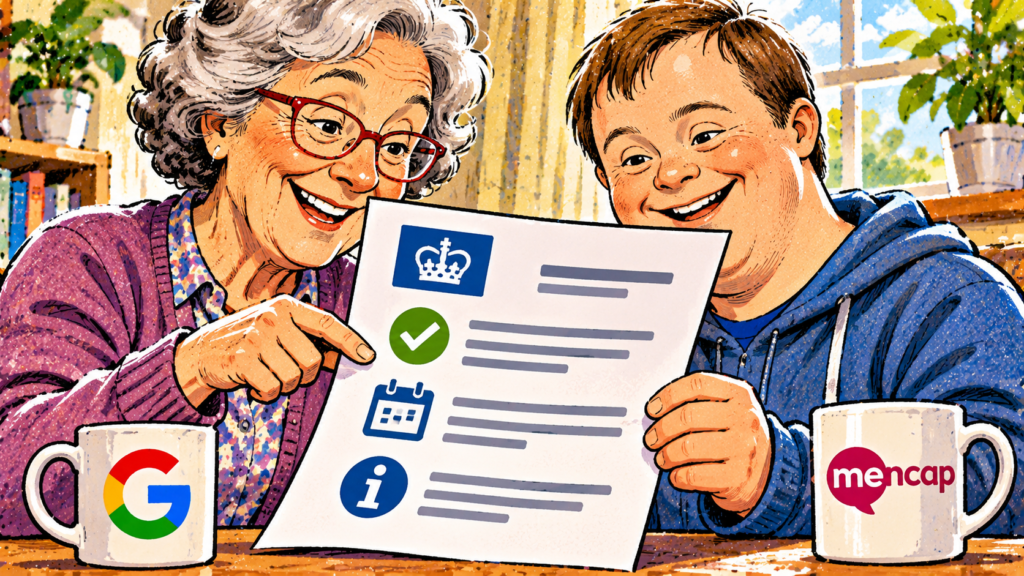
Easy Read AI could help organisations turn complicated documents into information that more people can understand. Google DeepMind and the learning disability charity Mencap have developed the Easy Read Co-Creator, a tool intended to support the creation of accessible material. People with a learning disability helped shape and test it, and their involvement is intended to continue during its use.
The initiative, announced by Mencap in November, addresses a problem that can be especially frustrating for an adult receiving correspondence about their own life. A letter from a public service, a bank or a transport provider may contain information they need to act on, yet the format of the document can make independent understanding unnecessarily difficult.
What makes Easy Read AI different from a summary?
Easy Read is a way of presenting information using clear language, short sentences, carefully designed layouts and relevant pictures. Its purpose is not simply to cut words from a long document. It is to make the meaning of that document accessible to its intended audience.
Imagine receiving a letter about a change to an appointment. The essential details might be scattered among introductory information, explanations of administrative procedures and a lengthy note about what happens if the appointment is missed. An accessible version would need to help the reader identify what is changing, what they need to do, and whom they can contact if they have a question.
A generic summary might omit a detail that seems minor to the machine but is essential to the recipient. That is why the design of a document and the selection of information deserve the same care as the wording. An accessible document needs to work as a complete means of communication, not just an attractive alternative to the original.
For anyone following advances in AI accessibility, this project is a useful example of technology being applied to a specific barrier rather than marketed as a universal solution.
The people who need the documents helped design the tool
Mencap says that people with a learning disability have been involved in shaping and testing the system. Its information about the Co-Creator makes clear that the technology is intended to assist co-production, where the people who will use accessible information participate in making it.
This is a particularly important feature of the project. Software can produce grammatically simple language without understanding whether a reader has been given enough information to make a decision. Someone who regularly uses Easy Read may notice an ambiguity or an unhelpful illustration that a specialist developer overlooks.
The point is not that all readers have identical preferences. Accessible information still needs to be appropriate to its purpose and audience. A document explaining an appointment is different from one explaining a financial decision, and the information needed to understand each may differ considerably.
Mencap is inviting organisations to register their interest, rather than offering the initiative as an unrestricted public service for individual users. The charity describes ongoing training and support funded by Google.org. The eventual value will depend on how effectively participating organisations integrate the tool and their human reviewers into existing processes.
Why a faster first draft could make a difference
The charity’s announcement identifies time and production cost as barriers to producing accessible documents. When an organisation has a substantial volume of public correspondence, a slow specialist process can mean that only some material is offered in an accessible format.
Artificial intelligence might help by carrying out initial language transformation and preparing a draft for review. If the time saved is substantial, staff could spend more of their effort checking that the wording, pictures and structure are genuinely useful.
There is a significant difference between reducing production time and removing the human work altogether. The first could improve access. The second risks introducing errors that readers may have difficulty identifying. An inaccurate accessible letter could be particularly damaging if it gives a misleading impression of the original instructions.
A successful workflow would allow the people reviewing the draft to compare it with the source, challenge unclear passages and retain important qualifications. The technology should make that process easier rather than obscure the decisions made during conversion.
Accessible information is about independence
An adult who cannot understand a letter may need to share it with a friend, family member or support worker. Sometimes that assistance is welcome. But having to ask someone else to read routine private correspondence can reduce an individual’s freedom to handle their own affairs.
This becomes especially apparent when the information concerns money, a job application or an important personal decision. An accessible version could allow someone to prepare questions independently before deciding whether they need further help. It could also make discussions with staff more productive because the recipient already understands the purpose of the conversation.
Technology is tackling related problems through different approaches, such as Apple's accessibility tools for documents. A tool that supports an individual reading information and a tool that helps the organisation produce accessible information are complementary, but they address different stages of the problem.
The responsibility should not fall entirely on the reader to translate everything an institution sends. It is reasonable to examine how the information is written and delivered in the first place.
How to judge whether the project succeeds
The most meaningful measure is whether the people receiving the finished documents understand them and can act on them. A rapid production process is useful only if it contributes to that result. Organisations will also need to think about whether their procedures protect confidential information and whether a person can correct a misleading explanation before it reaches the public.
For now, this is an initiative being introduced through participating organisations, with the charity emphasising continuing human involvement. It does not establish that every document can be converted automatically or that the need for accessibility specialists has disappeared.
The prospect is nevertheless significant. A difficult letter is an everyday obstacle with consequences well beyond the page on which it is printed. If the tool helps organisations offer more genuinely accessible correspondence, more people may be able to understand decisions that affect them without first having to ask someone else.
About the Author
Stuart Kerr is Technology Correspondent at LiveAIWire, covering artificial intelligence, cybersecurity and the social impact of emerging technology. LiveAIWire is an independent, human-led technology publication using AI-assisted research, editorial production and original AI-assisted editorial illustrations under his direction.