ai cheating crisis schools fighting back
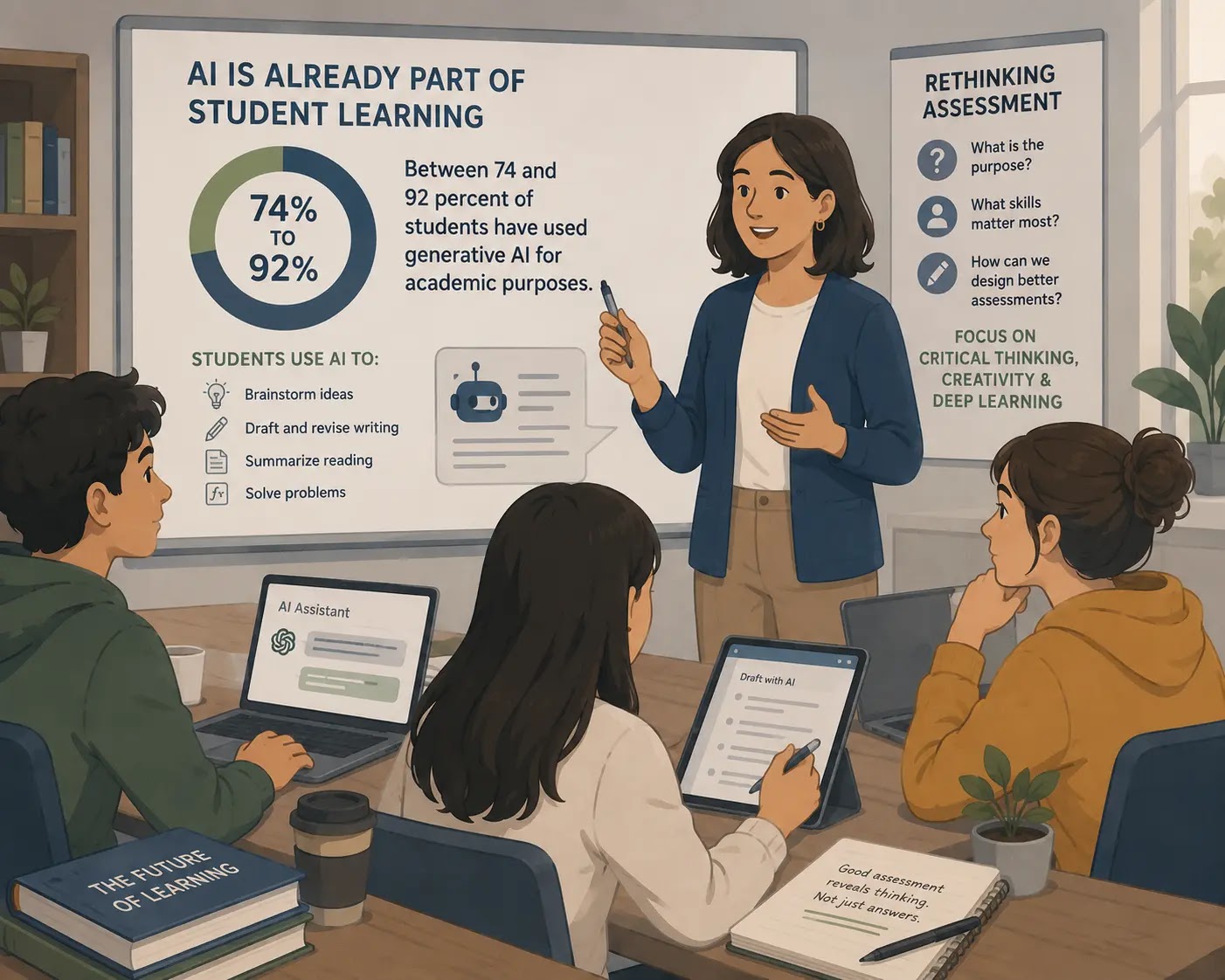
Between 74 and 92 percent of students have used generative AI for academic purposes, forcing schools to fundamentally rethink what assessment is for and how it should be designed.
By Stuart Kerr, Technology Correspondent, LiveAIWire
88 Percent of Students Have Used AI for Assessments. Education Has Never Faced a Challenge Quite Like This.
The numbers are stark enough to stop any educator in their tracks. Between 74 and 92 percent of students have experimented with generative AI tools for academic purposes, according to multiple independent surveys conducted in 2025. An 88 percent figure from a US survey found students using AI for assessments in some form. UK universities reported nearly 7,000 proven cases of AI-related cheating in the 2023 to 2024 academic year, a threefold increase from the previous year and part of a nearly 400 percent increase in AI-related misconduct incidents over just three academic years. Ninety-six percent of college instructors believe at least some of their students cheated over the past year, up from 72 percent in 2021. The cheating crisis created by generative AI is real, measurable, and accelerating. And the tools that education is reaching for to address it are themselves deeply flawed.
The right response to this crisis, however, is not simply stronger detection or stricter penalties. It is a fundamental rethinking of what assessment in education is for, what it should measure, and how it should be designed in a world where any student with a smartphone has access to a system that can write a competent essay, solve a maths problem step by step, or summarise a research paper in seconds. That rethinking is already underway at the leading institutions, and the direction it is pointing in is more interesting and more hopeful than the crisis framing suggests.
The Scale of the Problem and Why Detection Is Not Enough
The most widely deployed response to AI cheating has been AI detection tools, most prominently Turnitin, which claims 98 percent accuracy in identifying AI-generated content and is now integrated into learning management systems used by 70 percent of educational institutions across the countries analysed. The problem is that independent testing consistently finds higher false positive and false negative rates than the vendors claim. Research has demonstrated that standard AI detectors mislabel genuine essays by advanced non-native English writers at five times the rate recorded for native writers, creating a serious and documented equity problem where international students face disproportionate false accusations.
More fundamentally, simple text transformations can dramatically reduce detection rates. Research has shown that editing only a small fraction of AI-generated output can collapse detector accuracy to below ten percent. Students who want to use AI to complete assignments while avoiding detection have already discovered this, and the technology to assist them is evolving faster than the detection systems chasing it. Regulatory bodies including Ofqual in the UK have explicitly cautioned against high-stakes reliance on detector scores alone, recognising that the legal and ethical consequences of false accusations are too serious to rest on unreliable algorithmic assessments.
Some institutions have faced this directly. Vanderbilt University paused its use of AI detectors due to equity concerns. Students at institutions that rely heavily on Turnitin flags have faced serious academic misconduct proceedings based on algorithmic determinations that turned out to be incorrect, with consequences including failing grades, academic probation, scholarship loss, and in some cases expulsion. Legal professionals in the US are already advising students accused of AI cheating to seek legal representation, noting that the procedures used and the evidence relied upon frequently do not meet the standards that academic misconduct processes are supposed to apply.
What the Data Actually Shows About Student Behaviour
The framing of AI cheating as a new and catastrophic crisis benefits from some careful examination of the actual data. A figure that appears repeatedly in analysis of the current situation is illuminating: in 2012, 17 percent of students used phones to text answers during assessments. In 2026, 18 percent use AI to submit unedited work. The proportion of students submitting entirely AI-generated assignments without any personal engagement has not dramatically increased compared with previous forms of technological cheating. What has changed is that the quality of the output is vastly better, making it harder to detect and easier to submit with confidence.
More significantly, the surge in AI-related misconduct cases is partly a function of the fact that traditional plagiarism cases are declining simultaneously. Students are switching methods rather than increasing their overall propensity to cheat. And the vast majority of student AI use is not the straightforward submission of unedited AI output. It is a spectrum ranging from using AI to brainstorm, to using it to draft and then editing significantly, to submitting lightly edited AI content, to submitting unedited content entirely. Where on that spectrum a particular use falls, and whether each point on the spectrum constitutes academic misconduct, are genuinely contested questions that different institutions are answering in different ways.
How Forward-Thinking Schools Are Responding
The most sophisticated institutional responses are not primarily about detection. They are about assessment redesign: creating assignments and examinations that are genuinely difficult to complete without the understanding they are supposed to demonstrate.
The return of the handwritten blue book examination is one symbol of this shift. Some institutions have simply moved final assessments back to in-person, pen-and-paper conditions where AI cannot be used at all. The old-school approach has the virtue of certainty, but it is not a complete answer for all educational contexts.
More interesting are the institutions that are redesigning assessments to require exactly the kind of thinking that AI cannot yet replicate well. Oral examinations, where a student must explain and defend their reasoning in real time, are becoming more common. Project-based assessments that require students to apply knowledge to specific local contexts, personal experiences, or real-world problems that an AI tutor could not have access to. Portfolio assessments that track a student’s thinking process over time, requiring them to document their reasoning, their mistakes, and their revisions in ways that cannot be manufactured after the fact. Viva voce submissions where students present and discuss their written work with an examiner.
Forty-five percent of educational institutions are redesigning assessments to be more AI-resistant, according to the AllAboutAI analysis. Leading institutions in the UK and Australia are adopting transparency-based frameworks that require students to declare how they used AI tools in their work and to identify which parts of the submitted work are their own, treating AI as a tool to be used responsibly rather than one to be banned and then secretly used anyway.
The academic literature is increasingly clear that AI does not create the crisis of academic integrity. It exacerbates existing structural vulnerabilities within education systems that have relied too heavily on mass standardised assessment regimes designed for administrative convenience rather than genuine learning measurement. AI has simply made those vulnerabilities impossible to ignore.
The Deeper Question Education Cannot Avoid
The crisis is forcing a question that education has avoided for decades: if an AI can write a competent essay on most undergraduate topics, and a student can submit that essay and receive a qualification, what exactly is the qualification measuring? The honest answer for many current assessment systems is: not very much that matters for the world students are entering.
As explored in How AI Tutors Are Giving Every Child Access to Personalised Learning for the First Time, the most forward-looking educators are using AI to transform learning rather than simply to police cheating. A student who learns to use AI tools thoughtfully, who understands what they are doing and why, who can evaluate and improve AI output rather than blindly submitting it, and who can explain and defend their thinking under examination is demonstrating precisely the skills that employers in 2026 are looking for. A student who submits unedited AI output without understanding it is not learning anything useful, and is also taking a significant and detectable risk.
The institutions that will navigate this moment most successfully are those that treat AI not as a threat to be defeated but as a reality to be integrated thoughtfully. The goal is not to restore education to a world before AI existed. That world is gone. The goal is to design learning experiences that genuinely develop human capability in a world where AI is a permanent feature of every professional environment. The cheating crisis is painful. The redesign it is forcing may produce something better.
About the Author
Stuart Kerr is Technology Correspondent at LiveAIWire. He writes about artificial intelligence, ethics, and how technology is reshaping everyday life. Follow @LiveAIWire on X.