
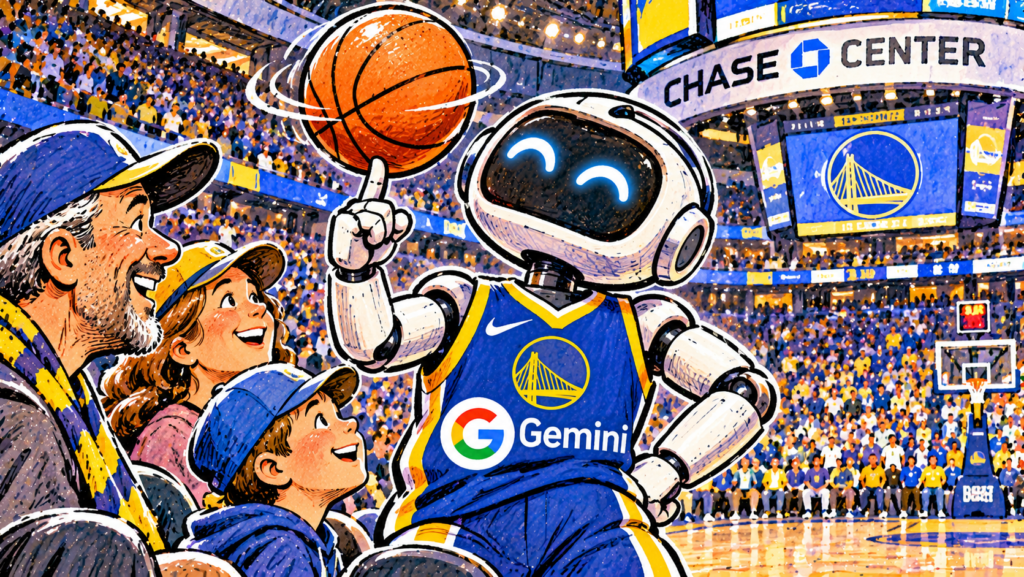
Google Gemini is moving further into professional basketball through an expanded partnership with the Golden State Warriors, the Golden State Valkyries and their San Francisco home, Chase Center. In an announcement on 24 November 2026, Google said Gemini had become the official AI assistant and enterprise generative AI partner of the three organisations.
The agreement is a useful glimpse of how the technology may enter the lives of people who have little interest in artificial intelligence itself. A supporter heading to a match cares about getting through the doors, finding a seat and enjoying the basketball. An assistant that actually helps with those things could earn its place. A sponsorship logo alone cannot.
Where Google Gemini fits into a night at the arena
The basketball organisation’s own announcement describes an ambition to improve the experience of visitors and remote supporters. This is an extension of an established commercial relationship rather than evidence that a complete new suite of fan-facing tools is already available. There is an important difference between naming an official technology partner and putting a reliable assistant into the hands of every ticket holder.
Consider a family visiting an unfamiliar venue. They might want to know which entrance is nearest their seats, whether a bag can be brought inside, what food is available or how to get home afterwards. The questions are simple, but the answers can be scattered across different pages. A conversational interface could reduce that friction if it draws on accurate and up-to-date venue information.
A general answer about stadiums would be of little use. The value would come from knowing the rules of this venue for this particular event. A concert may have different arrangements from a basketball fixture. The assistant would need to distinguish an ordinary policy from a special exception and recognise when it does not have enough information to answer.
The supporters who never see the court
A sports organisation has an audience well beyond the people inside its building. Supporters who follow a team from abroad or who cannot attend regularly may be just as interested in its history, players and activities. AI could offer different routes through material that already exists, such as interviews, event information and historical records.
Imagine a child who has just discovered basketball asking why a particular rule exists. A useful explanation would use examples appropriate to a newcomer, perhaps connecting an unfamiliar term with something the child saw during the game. Someone who has followed the sport for years could ask a more specialised question without having to wade through introductory information.
These are potential applications rather than features confirmed by this deal. They illustrate why a team may want a broader relationship with an AI company than a conventional advertising arrangement. The same technology can potentially help staff produce content, answer repetitive questions and organise material before a supporter ever encounters an AI interface.
A ticket is not the same thing as a conversation
The commercial opportunity also introduces questions about boundaries. A fan who asks about an upcoming match is providing information about their interests. A fan who authorises an assistant to arrange a visit is potentially sharing more sensitive details, including their plans and payment preferences. Those activities should not be treated as interchangeable.
There is a useful distinction between helping someone explore their options and trying to close a sale. A supporter asking for the most affordable way to attend should be shown relevant restrictions and alternatives rather than simply directed towards a premium package. The issue resembles the choices facing developers of AI-powered sports shopping experiences, where convenience and commercial incentives can meet in the same interface.
Clear identification of the organisation responsible for the answer would also matter. The team, the venue, a ticketing company and the AI supplier could each have a different part in the experience. If an assistant gives incorrect information about an event, supporters need a way to establish the correct position without being passed endlessly between different services.
The pressure of getting live information right
Sport is particularly unforgiving of stale information. A schedule may change, an event may be postponed or a route through a venue may be temporarily unavailable. An answer that was accurate earlier can become misleading before someone acts on it. An interface built around live events therefore needs a reliable source of current information and a sensible way to handle uncertainty.
For an organisation using generative AI behind the scenes, a useful measure would be how frequently staff have to correct the system’s work. Saving time on a draft is worthwhile only if the checking process does not consume the benefit. The questions are familiar to anyone considering AI in customer service, even though the setting here is entertainment rather than an ordinary support desk.
Supporters may have little patience for an automated response that cannot resolve a problem shortly before an event. An accessible human alternative would remain important, especially for unusual ticket arrangements, accessibility requirements or circumstances that do not fit the assistant’s standard interpretation.
What would make this partnership more than sponsorship?
The interesting evidence will be the services that emerge from the agreement and the way they perform in practice. An assistant could be genuinely helpful without trying to replace the experience of attending a sporting event. It might make the administrative parts of a visit easier while leaving the supporter free to concentrate on the sport.
For now, the confirmed development is the expanded partnership, not a demonstrated improvement in fan satisfaction. The next test is whether the technology can solve the ordinary problems that make an evening out unnecessarily complicated. A successful basketball assistant would scarcely need to remind the crowd that it is powered by AI.
About the Author
Stuart Kerr is Technology Correspondent at LiveAIWire, covering artificial intelligence, cybersecurity and the social impact of emerging technology. LiveAIWire is an independent, human-led technology publication using AI-assisted research, editorial production and original AI-assisted editorial illustrations under his direction.