
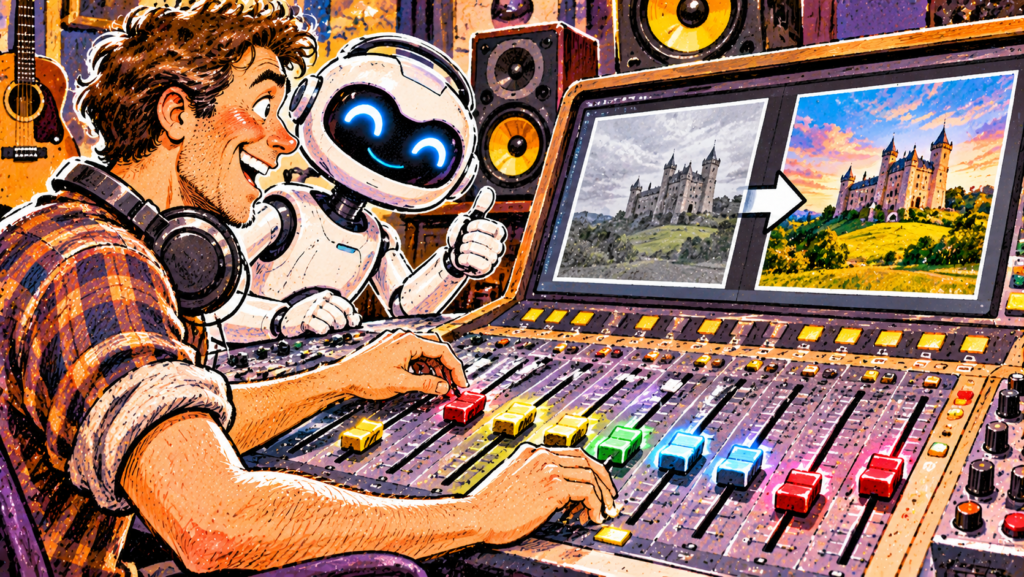
Physical controls have largely remained fixed in their purpose while software has become increasingly flexible. A research prototype described by MIT on 24 November 2026 explores a way to bring those two worlds together. Known as TangiMap, it uses artificial intelligence to work out how the knobs, sliders and buttons on an existing device could control the software task a person is performing.
The demonstrations include using a mixer to adjust photographs and a controller to manipulate a digital object. This is a proof of concept, rather than a product that can be plugged into any computer and expected to understand every programme. Nevertheless, it addresses a problem familiar to anyone who has ever wished a physical button were available instead of an option buried in a screen menu.
Why physical controls are worth bringing back
A radio volume knob offers something that a software control does not: it can be located and moved by touch. Once a person understands the layout, their eyes can remain focused on something else. A musician operating a mixing console can also move separate controls at the same time, using both hands to make related adjustments.
On a screen, those same functions can be perfectly accessible in principle but less convenient to operate together. A person might have to select a slider, adjust it, move to another and make a further adjustment. For a photographer deciding how light and contrast should interact, the order of these operations can make the work feel more like administration than creative exploration.
Specialist controllers already exist for particular software. Their limitations become apparent when someone switches between applications, or wants to perform a task for which the hardware has no suitable preset. Configuring each control manually can make the setup more trouble than it is worth.
The challenge is to preserve the simplicity of a familiar physical object while making its function adaptable. Rather than build a different control panel for every creative task, TangiMap investigates whether an existing panel can be assigned a different job automatically.
How the machine decides what a knob should do
The researchers’ project page and paper describe a system that brings together information about what the user wants, the capabilities of the software and the controls available on the physical device. A language model uses that information to propose a mapping, meaning an assignment between a hardware control and a software function.
Some programmes expose an application programming interface, a documented means for other software to interact with them. Where that is available, a system can obtain information about relevant functions and parameters directly. The prototype also explores extracting context from what appears on the screen.
A sensible mapping has to account for the shape of the control as well as the desired result. A rotary knob may be appropriate for an adjustment that can vary gradually, whereas a button is better suited to switching between states. A slider with a definite end position might be a poor choice for a function that is expected to change continuously without an obvious stopping point.
The design problem is therefore not simply asking a language model to name a button. It is finding a correspondence between the physical movement a person can perform, the capabilities of the software and the nature of the intended task.
A different kind of creative AI
A great deal of creative software now emphasises generating a finished image, text or sound from a written request. TangiMap takes a different direction. Its purpose is to help the user manipulate the work, rather than deciding what the finished work should look or sound like.
Imagine someone editing a landscape photograph who wants to explore the relationship between colour saturation and exposure. A suitable arrangement of physical controls would make it possible to change both parameters without repeatedly navigating a menu. The photographer can respond to the result visually and retain responsibility for the choices. The system has automated the arrangement of the controls, leaving the artistic judgement with the human.
That principle also connects with the development of AI assistants inside creative applications. There is a substantial distinction between making a tool easier to operate and having a tool make the creative decision. A person may welcome the former even if they have little interest in the latter.
A programmable controller might also offer benefits in situations where a particular on-screen arrangement is difficult to use. The wider field of adaptive and accessible software interfaces raises similar questions about making technology conform to the needs of the user, rather than always expecting the user to adapt to the technology. Accessibility benefits would need direct testing with the people concerned.
The danger of a button that changes its mind
The flexibility that makes this approach interesting also introduces a potential weakness. People learn how to operate physical controls partly through repetition. If the function of a familiar knob changes unexpectedly, the user can no longer rely on that familiarity. An adjustment intended to increase volume could instead change something entirely different.
A practical implementation would therefore need to make the current arrangement clear, avoid unnecessary changes during a task and provide an obvious way to undo an unsuitable mapping. The appropriate amount of flexibility would depend on the situation. Editing a photograph allows time to experiment and recover from mistakes; controlling equipment in a safety-sensitive environment presents a very different problem.
The researchers have not yet established the benefits through a formal user study of the proposed experience. Further work would need to explore ergonomics, reliability, preference and the effort required to recover when the AI chooses a poor configuration. A compelling demonstration cannot answer those questions on its own.
The interesting possibility is that a new generation of AI tools might make the objects on our desks more useful without requiring us to buy another screen. If a controller can adapt reliably to what its owner is doing, the old-fashioned pleasure of turning a real dial may have a place in the future of computing after all.
About the Author
Stuart Kerr is Technology Correspondent at LiveAIWire, covering artificial intelligence, cybersecurity and the social impact of emerging technology. LiveAIWire is an independent, human-led technology publication using AI-assisted research, editorial production and original AI-assisted editorial illustrations under his direction.