
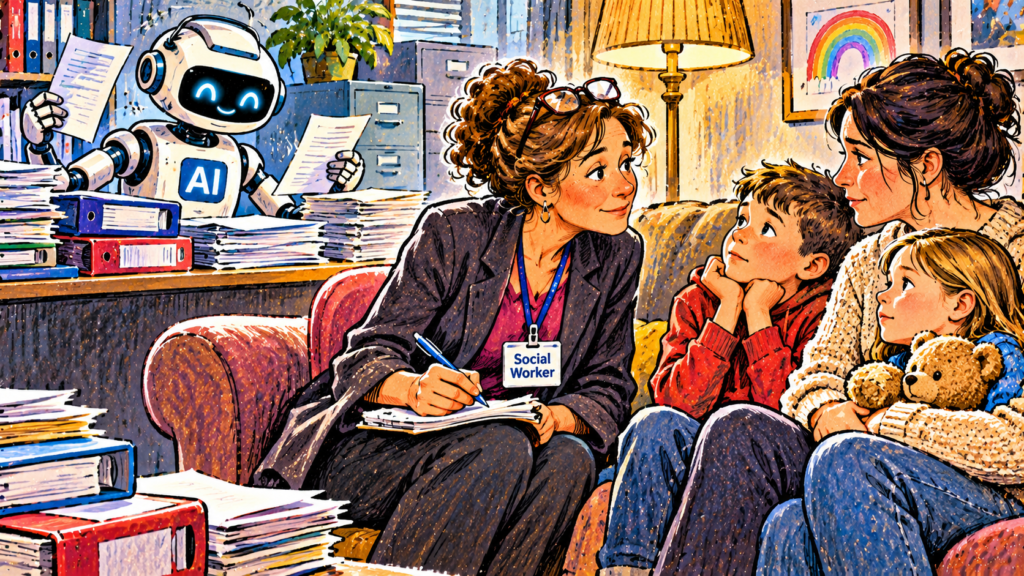
AI in social care could help a practitioner spend less time preparing paperwork and more time working with families, but a computer should not decide whether a child or adult needs an intervention. That distinction is central to guidance published jointly by England’s Department for Education and Department of Health and Social Care on 20 November 2026. The document addresses the use of artificial intelligence in both children’s and adults’ social care and puts professional responsibility firmly with practitioners and their organisations.
The government's non-statutory guidance is intended to help teams decide how the technology can be used appropriately. It recognises potential benefits in organising information, preparing drafts and supporting reflection, while warning against automated decisions about matters such as need, risk, eligibility and intervention. It does not impose a universal rollout or replace the duties that already govern social care.
For a family, the difference between these uses may not initially be obvious. A document that is generated with assistance from software can look very similar to one written entirely by a practitioner. Understanding how the document is produced, checked and used is therefore more important than the appearance of the finished page.
Where AI in social care might save useful time
Consider a hypothetical visit in which a practitioner spends time speaking with a family about the practical difficulties they are experiencing. The conversation may cover several different subjects, some of which require careful follow-up. Producing a useful record means identifying what was said, what was observed, what remains unclear and what has been agreed.
Software might support part of the process by preparing a transcription, organising the practitioner’s notes or offering a structure for a report. A human would still have to review the material and decide whether it accurately reflects the conversation. Any relevant consent, organisational authorisation and rules governing the use of personal information would need to be addressed before the technology was used.
The potential advantage is not limited to typing more quickly. A well-organised initial draft could make it easier to notice questions that remain unanswered, to distinguish information that needs verification from established facts and to prepare for a discussion with a supervisor. This is assistance with the work rather than an independent assessment of the people involved.
Whether it saves time in practice would depend on how much correction the draft requires. If a practitioner has to reconstruct the original conversation because the software has introduced errors or removed important context, the apparent efficiency could disappear. Measuring the time taken to create an initial document would not capture that additional work.
A fluent account can still be an inaccurate account
Social care records can contain information that is sensitive, contested or difficult to interpret. A person may describe something they have experienced, another person may give a different account and a practitioner may record an observation that does not resolve the disagreement. Keeping those distinctions intact can be essential.
An AI-generated summary may make separate statements sound like one settled version of events. It could fail to identify which person said something or remove an expression of uncertainty that matters to the professional judgement being made. Neither error necessarily produces text that looks unusual.
This makes reviewing a summary different from proofreading a document for spelling. A reviewer needs to compare it with the underlying material and consider whether the wording changes the meaning. The problem is relevant in other sensitive settings, including the use of AI to summarise asylum interviews, where an official account may later influence an important decision.
In a social care setting, an inaccurate sentence may be repeated in subsequent records. Someone reading the later document may not have access to the original conversation or know that the statement was initially generated as part of an automated draft. A correction process needs to be capable of identifying such problems before they are allowed to become part of an apparently authoritative account.
The professional still has to make the judgement
The government distinguishes between AI supporting practitioners and AI determining an outcome. A system can help someone identify material for further consideration without having the authority to decide what should happen to an individual.
For example, a practitioner might ask an approved tool to organise different categories of evidence in a complex record. The practitioner must still consider what the evidence means, whether it is incomplete and how it relates to the applicable professional responsibilities. Information that happens to be prominent in the computer’s output should not automatically receive greater weight than information that the system has overlooked.
A human sign-off at the end of an otherwise automated process may not offer meaningful oversight if the person approving the result lacks the information or time needed to challenge it. A substantive review requires access to the underlying evidence, the ability to disagree and the authority to change the proposed outcome.
The problem is sometimes described as automation bias: giving a computer’s output too much weight simply because it has been produced by a system that appears competent. The risk is especially apparent when an assessment is presented with polished language or a confident recommendation. Professional training and supervision need to support practitioners in recognising that confidence and correctness are different properties.
The information belongs to real people
The guidance says personal information should not be entered into publicly accessible AI tools outside the organisation’s approved secure arrangements. For a social care team, the choice of software therefore cannot be reduced to which assistant produces the most convincing summary.
A record may refer to people who never directly interacted with the software. It might contain information about relatives, other professionals or people whose details appear in the course of investigating a concern. An organisation has to consider how the information is handled, where it is processed and what safeguards apply to access and onward sharing.
Even an apparently convenient new feature may deserve separate scrutiny. A system that can obtain information from other applications, for example, could have different permissions from a tool designed only to prepare text. Questions surrounding information leakage through AI agents become more consequential when the underlying records relate to vulnerable people.
The government’s practical guide for practitioners accompanies the wider policy document and emphasises that AI use must be consistent with existing professional and organisational requirements. Staff should know what tools are approved, the purposes for which they can use them and how to get advice when a new situation falls outside those arrangements.
A practitioner should not have to invent a data-handling policy at the end of a busy day. Those decisions belong within an organisational process that includes the people responsible for safeguarding, information governance, procurement and operational practice.
What families should be able to understand
The involvement of artificial intelligence need not make a conversation with a practitioner more complicated. A clear explanation of why a tool is being used and what will happen to its output could allow the person involved to ask sensible questions about the process.
A family might want to know whether a meeting is being recorded, how a transcript is checked, whether the person taking the decision has read the original information and how an inaccurate account can be challenged. These questions concern the reliability of the work, irrespective of which particular AI supplier an organisation chooses.
A person should also be able to distinguish an administrative use from a decision-making use. It is quite different for a computer to assist in preparing a letter from a decision that a practitioner has already made than for it to decide the contents of that letter without meaningful human judgement.
Work on the limitations of AI meeting notes is relevant to the first of these scenarios. A meeting record that appears comprehensive may still omit an important agreement or qualification. That makes an opportunity to confirm the record particularly useful when everyone needs to understand what will happen next.
The right measure of a successful introduction
An organisation trialling AI for administrative tasks should consider whether its staff are actually able to devote more attention to the people they support. This requires looking beyond the speed at which the software produces a draft. Time spent correcting mistakes, investigating problems and training staff belongs in the same assessment.
Quality is equally important. A useful evaluation could examine whether records remain accurate, whether practitioners retain their ability to challenge the system and whether people understand decisions that affect them. These are proposed measures of success, rather than outcomes established by the publication of the guidance itself.
The organisational context will vary. A tool that works acceptably for a limited administrative activity may not be appropriate for an entirely different task. The scope of approval needs to be sufficiently specific that staff can recognise when they are moving beyond it.
England’s guidance leaves room for organisations to explore the useful applications of artificial intelligence without treating the technology as a replacement for the relationships and professional responsibilities that define social care. That is a sensible distinction to preserve even as the software becomes more capable.
The success of this technology should ultimately be visible in the quality of the service people receive, not merely in how quickly a record can be generated. When a decision can change the course of someone’s life, the person making it must be able to understand and account for the evidence behind it.
About the Author
Stuart Kerr is Technology Correspondent at LiveAIWire, covering artificial intelligence, cybersecurity and the social impact of emerging technology. LiveAIWire is an independent, human-led technology publication using AI-assisted research, editorial production and original AI-assisted editorial illustrations under his direction.