
The most rigorous study of AI credit score discrimination to date, published in the Journal of Financial Economics, found that algorithmic lenders discriminate roughly 40 percent less than face-to-face loan officers, and still charge Black and Latinx borrowers 5.3 basis points more on comparable purchase mortgages than white and Asian borrowers pay. That gap is smaller than the 7.9 basis point average across the whole mortgage market, most of which comes from human-reviewed lending, but it has not closed.
AI credit systems are simultaneously fairer than human bias in one dimension and demonstrably discriminatory in another, and that contradiction sits at the centre of one of the most consequential and least transparent uses of artificial intelligence in modern financial life.
The algorithmic credit score is not a new concept. FICO scores have been used in US lending decisions since 1989. What is new is the depth and diversity of data that AI credit score systems now draw on, the speed and scale at which they operate, and the near-total opacity with which they reach conclusions that determine whether millions of people can buy homes, access credit, or start businesses.
What an AI Credit Score Knows That FICO Does Not
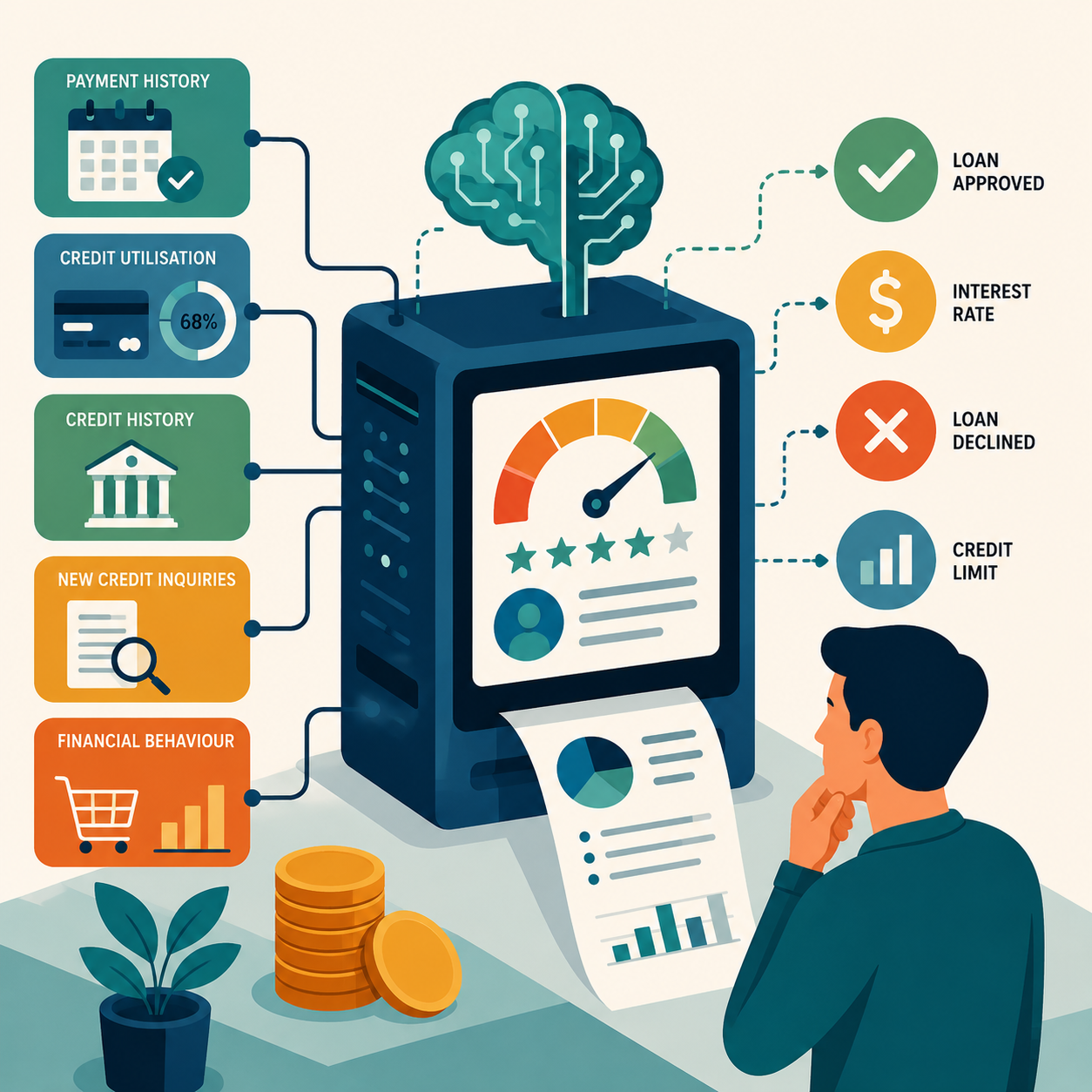
Traditional credit scores are built primarily on credit history, whether and how promptly a person has repaid previous loans. The limitation is structural: people without significant credit history, including recent graduates, recent immigrants, and people who have managed their financial lives primarily in cash, score poorly regardless of their actual creditworthiness. An AI credit score system has expanded the data universe considerably, ingesting rental payment history, utility bill patterns, mobile phone payment records, spending behaviour derived from bank transaction data, and in some jurisdictions, browsing behaviour and app usage patterns.
The predictive power of these signals is real, allowing lenders to extend credit to thin-file applicants who would have been declined under traditional models. The risk is equally real: each additional data source creates another pathway for proxy discrimination, in which characteristics correlated with protected attributes like race or gender influence outcomes in ways invisible to both the borrower and the regulator.
What the Best Evidence Actually Shows
The landmark analysis by Bartlett, Morse, Stanton, and Wallace, using guarantee-fee data from Fannie Mae and Freddie Mac that isolates lender pricing decisions from actual credit risk, is more nuanced than either side of the AI credit score debate usually admits. On loan rejections specifically, in-person lenders rejected minority applicants roughly 6 percent more often than comparable non-minority applicants, while algorithmic lenders showed no measurable difference in rejection rates at all. On pricing, the picture is less encouraging: minority borrowers paid higher interest through both channels, just less through the algorithmic one.
The researchers estimate the total pricing gap costs minority borrowers about $765 million a year in extra mortgage interest, and their reading of the evidence is that the pattern is consistent with lenders, human and algorithmic alike, extracting higher margins from borrowers less likely to shop aggressively across alternative lenders. An AI credit score does not eliminate that dynamic. It just prices it slightly more moderately than a loan officer does.
The Explainability Gap
When a human loan officer declines a mortgage application, the applicant has a legal right under the Equal Credit Opportunity Act to receive a specific, stated reason. When an AI credit score system declines the same application based on a model weighing hundreds of variables, providing that specific reason requires the model to be interpretable in a way many current systems are not. Financial institutions have addressed this through post-hoc explanation systems that generate human-readable reasons after the fact rather than drawing them from the model’s actual decision logic, and regulators are increasingly sceptical that these post-hoc explanations meet the legal standard of a genuine reason for denial.
The Regulatory Response, and Why the Timeline Just Moved
The regulatory picture around AI credit score systems has shifted meaningfully in the past few weeks. The EU AI Act classifies creditworthiness assessment as a high-risk application under Annex III, and for more than a year, August 2, 2026 stood as the date those obligations, data governance, technical documentation, human oversight, and meaningful explanations for adverse outcomes, would take effect. The European Parliament and Council have since approved a Digital Omnibus pushing that specific deadline to December 2, 2027, once the amendment enters into force, though most of the Act’s transparency obligations remain unchanged.
The US approach continues to rely on fair lending law interpretation rather than AI-specific legislation. The Consumer Financial Protection Bureau has stated that courts have already held that a lender’s decision to use algorithmic or machine-learning tools can itself constitute a policy that produces bias under disparate impact theory, meaning technical complexity is not a shield against fair lending accountability, a principle that predates and does not depend on any AI-specific statute being passed.
What This Means for You
If you have applied for credit recently, an AI credit score almost certainly played a role in the decision, whether or not the lender described it that way. Under US fair lending law, the right to a specific adverse action notice applies regardless of whether a human or an algorithm made the decision. Under GDPR in Europe, individuals have a right to contest automated decisions that significantly affect them and to request human review. The practical challenge is that exercising these rights requires knowing they exist and having the resources to pursue them if the lender’s initial response is inadequate.
As LiveAIWire’s coverage of how AI is rewiring global finance has found, the accountability gap in algorithmic credit decisions is part of a broader pattern across financial AI, where the pace of technological deployment is consistently outrunning the pace of institutional response. If a decision seems inconsistent with your actual financial reality, asking the lender directly what data drove the score, and whether a human reviewed it, is a reasonable step before accepting the outcome.
What Borrowers Gain and What They Lose
The expansion of credit access to thin-file applicants is real and significant, and the Bartlett et al. research is consistent with algorithmic review reducing at least the rejection-stage discrimination that has historically kept qualified minority applicants out of homeownership. The speed and consistency of algorithmic decisions also benefits borrowers who previously experienced wide variance in outcomes depending on which human loan officer happened to review their application on a given day.
What borrowers lose is the ability to provide context an AI credit score was not designed to capture. A human loan officer can hear that a gap in credit history reflects a period of serious illness, a bereavement, or a job loss the applicant has since recovered from. An AI scoring system processes that gap as a negative signal with no mechanism to weight the explanation, a limitation that disproportionately affects borrowers whose financial histories include recoverable disruptions, exactly the population that most needs credit access on fair terms.
As our reporting on AI’s growing role in managing personal finances found, this trade-off between consistency and contextual judgement recurs across nearly every consumer-facing financial AI application, not just credit scoring specifically.
The Small Business and Insurance-Adjacent Dimension
The AI credit score debate is dominated by mortgage lending, where the regulatory stakes and volume of decisions are highest, but the same systems are reshaping small business credit, invoice financing, and working capital lending with less regulatory attention. Small businesses owned by women and ethnic minorities face documented barriers to credit through traditional channels, and AI systems that extend credit to under-served businesses represent a genuine opportunity. Systems that instead encode historical under-lending patterns into algorithmic scores perpetuate the very inequalities they are marketed as solving.
The parallel with insurance pricing, where AI systems increasingly determine premiums using similarly broad behavioural data, is direct. As LiveAIWire’s analysis of how AI is reshaping insurance found, a model optimised purely for predictive accuracy will misread anyone who is not average, and the people most often misread are already on the margins. An AI credit score built on device type, postcode, or app usage carries the same risk: correlating with historical default rates in ways that may simply be encoding socioeconomic conditions as individual risk, a question regulators on both sides of the Atlantic are only beginning to engage with in depth.
About the Author
Stuart Kerr is Technology Correspondent at LiveAIWire, covering artificial intelligence, emerging technology, and their impact on business, society, and everyday life. LiveAIWire publishes original AI journalism every weekday at liveaiwire.com.