
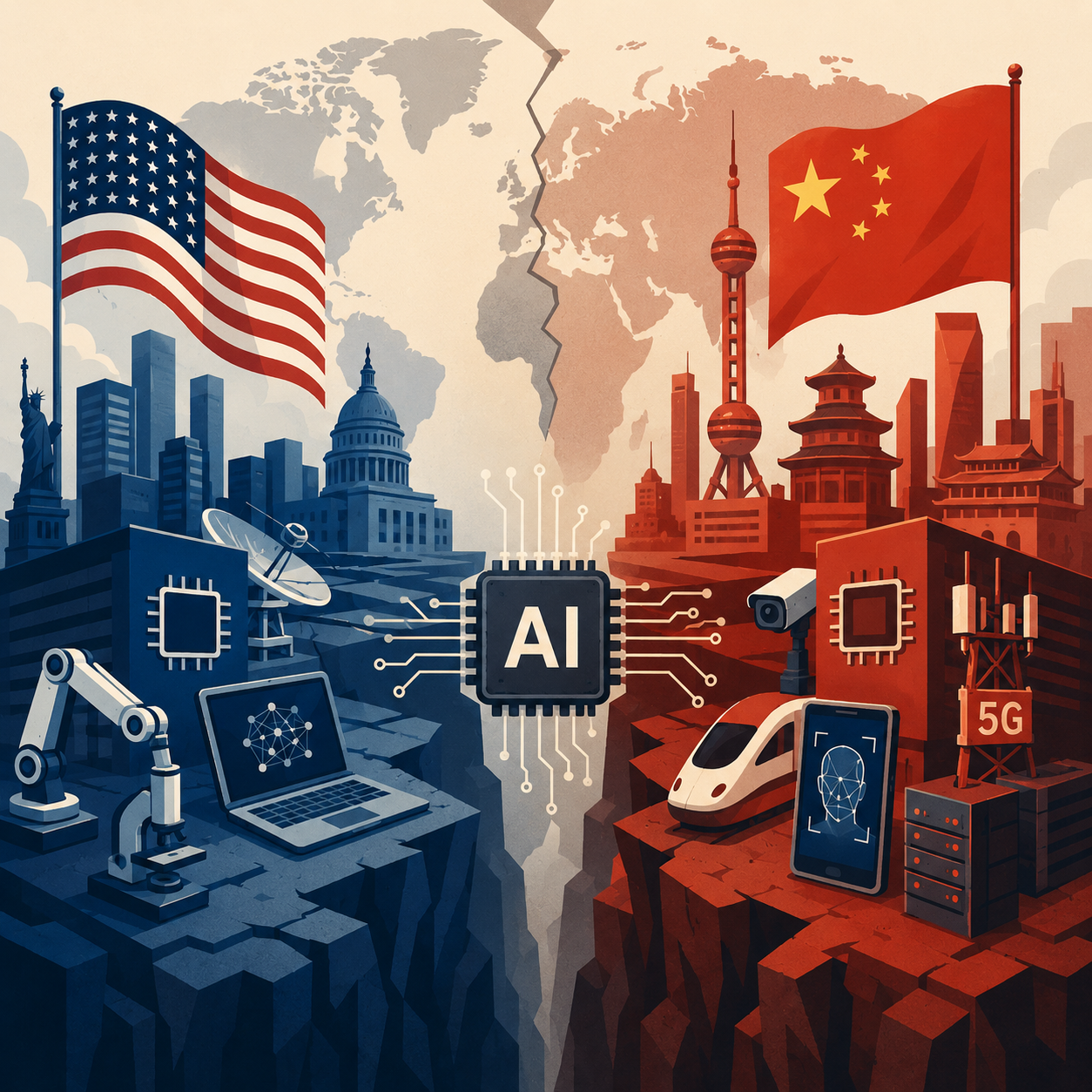
The AI Cold War reached a genuine inflection point on July 14, 2026, when a senior US Commerce Department official confirmed to Congress that Nvidia’s H200 chips have begun shipping to China again, more than a year after Washington moved to ban rival Huawei’s chips worldwide. The volume, officials stressed, remains “trivial.” But the reversal itself matters more than the number. It shows a policy that spent 2025 tightening in every direction has spent 2026 loosening in a targeted one, and that oscillation, not a single hardening line, is what the AI Cold War actually looks like in practice.
The current phase traces back to May 2025, when three events inside a single week reset the terms of the competition. On May 8, executives from OpenAI, Microsoft, CoreWeave, and AMD testified before a Senate hearing titled “Winning the AI Race,” urging lawmakers to strip away regulation rather than add it. Days later, the Commerce Department issued guidance warning that using Huawei’s Ascend AI chips would violate US export controls anywhere in the world, a rule so sweeping it briefly appeared to apply even inside China itself.
In the same week, Donald Trump signed chip agreements with Saudi Arabia and the UAE during a Gulf tour, worth a combined 800 billion dollars in American technology commitments. Three separate signals, in the space of days, confirmed that the competition between Washington and Beijing over AI had stopped being about research papers. It had become a contest over who controls the infrastructure, the chip supply, and the alliances that will shape how AI reorders global power.
Why the AI Cold War Keeps Changing Direction
What has changed since that May 2025 reset is that Washington’s own strategy has proven far less linear than “contain China” suggests. In December 2025, the Trump administration reversed course and approved the sale of Nvidia’s H200, the most powerful chip ever cleared for export to China, moving the review process from a presumption of denial to case-by-case licensing with a 25 percent tariff attached.
The Commerce Department has since cleared roughly ten Chinese firms, including units of Alibaba, Tencent, and ByteDance, though actual deliveries did not begin until this July. At the same time, Washington tightened a separate loophole in June 2026, extending licensing requirements to overseas subsidiaries of Chinese firms after evidence surfaced that restricted chips were reaching China indirectly.
That whiplash, ban Huawei everywhere in May 2025, approve H200 sales in December 2025, close a subsidiary loophole in June 2026, is the real shape of the AI Cold War in 2026. It is not a wall going up. It is a negotiation being conducted through export licences, in which chip access functions as leverage in a wider set of trade and diplomatic talks rather than a fixed strategic line.
The Contested Question at the Centre of the AI Cold War
Whether five years of export controls have actually slowed China’s AI progress is genuinely disputed among people who study the AI Cold War chip supply chain closely, and the disagreement is sharper than most coverage of the topic suggests. A Council on Foreign Relations analysis argues the controls are working precisely as designed: Huawei’s best chip is roughly five times weaker than Nvidia’s, a gap the analysis projects will widen to seventeen times by 2027, and even under the most aggressive production assumptions Huawei would generate only around five percent of Nvidia’s total AI computing output. On that reading, loosening controls further, rather than Huawei’s rise, is the actual risk to America’s lead.
Other analysts reach a starkly different conclusion using different data. Market estimates from Bernstein cited in mid-2026 industry coverage put Huawei’s share of China’s domestic AI chip market approaching fifty to sixty percent by year end, with Nvidia’s official share falling into the single digits after a sustained shift by Chinese hyperscalers away from Nvidia hardware entirely. Nvidia’s own CEO Jensen Huang has said the company has “largely conceded” China’s advanced AI chip market.
Both claims cannot be fully reconciled with simple chip-counting; they reflect different assumptions about production volume, real-world chip reliability, and how much of Huawei’s output actually reaches Chinese buyers rather than existing on paper. What is not disputed is that Huawei’s Ascend chips are shipping in China at a scale unimaginable before 2025, and that Chinese demand for domestic alternatives is now driven as much by enterprise procurement decisions as by government mandate.
From Containment to Bloc Formation
The deeper shift beneath the chip-by-chip disputes is that Washington has moved from trying to slow China’s AI progress to actively building a coalition of allies for the AI Cold War whose chip access, cloud infrastructure, and regulatory standards align with the American model rather than the Chinese one. The Gulf state deals signed in May 2025 were an early and explicit version of that strategy: as LiveAIWire’s coverage of Saudi Arabia and the UAE’s AI investment strategy has found, Trump’s decision to lift Gulf chip restrictions was partly a deliberate move to pull Gulf state infrastructure spending toward American companies and away from the Chinese alternatives those countries had spent a decade cultivating.
China is running the mirror strategy in the AI Cold War at the level of the Global South, offering infrastructure investment and preferential access to Chinese AI platforms across Africa, Southeast Asia, and Latin America as an alternative to Western dependency. As LiveAIWire’s reporting on China’s own super-datacentre ambitions has documented, Beijing is simultaneously building the domestic compute base to reduce its own reliance on any single foreign supplier, a dual strategy of courting allies abroad while insuring against dependency at home. Countries such as Indonesia are becoming genuine swing states in this competition, weighing compute access, regulatory alignment, and technology lock-in in ways that carry consequences well beyond their own borders.
What This Means for You
If your organisation buys AI infrastructure, cloud services, or hardware from either side of this AI Cold War divide, the practical lesson of the last eighteen months is that the rules governing that access can change within months, not years. A chip export policy that was a blanket global ban in May 2025 became a licensed, tariffed, case-by-case exception by December, and a subsidiary loophole closed again by June 2026.
As LiveAIWire’s coverage of Nvidia’s earlier chip export strategy found, this volatility is now a structural feature of doing business across the US-China technology divide rather than a temporary disruption, and organisations with supply chains that touch either country’s AI hardware should plan for policy reversal as a recurring risk rather than a one-off event.
The Bifurcation Beneath the Headlines
The practical consequence of this back-and-forth is a genuine bifurcation of the global technology stack, regardless of which side of the containment debate turns out to be right. One ecosystem is built on Nvidia’s architecture, Western cloud platforms, and the EU and US regulatory frameworks. The other is coalescing around Huawei’s Ascend chips, Chinese cloud platforms, and governance frameworks developed through Chinese-led multilateral processes.
A country building its AI infrastructure on Alibaba Cloud and Huawei hardware is making a different set of AI Cold War sovereignty trade-offs than one built on AWS and Nvidia, and as more of healthcare, finance, and education comes to depend on whichever stack a country has chosen, the cost of switching between them will only rise. The AI Cold War, on the evidence of the last eighteen months, is not being decided by a single export rule. It is being decided, license by license and deal by deal, in exactly the kind of back-and-forth that defined the period from May 2025 to July 2026, and there is little reason to expect that pattern to settle any time soon.
About the Author
Stuart Kerr is Technology Correspondent at LiveAIWire, covering artificial intelligence, emerging technology, and their impact on business, society, and everyday life. LiveAIWire publishes original AI journalism every weekday at liveaiwire.com.