
By Stuart Kerr, Technology Correspondent, LiveAIWire
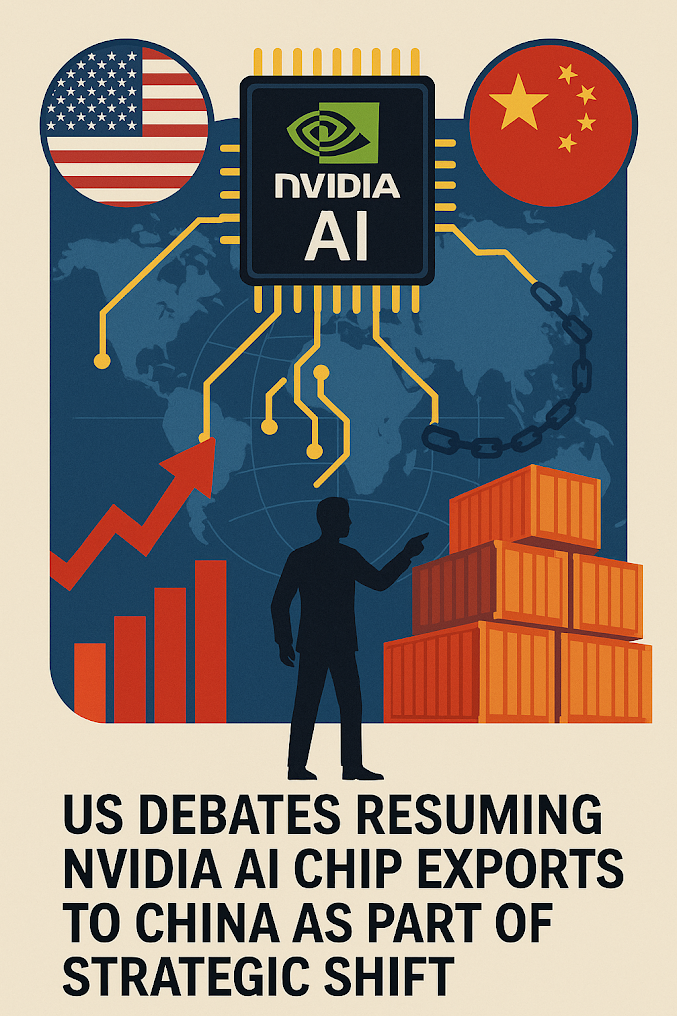
In May 2026, the US Commerce Department cleared roughly ten Chinese companies, including Alibaba, Tencent and ByteDance, to buy Nvidia’s H200 AI chip, capped at 75,000 units per customer. Months later, not one of those chips had actually been delivered. Chinese customs authorities were quietly instructing companies not to buy them at all. The story of Nvidia’s chip exports to China is no longer a policy debate. It is a running conflict between two governments that each keep changing their minds, sometimes within weeks of each other.
What began in August 2025 as a single question, whether Washington would let Nvidia sell advanced chips to China, has since split into a tangle of reversals, congressional pushback, and Chinese regulators blocking the very access the White House approved. Both governments are treating the same chips as simultaneously essential to sell and dangerous to allow, and the resulting policy has been described by one of Washington’s own foreign policy think tanks as strategically incoherent by design.
Table of Contents
From Total Ban to Case-by-Case: How We Got Here
The current fight traces back to October 2022, when the Biden administration first cut China off from advanced AI chips over national security concerns. Those rules tightened repeatedly through 2023 and culminated in a global tiered licensing framework in January 2025. The Trump administration scrapped that framework in May 2025, calling it burdensome, only to ban even Nvidia’s China-compliant H20 chip outright that same April, before reversing course again in July 2025 and allowing H20 and AMD’s MI308 to resume under a deal requiring the companies to share 15 percent of that China revenue with the US Treasury.
China’s own regulators then complicated matters further. In September 2025, its Cyberspace Administration barred domestic tech firms from buying Nvidia chips at all, pushing companies toward homegrown alternatives instead. By December, Trump had approved the more powerful H200 for export regardless, and Commerce formally codified that policy in January 2026, shifting the review posture for H200 and equivalent AMD chips from a presumption of denial to case-by-case approval, alongside a new 25 percent tariff on advanced chips merely transiting through the US en route to other countries.
What This Means for You
If you invest in, work for, or build products dependent on Nvidia, AMD, or the broader AI supply chain, the practical reality is that US-China chip policy has become genuinely unpredictable on a timescale of months, not years, and Chinese demand approvals no longer reliably translate into Chinese deliveries. For businesses planning around chip availability or China market access, treating any single policy announcement as durable is a mistake the last twelve months have repeatedly punished. The safer planning assumption is continued volatility in both directions, tightening and loosening, for the foreseeable future.
The Approval Nobody Can Actually Use
The gap between what Washington permits and what actually reaches China has become the defining feature of this policy. Even after Commerce’s January 2026 rule and China’s own approval of a first batch of over 400,000 H200 units in late January, deliveries stalled through the spring. Reuters reported Chinese customs authorities were instructing firms not to purchase the chips at all, and Nvidia’s Jensen Huang was still pushing for a breakthrough on stalled sales as late as May 2026, including personally joining President Trump’s state visit to China that month to make the case directly.
Nvidia has responded to the uncertainty with unusual caution of its own. As of January 2026, the company began requiring full, upfront payment from Chinese customers for H200 chips priced as high as 30,000 dollars per unit, a hedge against the very real risk that Beijing could block the deal entirely after money changes hands. That is not the behaviour of a company confident in the durability of its own export licenses.
Congress Pushes Back Against the White House
The administration’s approach has also run into resistance from its own side of government. The House Foreign Affairs Committee advanced the AI Overwatch Act in January 2026, a bill that would impose a two-year ban on Blackwell chip sales to China and require congressional sign-off on future advanced chip exports. Its Republican sponsors, Brian Mast and John Moolenaar among them, argue the administration is handing frontier compute to companies with documented ties to China’s military. White House AI czar David Sacks has publicly pushed back against the bill, and it has not yet passed either chamber.
The Council on Foreign Relations’ assessment of the underlying regulation captures why this fight keeps escalating on both sides. Its analysis found that shipping the full one million H200 units the current volume cap technically allows would increase China’s installed AI compute by roughly 250 percent relative to relying on domestic chips alone, and warned that applying the same ratio to next-generation Blackwell-class chips could increase it by over 1,000 percent. The report concluded there is no version of this policy that is simultaneously permissive, enforceable, and protective of US security interests all at once.
Closing the Loophole That Let Blackwell Slip Through
A separate complication emerged in June 2026, when Commerce issued guidance clarifying that its licensing requirements for the most advanced, still-banned Blackwell chips apply to any company headquartered in China regardless of where it operates globally, not just firms physically inside the country. The clarification followed accusations, including from a former Biden administration technology policy official, that Chinese companies had been buying restricted Blackwell chips through overseas subsidiaries because Commerce had never explicitly stated the rule covered them. Nvidia maintains its vetting process was already compliant with the clarified guidance throughout.
That episode illustrates a pattern that runs through this entire saga, restrictions written for one moment in the technology cycle get reinterpreted, loosened, tightened, and reinterpreted again as new chip generations and new workarounds emerge. As LiveAIWire’s earlier reporting on AI’s hidden infrastructure explored, semiconductors have become the kind of critical national infrastructure that used to describe pipelines and power grids, and the speed at which policy is now forced to move reflects that shift.
Why the White House and Its Critics See This So Differently
The administration’s own defenders frame the policy as a calculated trade-off rather than a contradiction. Commerce Secretary Howard Lutnick has argued publicly that China is only receiving what he calls Nvidia’s fourth-best chip, deliberately kept a generation behind what American companies use, on the theory that keeping China dependent on buying rather than building is itself a strategic win. Sacks has made a similar case, arguing the policy denies market share to China’s domestic champion, Huawei, without handing over frontier capability.
Critics, including the CFR’s own analysts, counter that the certifications built into the regulation, requiring Chinese buyers to prove robust internal controls against military end-use, are effectively unenforceable when the most likely buyers are cloud giants the US Defense Department has itself previously named as Chinese military companies. Both sides are, in effect, betting on the same uncertain variable: whether China’s domestic chip industry closes the gap faster with restricted access or with restricted access removed.
The Commercial Stakes Behind the Politics
For Nvidia, the financial stakes of getting this right are enormous. China has historically represented a meaningful share of the company’s revenue, and prolonged restriction has left billions of dollars in built inventory unsold at various points over the past year. That commercial pressure sits alongside Nvidia’s broader push, detailed in LiveAIWire’s coverage of Nvidia’s new revenue-sharing model, to extend its dominance from one-time hardware sales into recurring claims on the AI economy it powers, a strategy that depends on maximising the addressable market for its chips wherever politically possible.
The dynamic is not unique to China, either. As LiveAIWire has reported on Austria’s push to bring Anthropic into the EU, Washington’s willingness to use export control law as a lever, this time against Europe’s access to frontier AI models rather than chips, has left even close allies newly aware that the tools built underneath their own AI ambitions can be switched off by a decision made entirely outside their borders. Chip export policy toward China is the clearest and longest-running example of exactly that leverage in action.
What Happens Next
None of the underlying tension driving this saga looks close to resolved. Commerce’s volume caps still leave room for millions of additional chip shipments under current rules, Congress is still trying to claw back some of that discretion through the AI Overwatch Act, and Beijing has shown it is just as willing to block chips its own companies are cleared to buy as Washington is to approve them. Every part of this system, licensing thresholds, tariffs, entity lists, and now extraterritorial guidance, has changed at least once in the past year and is likely to change again. As the broader infrastructure race LiveAIWire has tracked across Google, Amazon and Meta continues to accelerate, the chips at the centre of the US-China dispute remain the one resource that no amount of capital alone can simply build more of.
About the Author
Stuart Kerr is Technology Correspondent at LiveAIWire, covering artificial intelligence, emerging technology, and their impact on business, society, and everyday life. LiveAIWire publishes original AI journalism every weekday at liveaiwire.com.