
By Stuart Kerr, Technology Correspondent, LiveAIWire
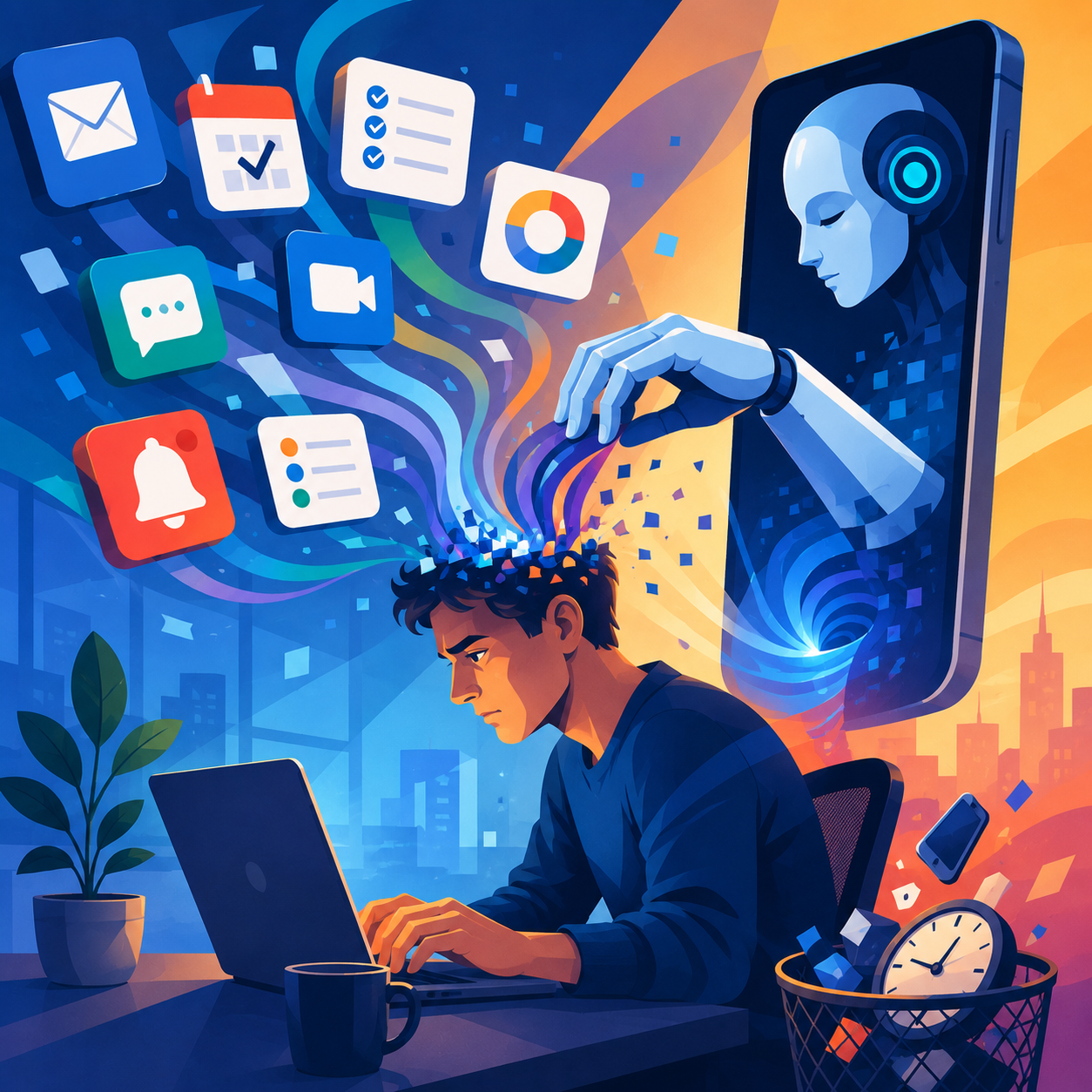
The attention economy collided head-on with AI productivity tools in 2025, and the collision did not go the way vendors promised. The average focused work session in 2025 lasted just 13 minutes and 7 seconds, down 9 percent from 2023, according to ActivTrak’s 2026 State of the Workplace report, which analysed 443 million work hours across 1,111 companies.
Microsoft’s 2025 Work Trend Index found that workers receive a notification every two minutes, totalling 275 interruptions across a working day. UC Irvine research by Gloria Mark established that it takes an average of 23 minutes and 15 seconds to fully regain deep focus after a single disruption. The mathematics of attention loss are stark: at 275 interruptions per day, each requiring 23 minutes of recovery time, the recovery window for each interruption overlaps with the next before it is complete.
Into this attention economy, organisations have deployed AI productivity tools with an explicit pitch: AI handles routine tasks, freeing human attention for the creative, strategic, and complex work that requires sustained concentration. AI adoption reached 80 percent of employees in 2025, up from 55 percent in 2023. Focus efficiency, the share of total work time spent in focused, uninterrupted work, fell to 60 percent in 2025, a three-year low. The data raises a question that enterprise AI programmes have not confronted directly: are the productivity tools designed to free attention actually consuming it?
The Attention Economy Before AI Arrived at Work
The attention economy, the framework for understanding digital media as a system that monetises human focus, was codified well before AI arrived as a workplace productivity tool. Meta, Google, and ByteDance built the modern attention economy on deep learning systems specifically optimised for retaining user attention as long as possible, with recommendation algorithms and notification systems expressly designed to interrupt and redirect attention toward their platforms.
The cognitive costs of this system were documented before generative AI tools arrived in workplaces. Research published in Frontiers in Human Neuroscience in 2025 found that lapses in sustained attention reduce connectivity within the prefrontal cortex and anterior cingulate gyrus, the brain regions responsible for executive control, in less than two minutes of unregulated task switching.
How AI Tools Add to the Attention Economy’s Cognitive Load
The mechanism by which AI productivity tools compound the attention problem rather than resolving it is specific and documented. The attention economy’s collision with AI is visible in Harvard Business Review’s February 2026 analysis, which identified AI brain fry, a form of cognitive fatigue tied to intensive use and oversight of AI systems, as a measurable phenomenon distinct from general workplace burnout. Workflows built around multiple AI agents and constant tool switching add cognitive strain because workers must simultaneously maintain task context, evaluate AI outputs for accuracy, redirect AI tools when they err, and document AI-assisted decisions for accountability purposes.
Before AI tools, knowledge work contained built-in recovery periods embedded in routine tasks: waiting for a report to compile, formatting a spreadsheet, searching through documents for a specific data point. These tasks served as micro-recovery periods that allowed the prefrontal cortex to consolidate and restore executive function. AI eliminates these breaks. When every task that used to take twenty minutes now takes twenty seconds, the worker moves immediately to the next cognitively demanding task without recovery. Only 8 percent of the time savings from AI tools are being reinvested into activities that actually benefit the worker, according to research compiled across multiple 2025 and 2026 studies.
The Cognitive Delegation Loop
A 2026 academic paper on AI context windows and human attention decline articulates the dynamic most precisely. As AI systems grow capable of processing ever-larger and more complex contexts, the cognitive threshold at which humans choose to delegate tasks falls correspondingly. Tasks once performed with minimal effort, a two-sentence email reply, a quick calculation, a brief summary, are now routinely offloaded. Using AI for tasks that do not require AI assistance reduces the cognitive engagement that maintains attention capacity, in the same way that a muscle atrophies without use.
Roy Baumeister’s decision fatigue research provides additional framework: the capacity for high-quality decision-making degrades with every decision made. Workers who evaluate AI outputs, accepting, rejecting, or modifying each suggestion, are making a continuous stream of small decisions that deplete the capacity required for the complex, consequential decisions AI cannot make for them. The 33 percent increase in decision fatigue among heavy AI users maps directly onto this mechanism, a pattern that connects to LiveAIWire’s coverage of AI job exposure, where cognitive task substitution is reshaping which skills workers retain and which atrophy.
What the Research Says Actually Works
Studies at the University of Wisconsin found that planned attention shifts at natural stopping points allow the brain’s default-mode network to consolidate information and restore focus capacity, while involuntary interruptions, including notifications and proactive AI suggestions, degrade the attention system. The ActivTrak data found that employees who spend 7 to 10 percent of their total work hours in AI tools have the highest productivity rates, 95 percent above baseline, of any usage tier. Only 3 percent of employees currently fall within that optimal range.
Organisations that have deliberately structured AI tool use to remain within the optimal band, through governance frameworks that specify which tasks AI handles and which remain unassisted, are generating consistent returns. Organisations that have deployed AI tools broadly and left usage to individual discretion are not, a distinction that echoes LiveAIWire’s broader coverage of the AI automation divide, where deliberate design choices consistently separate organisations that benefit from AI adoption from those that merely accelerate existing dysfunction.
The Weekend Work Signal
One of the most revealing findings in the ActivTrak 2026 data is the structural shift in weekend work. Saturday productive hours jumped 46 percent, from 3 hours 10 minutes to 4 hours 37 minutes. Sunday productive hours rose 58 percent, from 2 hours 30 minutes to 3 hours 58 minutes. Average Saturday start times moved an hour and 24 minutes earlier.
These figures reflect a workforce working more total hours than before AI tools were widely deployed, distributing those hours across the full week in an environment where the boundaries between work time and personal time have been eroded by always-available AI systems that invite engagement at any hour, a dynamic LiveAIWire has traced directly in our coverage of the AI cult of productivity.
What This Means for Individual Workers
For individual workers navigating the attention economy’s collision with AI tools, the practical response is not to abandon AI productivity tools but to be deliberate about when and how they are used. Batching AI-assisted tasks into defined blocks, rather than toggling between AI tools and deep work throughout the day, preserves more of the recovery time that sustained attention depends on. Turning off proactive AI notifications and suggestions, reviewing AI outputs at scheduled intervals rather than as they arrive, and protecting at least one substantial block of each working day for AI-free concentration are all changes within an individual worker’s control, even without organisational policy support.
The Design Imperative
The organisations successfully managing the attention economy’s collision with AI share a characteristic the research identifies consistently: they treat the design of AI-augmented work as explicitly as they treat the design of physical workspaces or meeting cadences. They specify which tasks should be AI-assisted and which should remain unassisted. They establish notification hygiene, rules about which AI alerts require immediate attention and which can be batched. They protect calendar blocks for uninterrupted focus work that AI cannot interrupt. The attention crisis that AI is amplifying is not inevitable. It is a design choice that organisations can make differently.
About the Author
Stuart Kerr is Technology Correspondent at LiveAIWire, covering artificial intelligence, cybersecurity, and the social impact of emerging technology. He publishes daily at LiveAIWire.com.