
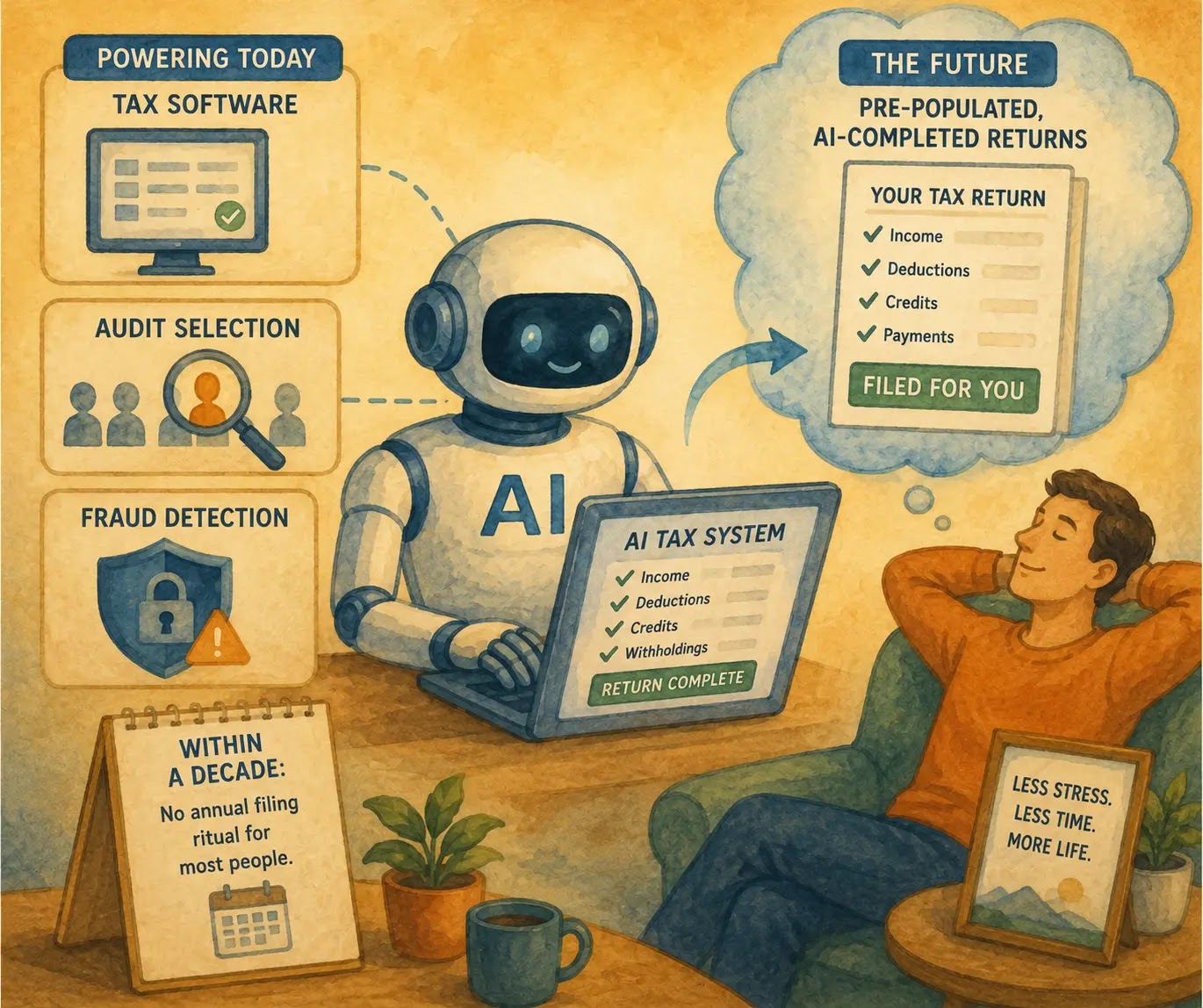
AI tax administration is already finding money humans miss. In 2023, Austria’s finance ministry credited artificial intelligence with generating around 185 million euros in additional tax revenue, a figure published by the country’s Federal Ministry of Finance and cited by the OECD in its 2025 review of AI in tax administration. That is what a machine can find in the gaps people miss. It matters now because the same capability that hunts for unpaid tax is quietly dismantling the annual ritual most of us still dread: the tax return.
The Annual Return Is Already Being Dismantled by AI Tax Administration
Tax authorities have moved faster than most people realise. The OECD found that 29 of its 38 member countries already report using AI in tax administration, drawing on its 2024 inventory of tax technology initiatives. The work is no longer experimental. It runs underneath the systems millions of citizens touch every year.
Britain is a clear example. From April 2026, HMRC’s Making Tax Digital for Income Tax replaces the once-a-year self-assessment form with quarterly digital updates for sole traders and landlords earning above a threshold, according to GOV.UK guidance. The familiar shoebox of receipts and the January scramble are being replaced by software that reports as you go.
Several administrations already pre-fill large parts of a return from data they hold, so that for many people the task shrinks to checking and confirming figures rather than assembling them. The UK’s move to quarterly digital updates pushes in the same direction, shifting the burden from an annual act of memory to a continuous, software-assisted record. As that pre-filling deepens, the moment when a taxpayer must actively compile and submit their own numbers steadily recedes.
How Machines Already Do the Hard Part of AI Tax Administration
The grind of a tax return is data entry, and that is precisely what machines do best. The OECD’s review describes administrations using AI virtual assistants to answer routine queries, and more recently large language models to personalise and speed up interactions with taxpayers. Where data already flows in from employers, banks and platforms, the return increasingly fills itself.
The direction of travel is a system that knows what you earned before you tell it. For a salaried worker whose income is already reported through payroll, the case for asking them to declare it again every year grows weaker each time the data pipes improve. The form survives today less because it is needed and more because the law still asks for it.
Catching What Humans Miss
The other half of the AI tax administration shift is enforcement, and here the gains are concrete. The OECD notes that tax administrations use AI to uncover hidden patterns and connections between transactions, assets and taxpayers, and to analyse unstructured material such as text and social media to flag possible evasion. Austria’s 185 million euro figure is what that looks like on a balance sheet.
The reach widens as the data pipes improve. The OECD reports that more than 80 per cent of tax administrations are now developing application programming interfaces that let their systems draw information directly from banks, employers and software providers, rather than waiting for taxpayers to type it in. Each new connection narrows the space between what you declare and what the authority can already see, and it is that shrinking gap, more than any single algorithm, that spells the end of the return as we know it.
For honest taxpayers, this shift in AI tax administration is mostly good news, because every pound or euro recovered from evasion is one that does not have to be raised elsewhere. It also changes the texture of compliance. A system that cross-checks your declared income against dozens of external sources in seconds leaves far less room for the quiet rounding-down that paper returns once invited.
The Accountant’s Job Changes, It Does Not Vanish
If the form disappears under AI tax administration, what happens to the people who fill it in? The likeliest outcome is not mass redundancy but a shift in what tax professionals are paid for. Routine data entry and reconciliation, the bulk of low-value compliance work, is exactly what automation absorbs first. What it does not absorb is judgement: how to structure a business, when a deduction is defensible, how to handle the genuinely ambiguous case no model has seen before.
The OECD’s review frames AI tax administration as a way to free up human resources for higher-value work rather than to strip people out entirely, and the same logic holds for the private sector. For an accountant or bookkeeper, the lesson is to move up the chain toward advice and planning, because the part of the job a machine cannot yet replicate is the part clients will still pay for. The firms that treat Making Tax Digital as a prompt to retool, rather than a threat to resist, are the ones most likely to come out ahead.
What This Means for You
If you are a UK sole trader or landlord affected by AI tax administration, the change is not theoretical. More than 860,000 people are estimated to fall into the first phase of Making Tax Digital from April 2026, with the qualifying income threshold dropping in later years to pull in many more. The practical steps are to check whether your combined self-employment and property income crosses the threshold, choose compatible software early, and start keeping digital records now rather than in a panic next spring.
It is also worth getting comfortable with the software before the deadline rather than after it, because the tools that file on your behalf are only as good as the records you feed them, and a clean digital trail kept through the year is what turns the new regime from a chore into a genuine time-saving. HMRC has signalled a lighter touch on penalties in the first year of the rollout, but that grace period is finite, and the businesses that use it to build good habits will fare better than those that wait to be chased.
For everyone else, the smart move is to treat your financial data as something worth keeping clean and current, because the more your records already match what the authorities can see, the less the coming systems will trouble you. As LiveAIWire’s coverage of the AI revolution in personal finance found, the same logic of letting software carry the routine load runs through budgeting, investing, and fraud detection, and the broader rewiring of money is covered in how AI is rewiring global finance.
The Return Won’t Vanish Overnight, But AI Tax Administration Is Accelerating
The annual return will not disappear in a single budget. Thresholds, exemptions and the sheer inertia of tax law mean a long transition rather than a clean break, and plenty of people will be filing some version of a return for years yet. The trajectory driven by AI tax administration is hard to mistake, though.
As more income is reported automatically and more checks happen in real time, the once-a-year declaration looks less like a necessity and more like a habit the system has not yet shed. Within a decade the question may not be how to file your return, but why you were ever asked to. For a sense of how far automated money management could reach into daily life, see LiveAIWire’s look at whether AI can manage your wallet.
About the Author
Stuart Kerr is Technology Correspondent at LiveAIWire, covering artificial intelligence, cybersecurity, and the social impact of emerging technology. He publishes daily at LiveAIWire.com.