AI cheating in schools has moved from isolated incidents to a documented, measurable crisis in under two years. Nearly 7,000 UK university students were formally confirmed to have cheated using AI tools in the 2023-24 academic year, according to a Freedom of Information investigation reported by The Register in June 2025, representing triple the number from the previous year and a rate of 5.1 cases per 1,000 students, up from 1.6 per 1,000 twelve months earlier.
Researchers familiar with the data believe even this is a significant undercount. In a controlled test at the University of Reading, 94 percent of AI-written submissions went undetected by assessors, suggesting the formal case numbers reflect only the fraction of AI misuse that is ever caught and reported.
The scale and pace of the shift has placed academic institutions in a position most were not designed to handle. ChatGPT reached 100 million users faster than any consumer technology in history, and it did so while students were mid-degree and mid-semester. The integrity frameworks, assessment designs, and detection tools that institutions had built over decades to address plagiarism were not built for a world where a free, widely available tool could produce plausible academic prose on any topic in seconds. What is happening now is not an AI cheating crisis in the traditional sense. It is a structural mismatch between the technology environment students inhabit and the assessment environment institutions built before that technology existed.
For students currently in higher or secondary education, for educators trying to manage this in real time, and for employers who will eventually hire graduates whose academic records may or may not reflect genuine capability, understanding what is actually happening and what is being done about it is directly relevant to decisions being made right now.
The AI Cheating Detection Arms Race Nobody Is Winning
The institutional response to AI cheating has been dominated by detection tools, and the evidence on their effectiveness is discouraging. Australian Catholic University reported nearly 6,000 AI cheating allegations in 2024, representing approximately 90 percent of all academic integrity cases that year. Around 25 percent of those referrals were dismissed after investigation, which prompted the university to abandon Turnitin’s AI detection tool in March 2025. The University of Cape Town announced in July 2025 it would stop using Turnitin’s AI detection score from October 2025, citing evidence that the tool is unreliable. Princeton and MIT have both advised against relying solely on AI detection tools, citing false accusation rates that damage trust without reliably improving integrity.
The technical reason detection is losing the arms race is straightforward. AI detection tools work by identifying statistical patterns in text that differ from typical human writing, but those patterns shift as AI models improve and as students learn to prompt and edit AI outputs to reduce detectability. The tools designed to catch yesterday’s AI-generated content are always playing catch-up with today’s generation of models. The gap between what AI can produce and what detection can identify is widening, not closing.
What Is Actually Working
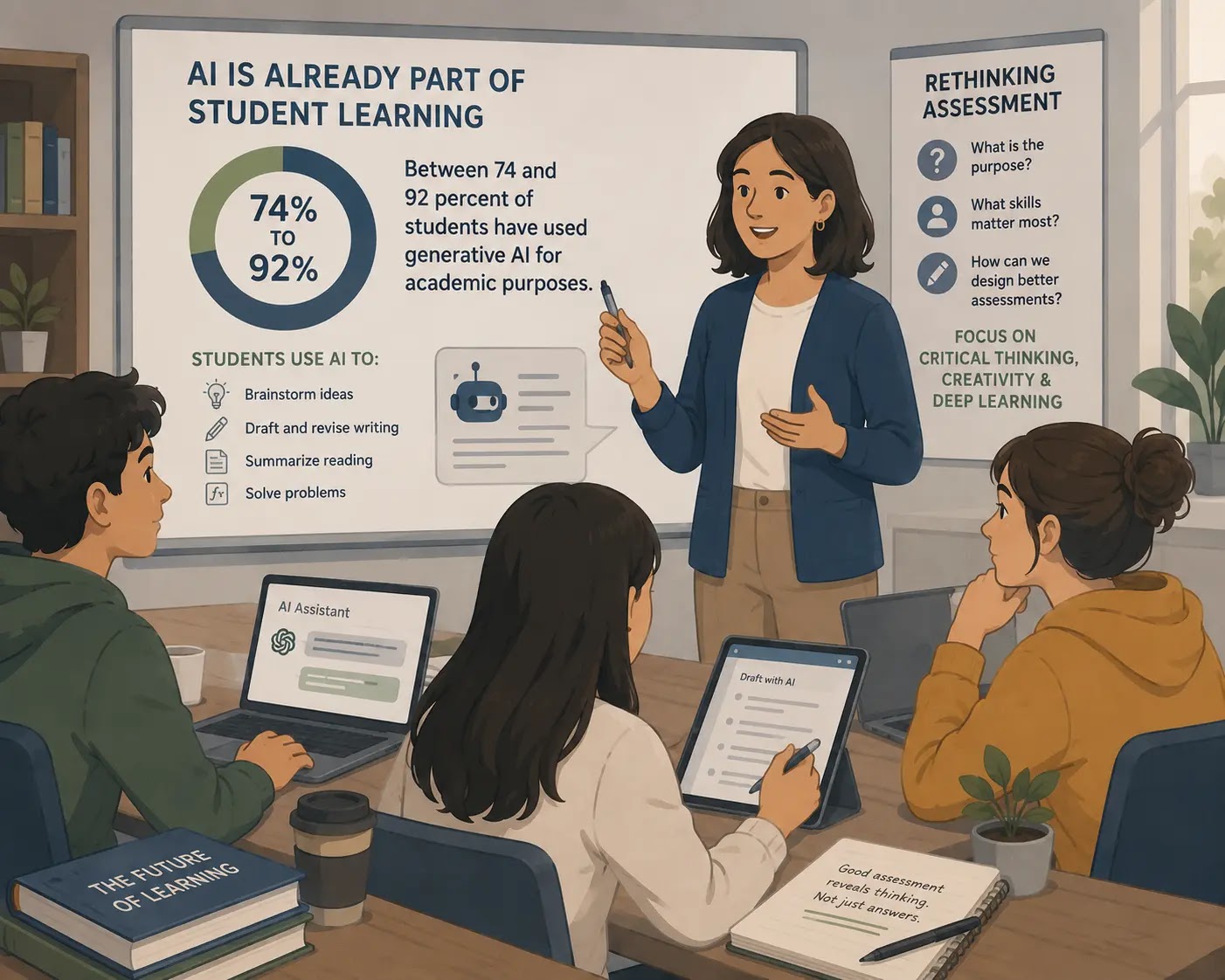
The institutions making most progress against AI cheating are those that have moved the problem upstream, redesigning assessment rather than trying to detect misuse after submission. Schools implementing assessment redesign, shifting toward oral examinations, in-class work, portfolio assessments, and project formats that require demonstrated process rather than finished text, report 40 percent fewer AI-related integrity issues compared to detection-only approaches. The logic is simple: if the assessment requires something an AI cannot provide, the detection problem largely disappears.
The Higher Education Policy Institute’s 2025 survey of UK undergraduates found that the proportion of students who believe university staff are well-equipped to work with AI more than doubled from 18 percent in 2024 to 42 percent in 2025, a rate of change the report’s author called almost unheard of over a single year. That is meaningful institutional progress. It also means most students still do not believe their institutions are fully ready, which is a more honest measure of where the sector actually stands.
The Student View Is More Complicated Than the Headlines Suggest
A Pew Research Center survey of American teenagers found that roughly a quarter use AI chatbots for schoolwork, and a majority say students at their school use AI to cheat often. But 51 percent of students in BestColleges survey data believe using AI without attribution is cheating, and 22 percent admit doing it anyway. The gap between belief and behaviour reflects what anyone who has worked with adolescents under pressure would recognise: knowing something is wrong and choosing not to do it require more than knowing. They require an environment where doing the right thing is viable and the cost of doing the wrong thing is real. Neither condition is reliably present in current academic culture around AI.
For a broader picture of how AI is reshaping learning beyond the cheating dimension, LiveAIWire’s coverage of how AI is helping and hurting workers at the same time found the same augmentation-versus-replacement tension playing out in workplaces that these same students will soon enter.
Understanding how to know when you can actually trust an AI system is directly relevant here too, since the same calibration skill students need to avoid over-relying on AI in coursework is what employers will expect of them after graduation. And the question of whether AI tools are leading to learning loss or genuine educational gains is one the evidence base has not yet settled. The two questions, cheating and learning, are related but not identical, and conflating them produces bad policy on both.
Where Institutions Go From Here
The trajectory for the next three years is toward a hybrid model where some use of AI in academic work is permitted and disclosed, similar to how citation practices developed around the internet, and where assessments are redesigned to evaluate demonstrated capability rather than polished text output. That is a significant change to teaching practice, assessment design, and academic culture that cannot be achieved through policy statements alone. It requires investment in staff development, curriculum redesign, and the kind of institutional patience that is difficult to sustain when the pressure for quick fixes is as intense as it currently is.
What is clear from the evidence is that detection-only approaches to AI cheating are not working and are creating their own harms through false accusations. Understanding how to use AI tools effectively and appropriately is a skill that students, educators, and institutions all need simultaneously. The AI cheating crisis is, at its core, a speed mismatch: the technology arrived faster than the frameworks to use it well. Closing that gap is the work of the next several years, and the institutions starting that work now will be better positioned than those still waiting for the detection tools to catch up.
Scottish universities caught more than 1,000 students cheating with AI in 2024, a 700 percent increase from the previous year, and similar trajectories are visible in Australia, Canada, and across US higher education. The geographic spread confirms this is not a problem specific to any one institutional culture or national education system. It is a direct consequence of the technology being available and the incentive structures of competitive assessment environments.
Faculty in a 2025 eCampusOntario survey rated AI-specific plagiarism policies as only 28 percent effective, against 49 percent for traditional plagiarism policies. Both numbers are discouraging, but the gap between them points to where the work needs to happen: not faster detection but better policy design informed by how AI is actually being used.
About the Author
Stuart Kerr is Technology Correspondent at LiveAIWire, covering artificial intelligence, cybersecurity, and the social impact of emerging technology. He publishes daily at LiveAIWire.com.