
By
Stuart Kerr, Technology Correspondent,
LiveAIWire
A brazen daylight raid at the Louvre has left eight pieces of France’s imperial jewellery missing and the world’s most visited museum asking hard questions about its defences. The Louvre heist saw four thieves disguised as construction workers use a truck-mounted furniture lift to reach an upper-storey window of the Galerie d’Apollon, force entry with an angle grinder, smash two display cases and escape by motorbike in seven minutes, according to French Interior Minister Laurent Nunez and confirmed reporting from CNN. The museum closed for the day as investigators began reconstructing a timeline that unfolded almost entirely out of anyone’s reach to stop it.
The missing set reads like a precis of nineteenth-century power. Stolen pieces include emeralds associated with Empress Marie-Louise and sapphires linked to Queen Hortense and Queen Marie-Amelie, with a crown belonging to Empress Eugenie recovered outside, damaged, an emblem of the speed and chaos of the escape rather than reassurance about what remains missing. France24’s reporting on the aftermath noted the Louvre heist has reopened decades-old questions about museum security funding, with the institution’s own leadership acknowledging camera coverage gaps around the building’s exterior.
The Seconds That Mattered
What failed was not the existence of alarms but the choreography that turns raw alerts into decisive action. In high-value galleries, seconds matter more than sensors. Traditional systems throw motion, vibration and perimeter triggers into a control room; without instant context, operators hesitate. The crew exploited those seconds, the pause between a trigger, a camera being re-tasked and a guard being dispatched, and turned them into a blind spot in the heart of Paris. It is the exact vulnerability that has made the Louvre heist a case study for museum security teams worldwide, not just in France.
How AI Closes the Gap
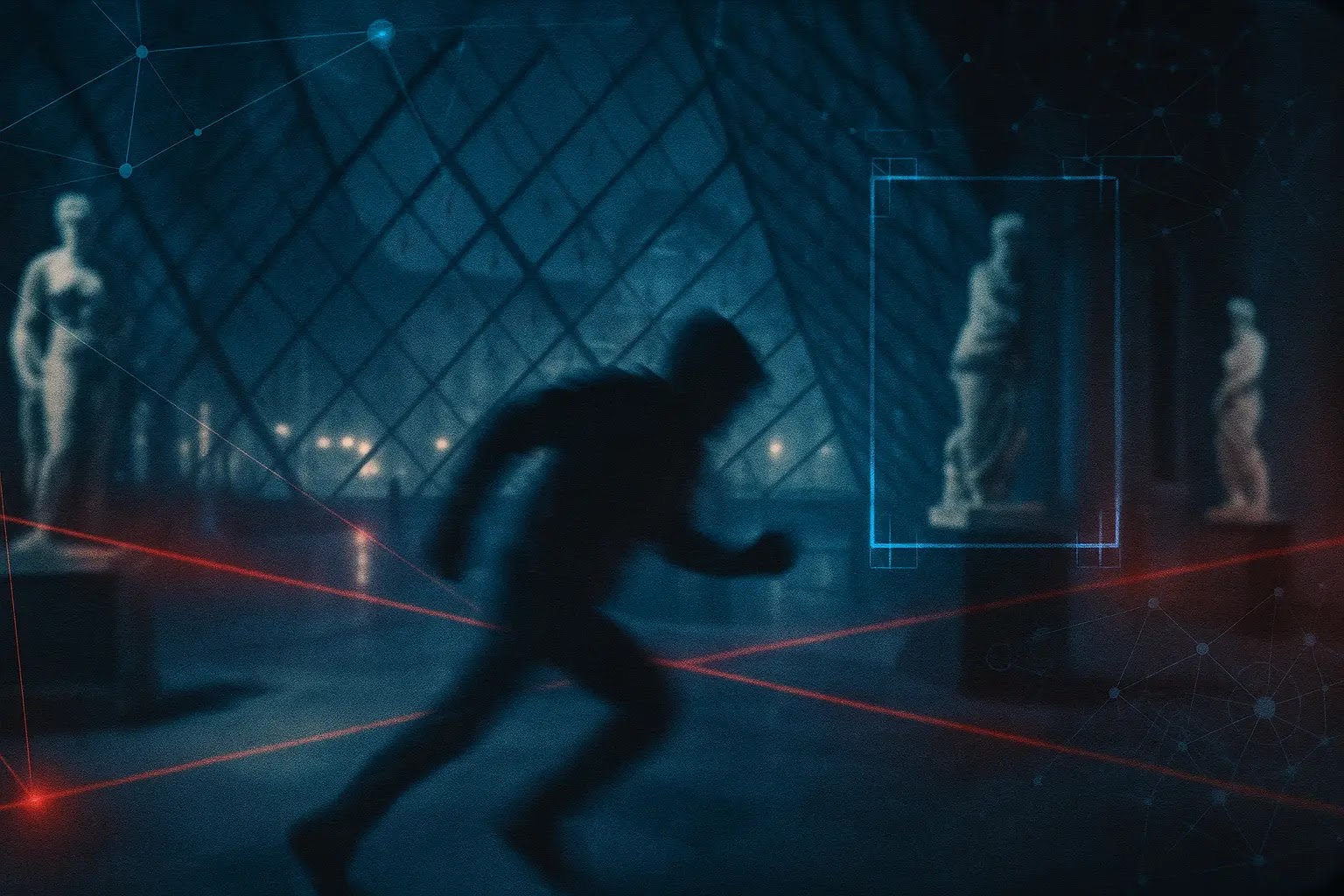
Modern AI changes that loop by making cameras reason about context rather than just motion. A lift parked against a heritage facade at an odd hour, workers in unusual gear converging on a second-storey window, sparks and posture consistent with an angle-grinder, each is a pattern computer vision can score in real time. Instead of a blinking icon, operators receive a short clip with bounding-box evidence and a confidence score.
When those feeds are fused with door logs and acoustic signatures, response time compresses: shutters can drop on pre-mapped exits, an audio challenge can fire into the gallery, and roving guards can be routed to intercept points instead of searching blind. That difference, seconds saved rather than minutes lost, can be the margin between a smashed case and an interrupted escape. Security consultants reviewing the Louvre heist footage since October have pointed to exactly this gap: cameras that recorded everything but understood nothing.
Deploying This Responsibly
Deployment, though, must be disciplined. Appearance-based re-identification can track a specific individual by clothing and equipment across a network of cameras without creating biometric dossiers on ordinary visitors, reserving facial recognition for the narrower, judicially authorised phase of a major crime. Our fairness framework for AI bias guardrails outlines how to stress-test such systems for disparate error rates, set strict retention limits and document vendor models before any system goes live. The civic side matters too: coverage of how protective technology in public spaces can also chill everyday life is a reminder that capability and legitimacy must rise together, a balance any museum drawing lessons from the Louvre heist will have to strike deliberately rather than by default.
The Hunt for the Jewels
If prevention slips, AI still accelerates the hunt. Vehicle and route analytics can reconstruct paths from a crime scene across a city’s camera network; tool-mark patterns on cut glass can be matched to seized equipment; micro-debris from abrasives becomes a forensic fingerprint when a suspect workshop is found. Open-source intelligence workflows can watch multilingual marketplaces for chatter about broken-up stones or mounts with distinctive hallmarks, exactly the kind of monitoring French investigators are now relying on as they search for the jewels stolen in the Louvre heist.
The scale of the response underway illustrates how seriously French authorities are treating the case. Within days of the Louvre heist, prosecutors had opened a formal investigation, and cultural institutions across France began reviewing their own perimeter camera coverage against the same failure pattern: sensors that log an event without anyone positioned to interpret and act on it in real time.
What happens next will be decided in minutes and months. In the short term, there is a narrowing window before the jewels are broken up or reset for individual sale. In the longer term, the test is whether France can translate budget into seconds saved at the point of attack, seconds that turn an alarm into an intervention, and whether those seconds are enough when the next crew tries to race the clock. The Louvre will modernise. The question the Louvre heist leaves unanswered is whether that modernisation means merely more sensors, or a smarter system that treats time as the asset it actually is.
About the Author
Stuart Kerr is Technology Correspondent at LiveAIWire, covering artificial intelligence, cybersecurity, and the social impact of emerging technology. He publishes daily at LiveAIWire.com.