
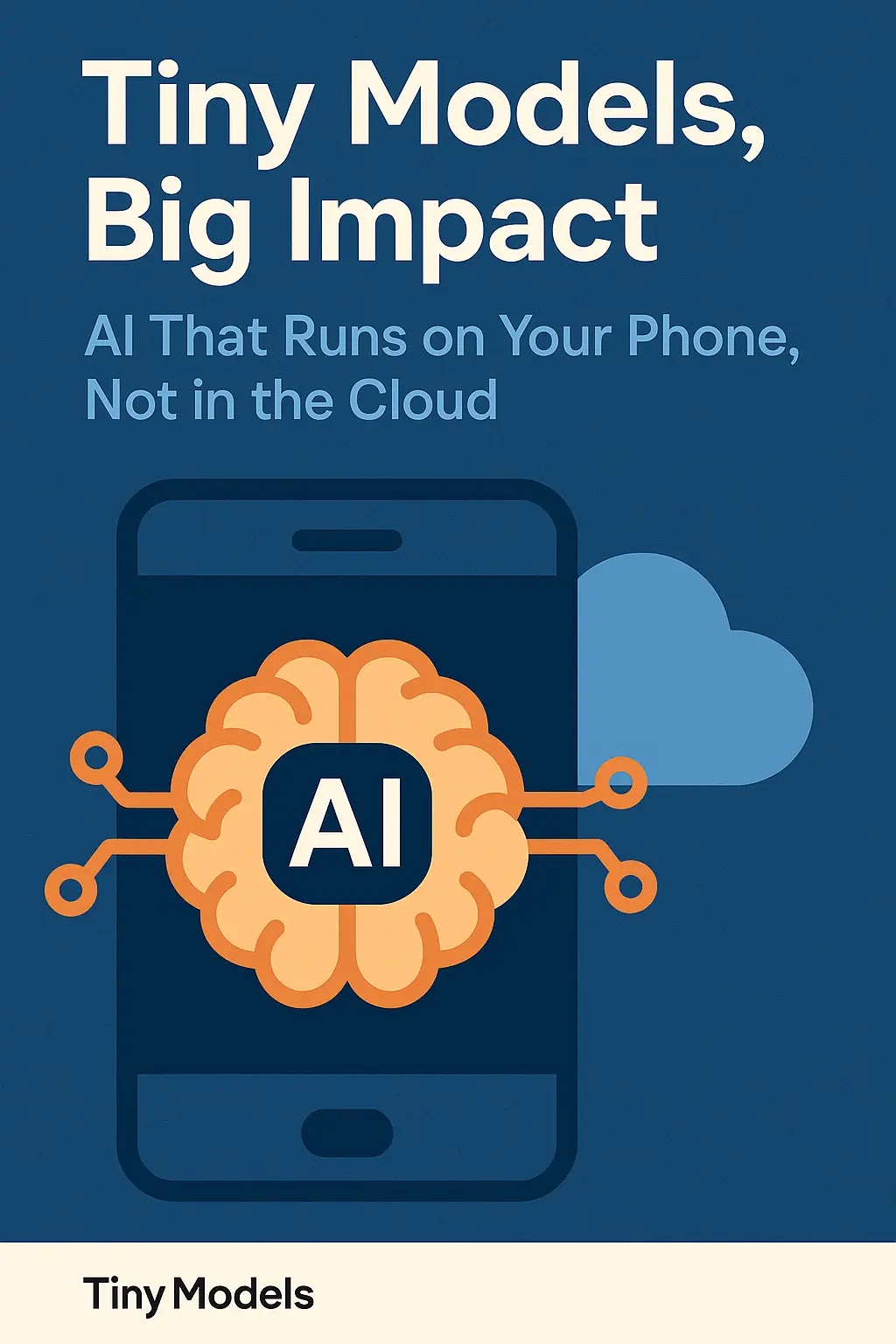
The
dominant narrative about artificial intelligence has always been one of
scale. Bigger models, more data, more compute, more capability. In the summer
of 2025 that story developed a counter-narrative, and it is running on less
than four billion para
By
Stuart Kerr, Technology Correspondent,
LiveAIWire
The Shift from Cloud to Edge
For years, artificial intelligence has relied on massive cloud-based models, with billions, or even trillions, of parameters. But a quiet revolution is underway. As IEEE Spectrum reports, small AI language models are powering edge devices, enabling AI to run directly on hardware such as smartphones, wearables, and IoT gadgets. These compact systems, sometimes with as few as 94 million parameters, can deliver surprisingly strong performance without the need for constant cloud access.
The appeal is clear: lower latency, reduced reliance on data centres, and enhanced privacy. Instead of sending sensitive data to the cloud for processing, your phone itself can handle voice recognition, image analysis, or translation in real time.
Why Smaller Can Be Smarter
As IEEE Spectrum noted in another analysis on the limits of cloud-bound AI, the latest giant models are not always the best fit for edge computing. By stripping down architectures and applying new quantisation and pruning techniques, engineers can deliver small AI language models efficient enough for everyday hardware, but still accurate enough for practical use.
Google, for example, recently announced a new wave of on-device small language models capable of handling multimodal input, text, images, even audio, without relying on cloud servers. These systems also integrate retrieval-augmented generation and function calling, tools once reserved for heavyweight models.
Edge AI in Academia
The academic community has responded with a flurry of research. The SHAKTI project introduced a 2.5 billion parameter model for edge AI, optimised to run on smartphones and wearables. Another influential paper presented EdgeViTs, lightweight vision transformers designed specifically for mobile inference, balancing high accuracy with reduced energy consumption.
These breakthroughs underscore a fundamental shift: instead of scaling models endlessly upward, researchers are finding new value in scaling down.
The Broader Context
This trend reflects a wider theme in the evolution of technology. Just as our reporting on AI’s environmental costs beyond carbon showed, the move toward small AI language models highlights overlooked dimensions of efficiency, like energy, bandwidth, and user privacy.
It also intersects with media and industry trends. In the same way our article on Can Publishers Survive Zero-Click Era explored shifts in information flows, edge AI decentralises computing power, challenging cloud monopolies, raising new questions about user trust, autonomy, and control.
A New Frontier for Everyday AI
The promise of small AI language models is not just technical, it is cultural. By embedding intelligence directly into devices, AI becomes more personal, more private, and more accessible. No longer tethered to a cloud, users gain faster performance and greater control over their data.
If the last decade of AI was about scale, the next may be about restraint. Small AI language models are proving that smaller doesn’t just mean cheaper or weaker, it can also mean smarter.
About the Author
Stuart Kerr is Technology Correspondent at LiveAIWire, covering artificial intelligence, cybersecurity, and the social impact of emerging technology. He publishes daily at LiveAIWire.com.
meters on the device in your pocket. Small language
models, or SLMs, that operate entirely on smartphones and laptops without
sending a single byte to a cloud server are no longer research curiosities.
They are products, and they are changing what AI can mean for the billions of
people who interact with their phone far more than with any enterprise
software platform.
The shift matters for several overlapping reasons. Privacy is the
most obvious: a model that processes your data on your device cannot leak
that data to a remote server, cannot be accessed by a breach of a cloud
provider, and cannot feed your inputs into training datasets without your
knowledge. Latency is another: a model that runs locally responds instantly,
without the 200 to 500 milliseconds of round-trip delay that cloud API calls
typically introduce. And then there is availability: a local model works
without an internet connection, in hospitals, aircraft, remote
infrastructure, and the growing number of contexts where reliable
connectivity cannot be assumed.
What the Models Can Do Now
The practical capabilities of on-device models have advanced
rapidly in 2025. Microsoft’s
Phi-3 Mini, a 3.8-billion parameter model specifically designed for
deployment on resource-constrained hardware, achieves benchmark performance
that rivals much larger models on reasoning, coding, and language tasks. The
key insight behind Phi-3 Mini’s development, which Microsoft has described
publicly, is that training quality matters more than training volume: a model
trained on high-quality, carefully curated data can rival models ten times
its size trained on unfiltered web text. That finding has significant
implications for what hardware AI can realistically run on.
Apple’s approach to on-device AI, detailed in its documentation
for Apple
Intelligence, uses a quantised model of approximately three billion
parameters for tasks that can be completed locally on iPhone 16 and recent
iPad and Mac hardware, with a fallback to Private Cloud Compute for requests
that exceed on-device capability. The Private Cloud Compute system is
designed to prevent Apple from accessing the content of requests even when
they are routed to Apple’s servers, a claim the company has invited
independent security researchers to verify. The architecture treats the cloud
not as the primary processing location but as overflow capacity, inverting
the conventional assumption about where intelligence lives in an AI system.
Apple’s Neural Engine hardware, present in its silicon since 2017 and
substantially upgraded in each generation, is what makes this architecture
viable: on-device inference that once required a dedicated server can now be
performed locally fast enough to feel instantaneous to the
user.
What “Small” Actually Means in
Practice
The term small language model covers a wide range. At the smallest
end, sub-one-billion parameter models can run on IoT devices, sensors, and
embedded hardware, performing specific classification or extraction tasks
with minimal memory and power consumption. In the one-to-three billion
parameter range, models like Phi-3 Mini and Google’s Gemma 2 can handle
conversational tasks, summarisation, and code assistance on a mid-range
smartphone. Above that, models in the seven billion parameter range represent
the current practical upper limit for comfortable operation on consumer
devices with twelve to sixteen gigabytes of unified memory.
The gap between these categories and the largest cloud-hosted
models, which can have hundreds of billions of parameters, is significant but
narrowing. Knowledge distillation, the technique of training a small model to
replicate the outputs of a much larger one, has become the primary method for
closing that gap. The small model never sees all the training data directly;
it learns from the large model’s responses, inheriting its reasoning patterns
without inheriting its memory requirements. As we explored in our coverage of
the
tipping point generative AI has reached in creative industries, the
moment when a technology becomes deployable rather than merely impressive is
often a quality threshold rather than a capability one. On-device models are
reaching that threshold for a broadening range of tasks.
What This Means for You
The practical implications extend well beyond power users and
developers. Consumer applications of on-device AI are already live: keyboard
and autocomplete assistance that works offline, on-device photo organisation
and search, voice transcription that never leaves your phone, and
increasingly, AI writing assistance that operates locally. For users who have
been reluctant to adopt cloud-based AI tools because of privacy concerns,
locally-running models represent a different proposition entirely. The data
never travels; the assistance still arrives.
For healthcare applications in particular, on-device processing
removes a significant regulatory and ethical barrier. Medical AI tools that
analyse patient data locally can operate within healthcare settings where
sending patient information to third-party cloud servers would create
compliance and consent problems. As our investigation into AI
decision-making in high-stakes contexts found, the trust placed in
AI systems in sensitive environments depends critically on being able to
account for where data goes and who can access it. Local processing provides
an answer that cloud-based AI fundamentally cannot.
The Environmental Case for Small Models
The energy and resource argument for on-device AI deserves
attention that it does not always receive in discussions dominated by
capability comparisons. Running inference on a device that is already powered
by its own battery, without spinning up a remote data centre to serve a
request, consumes a fraction of the energy of a cloud API call at scale. As
our analysis of the
hidden carbon and water costs of AI infrastructure demonstrated,
the environmental footprint of AI is primarily driven by inference at scale
rather than training. Every request served locally rather than by a data
centre is a marginal reduction in that footprint, and at the aggregate scale
of billions of daily AI interactions the marginal becomes
material.
The constraints of on-device AI are real. Local models cannot
match the capabilities of the largest cloud systems on tasks that require
broad world knowledge, complex multi-step reasoning, or access to real-time
information. The user who needs a thorough research analysis, a complex
creative project, or a question that requires knowledge of events from this
morning will still route that request to the cloud. But the large proportion
of daily AI interactions that are shorter, more routine, and more personal
are increasingly candidates for local processing. The trajectory is clear:
the models running on your phone in 2027 will be more capable than those
running in the cloud in 2023. The question is not whether on-device AI will
matter, but how quickly it becomes the default expectation.
Beyond consumer phones, the industrial implications are
significant: edge AI running on manufacturing equipment, medical devices, and
retail point-of-sale systems can make real-time decisions without network
dependency, unlocking applications in environments where cloud connectivity
would have been a disqualifying constraint. The convergence of better model
architectures, better training methods, and better on-device hardware is
producing a category of AI deployment that did not meaningfully exist three
years ago and that will reshape the landscape of who can benefit from AI
capability and under what conditions.
About the Author
Stuart Kerr is the Technology Correspondent for LiveAIWire. He
writes about artificial intelligence, emerging technology, and the forces
reshaping work, business, and society.